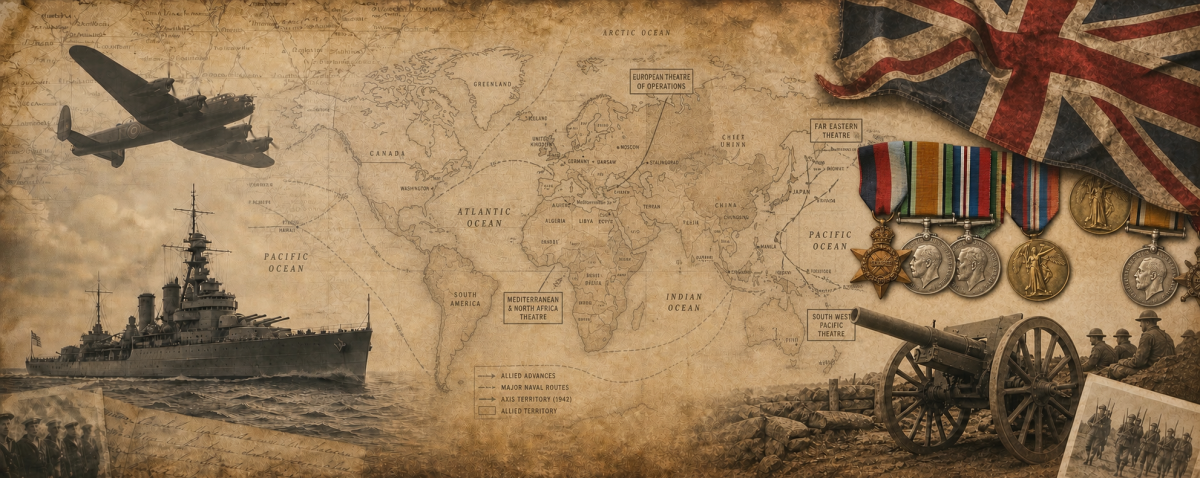

Sergeant Pilot Ernest Walter Cox (service number 1334812) served with No. 51 Squadron, Royal Air Force Volunteer Reserve, flying Handley Page Halifax II bombers from RAF Snaith as part of No. 4 Group, Bomber Command, and was killed in action on 17 April 1943 during a raid on the Škoda Works at Plzeň.[file:162][web:158]
He is buried in Dürnbach War Cemetery near Gmund am Tegernsee, Bavaria, where his grave lies among those of almost 3,000 Commonwealth airmen brought in from scattered crash sites and temporary graves across southern Germany.[file:162][web:159]
Early Life and Family
Ernest Walter Cox was born on 30 April 1921 in Canterbury, Kent, his birth registered in the Canterbury district in the June quarter of 1921 (volume 2A, page 1853), with his mother’s surname recorded as “Cartwell,” a variant of Carswell. He was the son of George Ernest Cox and Frances May Carswell.[file:162]
By 19 June 1921 he appears as an infant at 16 Seymour Place, Canterbury, recorded as a son in the household. Seymour Place lay in the St Stephen’s district, an area of mixed Victorian and Edwardian housing, home to professionals, tradespeople, and families in suburban surroundings just outside the city centre.[file:162]
By 1939 the family were at 46 Roper Road, Canterbury, where the Register records Ernest as an assistant building surveyor, a role that involved supporting survey work, preparing reports and drawings, monitoring compliance, and helping to coordinate small construction and maintenance projects in a city rich in historic buildings.[file:162] Roper Road itself was a desirable residential street of late Victorian and Edwardian houses associated with middle‑class families and local professionals.[file:162]
The Whitstable Times and Herne Bay Herald described him as “O.P.S. Ernest W. Cox, 46, Roper Road, Canterbury,” noting that he was training for active service with the RAF in the United States, and later as one of several Cox brothers in RAF service. He did not marry and left no children, but belonged to a family with a strong air force tradition: his brothers George, John, Stephen (“Steve”), and Kenneth all served or trained with the RAF or Air Training Corps, with Stephen awarded the Distinguished Flying Medal.[file:162]
From Roper Road in Canterbury, Ernest Cox left a promising civilian career as an assistant surveyor to become a Halifax bomber pilot with 51 Squadron.
Reconstructed from civil and newspaper records
Training under the Arnold Scheme and RAFVR Service
Ernest enlisted in the Royal Air Force Volunteer Reserve after November 1940, probably at Uxbridge or Weston‑super‑Mare, and began aircrew training. A Whitstable Times notice of 22 August 1942 records that Ernest W. Cox of 46 Roper Road, Canterbury, and D. T. Howard of Sturry were training at Craigfield, Alabama, USA, for active service with the RAF.[file:162]
This training in Alabama formed part of the Arnold Scheme, under which RAF cadets received flight training in the United States because Britain lacked sufficient capacity and suitable weather for large‑scale flying training. Having gained his wings, Ernest qualified as a pilot and was promoted to Sergeant Pilot, reflecting completion of advanced training and readiness for operational posting.[file:162][web:152]
By 1943 he was serving with No. 51 Squadron, RAFVR, based at RAF Snaith in Yorkshire. His service is summarised in the report as “Sergeant Pilot, 51 Squadron, No. 4 Group – Halifax II DT561 MH‑K, based at RAF Snaith,” firmly placing him within Bomber Command’s heavy bomber force in the crucial middle years of the war.[file:162]
Trained in Alabama under the Arnold Scheme, Cox returned to Britain as a newly qualified Halifax pilot, ready for night operations over occupied Europe.
Summary of training and posting evidence
No. 51 Squadron at RAF Snaith
No. 51 Squadron had previously served with Coastal Command at RAF Chivenor but converted to Handley Page Halifax bombers and moved to RAF Snaith, near Pollington in Yorkshire, as part of No. 4 Group, Bomber Command. From Snaith, the squadron operated Halifaxes until the end of the war, flying 264 raids and losing 148 aircraft.[file:162][web:161]
The Handley Page Halifax II was a four‑engined heavy bomber used extensively by Bomber Command for night attacks against industrial targets, transport hubs, and military facilities across occupied Europe and Germany. No. 51 Squadron’s aircraft carried the squadron code “MH,” and Ernest’s Halifax, serial DT561, is recorded as MH‑K.[file:162][web:161]
No. 4 Group, of which 51 Squadron formed part, was responsible for a large share of Bomber Command’s operations from its bases in Yorkshire. The group’s squadrons, including 51, repeatedly attacked strategic targets such as the Ruhr, Hamburg, and industrial plants in Czechoslovakia and elsewhere, at heavy cost in crews and aircraft.[file:162][web:158]
From RAF Snaith, 51 Squadron’s Halifax crews flew some of Bomber Command’s most demanding night raids, suffering heavy losses over heavily defended targets.
Context from No. 4 Group and squadron histories
The Plzeň Raid and the Loss of Halifax DT561
On the night of 16/17 April 1943, No. 51 Squadron took part in a Bomber Command raid on the Škoda armaments works at Plzeň in Czechoslovakia, a long‑range and heavily defended target. Ernest’s aircraft was Handley Page Halifax II DT561, code MH‑K, flying from RAF Snaith as part of this operation.[file:162][web:158]
The individual report notes that Halifax DT561 took off at 20:46 hours and that Sergeant Cox was “captain of a Halifax bomber,” confirming that he was the pilot in command. During the return leg, the aircraft was intercepted over Germany and shot down near Hadamar, in the “Bruchborn” district, by a German night fighter.[file:162]
The cemetery notes specify that DT561 was brought down at 03:12 hours by Lt. Otto Blohm of 10./NJG4, and that the crash occurred near Hadamar, Limburg‑Weilburg. All crew members were killed. A German death certificate issued at Hadamar on 11 September 1947 confirms that “the English airman E.W. Cox, identification tag 1 334 812, died on 17 April 1943 in Hadamar, district ‘Bruchborn’, as a result of an aircraft crash (Flugzeugabsturz).”[file:162]
Halifax DT561 MH‑K fell near Hadamar after a night‑fighter attack, its young captain, Ernest Cox, and his crew lost returning from the long‑range raid on Plzeň.
Derived from CWGC, German death certificate, and raid summaries
Burial and Commemoration
Ernest was initially buried locally in Germany, but after the war his remains were concentrated into Dürnbach War Cemetery near Gmund am Tegernsee, Bavaria. CWGC records give his grave as Plot 6, Row H, Grave 26, with his parents named as George Ernest and Frances May Cox, of Canterbury.[file:162][web:159]
Dürnbach War Cemetery contains 2,934 Commonwealth burials of the Second World War, most of them airmen whose graves were moved in from small cemeteries and crash sites across southern Germany, Austria, and Czechoslovakia. The cemetery’s carefully maintained lawns and stone headstones provide a collective resting place for scattered losses like those of Halifax DT561.[file:162][web:159]

The transcription of his CWGC headstone reads: “1334812 SERGEANT E. W. COX, PILOT, ROYAL AIR FORCE, 17TH APRIL 1943, AGE 21,” followed by a cross and the inscription “BLESSED ARE THE PURE IN HEART: FOR THEY SHALL SEE GOD,” a quotation from Matthew 5:8 chosen as a personal epitaph.[file:162]
His CWGC entry can be accessed at CWGC casualty details for Sergeant E. W. Cox. A complementary memorial page, sometimes with photographs and additional notes, is available at Find a Grave memorial 18600932.[file:162]
Medals, Probate, and Family Context
Ernest was entitled to the 1939–45 Star, the Air Crew Europe Star, and the War Medal 1939–45, reflecting his service in Bomber Command’s European campaign. As a fallen serviceman, his family also received the Memorial Scroll and Memorial Plaque commemorating his sacrifice.[file:162]
Probate was granted at Llandudno on 7 January 1944, with the entry stating that “Ernest Walter Cox of 46 Roper‑road, Canterbury, died on or since 17 April 1943 on war service,” administration being granted to his father, George Ernest Cox, municipal authority disinfector, with effects valued at £263 2s. 10d.[file:162]
Newspaper reports in the Whitstable Times in April 1943 noted that Sergeant Cox was “captain of a Halifax bomber” and listed his four brothers in RAF or related service: George on deferred service; John, a Pilot Officer who had served with Ferry Command in the Middle East; “Steve,” a Flight Officer with the Distinguished Flying Medal serving in Coastal Command; and Kenneth, the youngest, an engineering cadet scholar at Dartmouth and a member of the Air Training Corps.[file:162]
The Cox family of Roper Road sent five sons into the air war; Ernest, the Halifax pilot, did not return, but his story stands alongside his brothers’ distinguished service.
Summarising local newspaper tributes
Legacy
Sergeant Ernest Walter Cox left no descendants, but his memory lives on through his CWGC grave at Dürnbach, the local newspaper tributes that recorded his training and loss, and the wider remembrance of No. 51 Squadron’s wartime operations. His story exemplifies the contribution of Bomber Command crews trained under the Arnold Scheme and deployed to long‑range European raids.[file:162][web:158][web:161]
For family historians and researchers, sources such as Ancestry, the Whitstable Times and Herne Bay Herald archives, Bomber Command loss records, and the CWGC provide multiple avenues to explore the Cox family’s remarkable wartime service—from their home at 46 Roper Road, Canterbury, to the skies over Europe and the quiet cemetery at Dürnbach.[file:162][web:147][web:159]
Sources
- Individual report for Sergeant Ernest Walter Cox (family tree compilation, including birth and residence in Canterbury; 1921 address at 16 Seymour Place; 1939 address at 46 Roper Road and occupation as assistant building surveyor; training under the Arnold Scheme in Alabama; service as Sergeant Pilot, No. 51 Squadron, RAFVR; loss of Halifax II DT561 MH‑K; and burial at Dürnbach War Cemetery, Plot 6, Row H, Grave 26).[file:162]
- Commonwealth War Graves Commission – casualty record for “COX, ERNEST WALTER”, Sergeant 1334812, 51 Sqdn., Royal Air Force Volunteer Reserve, buried at Dürnbach War Cemetery, grave 6.H.26: CWGC casualty details.[file:162]
- Find a Grave – memorial for Ernest Walter Cox (Dürnbach War Cemetery, with scope for photographs and tributes): Find a Grave memorial 18600932.[file:162]
- German death certificate, Hadamar, 11 September 1947 – confirms death of “englische Flieger E. W. Cox” on 17 April 1943 at Hadamar, district “Bruchborn”, as a result of an aircraft crash (Flugzeugabsturz); transcript and English translation reproduced in the individual report.[file:162]
- Dürnbach War Cemetery – background and description of the cemetery as a concentration site for 2,934 Commonwealth burials from scattered wartime graves across southern Germany and neighbouring regions: Dürnbach War Cemetery (general description) and related CWGC/commemorative material.[web:159]
- No. 51 Squadron and RAF Snaith – squadron and station histories outlining 51 Squadron’s operations with Halifax bombers from RAF Snaith as part of No. 4 Group, Bomber Command, including total raids flown and aircraft losses; used to contextualise Cox’s service and final mission.[file:162][web:161]
- Whitstable Times and Herne Bay Herald, 22 August 1942 – notice of Ernest W. Cox of 46 Roper Road, Canterbury, training at Craigfield, Alabama, for RAF service under the Arnold Scheme; 7 November 1942 notice on his brother Pilot Officer Stephen Charles Cox’s D.F.M.; and 24 April 1943 report “Captain of a Bomber Missing,” naming Ernest as captain of a Halifax and listing his four RAF‑serving brothers.[file:162]
- Articles on the Arnold Scheme and RAF training in the USA – used to explain the context of Ernest’s pilot training at Craigfield, Alabama, and the wider programme of RAF cadets trained in North America.[web:152]
- Bomber Command operational histories describing the raid on the Škoda Works at Plzeň and night‑fighter defences over Germany; used alongside the individual report’s account to frame the mission on which Halifax DT561 was lost.[file:162][web:158]
Discover more from Mike's Cousins
Subscribe to get the latest posts sent to your email.