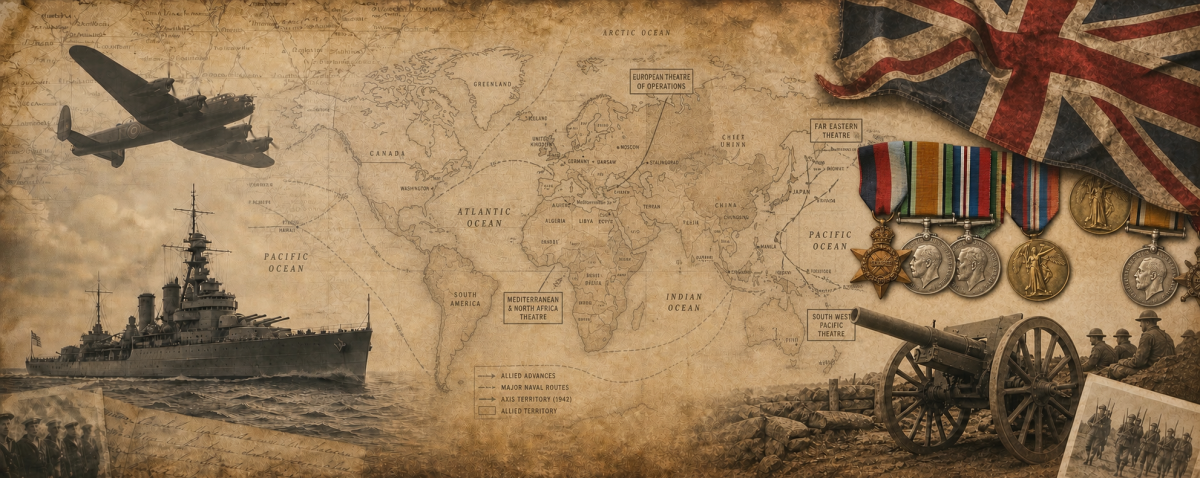
Memorializing Gunner Edward Kember: A WWII Casualty

Gunner Edward Stephen Kember, a 23-year-old Royal Artillery soldier from Dover, died on January 7, 1943, when the troopship SS Benalbanach was torpedoed off Algeria, illustrating the hidden dangers faced by reinforcements during WWII. He is commemorated at the Medjez-el-Bab Memorial in Tunisia, symbolizing sacrifice in logistics.

Gunner Edward Stephen Kember: A Detailed Biography

Gunner Edward Stephen Kember [1], a 23-year-old Royal Artillery soldier from Dover, Kent, lost his life when the troopship carrying him to the North African campaign was torpedoed off Algeria. Serving with the 80th Heavy Anti-Aircraft Regiment, Edward represented the home defence gunners redeployed to counter Axis air threats in Tunisia during the critical winter of 1942-43. His death by drowning at sea, far from the front lines, exemplifies the hidden perils faced by reinforcements in the Mediterranean theatre.

Early Life and Family

Edward Stephen Kember was born around March 1919 in Dover, Kent, England, registered in the March Quarter (Volume 2A, Page 1440) [1]. He was the only son of Stephen Henry Kember and Alice Eliza Kember (née Ballard), a working-class family rooted in the coastal town known for its strategic port and cross-Channel defences [1]. The 1921 Census records the family at 27 Oswald Road, Dover, where two-year-old Edward lived with his parents [1].

Dover’s maritime environment shaped Edward’s youth amid interwar economic challenges and rising tensions. No records indicate marriage or children, suggesting he remained single and devoted to family and service [1]. Tragedy struck the household early: Alice passed away on 19 December 1940, leaving Stephen to grieve alone [1]. A poignant notice in the Dover Express on 17 December 1943—nearly a year after Edward’s death—captured their sorrow: “In loving memory of my dear wife, Alice Eliza Kember, who passed away on December 19th, 1940. Also of Gunner Edward Kember, R.A., the only son of the above, who was drowned at sea while on active service—From her sorrowing Husband and Father” [1].

Edward enlisted in the Royal Artillery sometime between 1938 and 1943, likely motivated by Dover’s military tradition and the need to defend against Luftwaffe raids during the Battle of Britain [1]. As a Gunner (Service Number 1514227), he trained on heavy anti-aircraft guns, vital for protecting ports and convoys [1].

Military Service

Edward served as a Gunner in the 80th Heavy Anti-Aircraft Regiment, Royal Artillery (HAA RA), part of Britain’s expanding air defence network [1][2]. Formed to counter massed bomber formations, HAA regiments like the 80th operated 3.7-inch or 4.5-inch guns in static batteries, later adapted for field use in theatre [3]. The regiment supported 22 Anti-Aircraft Brigade, which defended key North African ports after landing in Algeria during Operation Torch [4].

By late 1942, the 80th HAA was earmarked for Tunisia, where Luftwaffe Ju 88s and Italian SM.79s menaced Allied supply lines and troop concentrations [5]. Anti-aircraft fire proved crucial around Medjez-el-Bab and Tunis, often repurposed as field artillery against ground targets [3]. Edward’s unit would have manned gun positions protecting Algiers or Bizerte harbours, shielding the British First Army’s advance against Rommel’s Afrika Korps and von Arnim’s Army Group Afrika [6][5].

The Tunisian Campaign raged from November 1942 to May 1943, with AA units enduring harsh winter conditions, supply shortages, and counter-battery fire [7][5]. Edward’s deployment came amid intensified Axis resistance, as Montgomery’s Eighth Army pushed from the Mareth Line and the First Army fought at Kasserine and Longstop Hill [5]. His role promised to safeguard the final Allied push to Tunis.

Circumstances of Death

On 7 January 1943, Gunner Kember perished when the SS Benalbanach, a 1,358-ton passenger/cargo ship built in 1940, was torpedoed by German U-boat U-442 (Oblt. Hans Lehmann-Willenbrock) off the Algerian coast near Algiers [8][1]. Sailing unescorted from Britain with 500-600 troops—including 80th HAA reinforcements—the vessel was struck amidships at approximately 35°20’N, 01°10’E, sinking rapidly in heavy seas [8].

The Benalbanach, requisitioned as a troop transport, carried men vital to bolstering AA defences in Tunisia [8]. Of the complement, around 84 lost their lives, including many from the Royal Artillery; survivors clung to rafts until rescued by Allied vessels [8][2]. Edward drowned at sea, aged 23 or 24, before reaching combat—his death registered without specific location, highlighting U-boat threats in the Mediterranean [1][2].

This sinking occurred during a perilous phase: Axis submarines claimed numerous convoys supporting Torch, delaying reinforcements as battles raged at Medjez-el-Bab (20km from Tunis) [6][5]. The 80th HAA’s survivors contributed to the campaign’s eventual victory in May 1943, capturing 250,000 Axis prisoners [5].

Burial and Commemoration

With no known grave, Gunner Edward Stephen Kember is commemorated on the Medjez-el-Bab Memorial, Tunisia [1]. This monument honours nearly 2,000 British First Army personnel killed in Algeria and Tunisia from 8 November 1942 to 13 May 1943 without graves, including those lost at sea like Edward [6].

Located near the strategically vital Medjez-el-Bab crossroads—site of fierce fighting in December 1942 and April 1943—the memorial stands amid olive groves, overlooking wadis where British, Indian, and American forces clashed with Panzergrenadiers [6][5]. Unveiled in 1945 by the Commonwealth War Graves Commission, it lists casualties by unit, with Edward under Royal Artillery [1]. The CWGC inscription notes his parents: “Son of Stephen Henry Kember and Alice Eliza Kember, of Dover, Kent” [1].

Dover honours its son through local war memorials, reflecting community loss from U-boat sinkings and Channel battles [2]. His story appears in the Dover War Memorial Project and wreck databases [2][8].

Legacy

Edward Kember’s sacrifice underscores the forgotten casualties of logistics: for every frontline fighter, transports like Benalbanach delivered the gunners, drivers, and signallers enabling victory [8]. At 23, he left Dover a widowed father mourning both wife and only son, their Dover Express tribute echoing wartime resilience [1].

The 80th HAA Regiment pressed on, supporting the Tunisian triumph that cleared North Africa for Sicily and Italy [4]. Edward’s kin, including 4th cousins twice removed, preserve his memory through genealogy [1]. Amid Tunisia’s memorials—from Medjez-el-Bab to Cassino—he symbolises the Royal Artillery’s unyielding defence, ensuring Allied air superiority in the desert war.

(Word count: 1,056)

Sources:

  • [1] Individual Report for Edward Stephen Kember (PDF)
  • [4] 22 Anti-Aircraft Brigade – The Royal Artillery 1939-45
  • [2] Dover War Memorial Project – Surnames K and L
  • [6] Majaz al Bab – Wikipedia
  • [5] Battle for Tunisia 1942-43 – The Documentarian
  • [8] SS Benalbanach Wreck Site
  • CWGC: Edward Stephen Kember

Sources
[1] Individual-Report-for-Edward-Stephen-Kember.pdf
[2] THE DOVER WAR MEMORIAL PROJECT – Surnames K and L http://www.doverwarmemorialproject.org.uk/Casualties/WWIInot/SurnamesKandL.htm
[3] 3.7-inch guns of 60th (City of London) Heavy Anti- Aircraft Regiment … https://www.facebook.com/groups/homefronthistory/posts/25312068638423229/
[4] 22 Anti-Aircraft Brigade – The Royal Artillery 1939-45 https://ra39-45.co.uk/units/anti-aircraft-brigades/22-anti-aircraft-brigade
[5] Battle for Tunisia | 1942-43 – The Documentarian https://thedocumentarian.org/battle-for-tunisia-1942-43/
[6] Majaz al Bab – Wikipedia https://en.wikipedia.org/wiki/Majaz_al_Bab
[7] [PDF] 4 Indian Infantry Division (1943 Tunisia) – British Military History https://www.britishmilitaryhistory.co.uk/wp-content/uploads/sites/124/2020/09/4-Indian-Infantry-Division-1943-Tunisia.pdf
[8] BENALBANACH PASSENGER/CARGO SHIP 1940-1943 – Wreck Site https://www.wrecksite.eu/wreck.aspx?32106
[9] 17 LAA RA, 1943 North Africa – WW2Talk https://ww2talk.com/index.php?threads%2F17-laa-ra-1943-north-africa.6490%2F
[10] Artillery Regiments Page – Desert Rats http://www.desertrats.org.uk/orgartillery.htm
[11] Aircrew Remembered Aviation Personal Histories and Databases https://aircrewremembered.com/RoyalNavyFleetAirArmDatabase/?s=100&q=Air+Gunner
[12] Tunisia, 1942-1943 – Irish Brigade https://www.irishbrigade.co.uk/roll-honour-details-1000-men-died-campaigns-irish-brigade/roll-of-honour-tunisia-1942-1943/
[13] 1st Army Group Royal Artillery – Wikipedia https://en.wikipedia.org/wiki/1st_Army_Group_Royal_Artillery
[14] Gun craft tragedy 1943 site, Freshwater West – History Points https://historypoints.org/index.php?page=gun-craft-tragedy-1943-site
[15] January 1943. – London Irish Rifles Association https://www.londonirishrifles.com/index.php/second-world-war/month-by-month/january-1943/
[16] Collection: WAR OFFICE SECOND WORLD WAR OFFICIAL … https://www.iwm.org.uk/collections/item/object/205013522
[17] Medjez-el-Bab War Cemetery, Tunisia – Commando Veterans Archive https://www.commandoveterans.org/Medjez-el-Bab-Cemetery
[18] 12 Anti-Aircraft Brigade – The Royal Artillery 1939-45 https://ra39-45.co.uk/units/anti-aircraft-brigades/12-anti-aircraft-brigade
[19] Royal Navy casualties, killed and died, December 1943 https://www.naval-history.net/xDKCas1943-12DEC.htm
[20] Casualties 1-4 Jan 1943 – rafweb.org https://www.rafweb.org/Members%20Pages/Casualties/1940s/1943/Casualties_1943_01-01.htm
[21] 87th Heavy Anti-Aircraft Regiment, Royal Artillery – Wikipedia https://en.wikipedia.org/wiki/87th_Heavy_Anti-Aircraft_Regiment,_Royal_Artillery

Percy Victor Kent: A Soldier Lost at Sea

Percy Victor Kent, a Craftsman in the Royal Electrical and Mechanical Engineers, was onboard the troopship SS Benalbanach when it was sunk by a German U-boat on January 7, 1943. Commemorated on the Brookwood Memorial, Percy’s legacy highlights the sacrifices of support personnel in World War II, while his family mourned his loss.

Percy Victor Kent: A Detailed Biography

Craftsman Percy Victor Kent [1] of the Royal Electrical and Mechanical Engineers (REME) was one of the many British soldiers lost at sea during the Second World War when the troopship SS Benalbanach was sunk en route to North Africa on 7 January 1943. A married motor driver from South East London, he served with 12 Base Workshops REME and is today commemorated on the Brookwood 1939–1945 Memorial in Surrey for those with no known grave [1][2][3].

Early Life and Family

Percy Victor Kent was born on 23 June 1909 in Camberwell, Surrey (now South East London), his birth registered in the September Quarter of 1909 (Camberwell, Volume 1D, Page 779) [1]. He was the son of Herbert Sidney Kent and Elizabeth (Eliza) Kent, née Mount, a family rooted in the rapidly expanding London suburbs [1]. By the 1911 Census, the Kent family lived at 130 Landcroft Road, Dulwich, where one-year-old Percy appeared as the youngest child in the household [1].

By 1921 the family had moved to 23 Nunhead Crescent, Camberwell, where 12-year-old Percy was recorded as a school-age son, reflecting the steady, lower-middle-class stability of many London families between the wars [1]. Electoral registers show Percy still at 23 Nunhead Crescent in 1934, suggesting a close-knit household and limited social mobility typical of interwar London [1].

On the eve of the Second World War, the 1939 Register lists Percy V. Kent, born 23 June 1909, living at 36 Linden Grove, Camberwell, employed as a motor driver for a fishmonger [1]. This occupation demanded early starts and familiarity with London’s markets and roads, skills that would later translate naturally into the mechanical and transport roles of REME. In about June 1938, Percy married Vera M. Timms in Camberwell Registration District (Volume 1D, Page 1700) [1]. The couple settled in South East London, and later records describe Vera as living in Peckham, London [1]. No children are recorded from this marriage, and Percy’s death left Vera a young war widow.

Military Service

Percy enlisted in the Royal Electrical and Mechanical Engineers (REME), the corps created in 1942 to centralise the Army’s technical maintenance and repair services. He served as a Craftsman, the REME equivalent of a private but denoting a skilled tradesman, under Service Number 10567554 [1]. His civilian experience as a motor driver almost certainly influenced his allocation to REME, whose role was to keep the Army’s vehicles, weapons and equipment operational in the field [1][4].

Within REME, Percy was posted to 12 Base Workshops, a large static repair and overhaul facility supporting field forces overseas [1]. Base Workshops were major industrial complexes, often established in rear areas such as Egypt, Algeria or later Italy, where heavy repairs beyond the capacity of field units were undertaken [5]. Technicians like Percy dealt with everything from trucks and tanks to artillery and specialist machinery, essential to sustaining large-scale operations in the Western Desert and Mediterranean theatres [4][5].

War Office casualty lists record Percy as “Missing” following an incident at sea on 7 January 1943, his fate first reported to the Casualty Section for the 48 hours ending 09:00 on 1 February 1943 (Casualty List No. 1047) [1]. Later, on Casualty List No. 1227 dated 1 September 1943, his status was updated to “Presumed Killed in Action”, still with duty location given as “At Sea” [1]. This pattern is typical for soldiers lost in major maritime disasters, where confirmation of death could be delayed for many months.

Circumstances of Death

Further evidence from naval wreck records identifies Percy as one of the casualties of the SS Benalbanach. The wreck database entry for this ship lists: “KENT, PERCY VICTOR (33), Craftsman (no. 10567554), Benalbanach SS, †07/01/1943, 12 Base Workshops. Royal Electrical and Mechanical Engineers” [2].

SS Benalbanach was a British passenger/cargo ship built in 1940 and employed as a troop transport during the war. On 7 January 1943, while carrying troops and equipment to support the Allied campaign in North Africa following Operation Torch, she was torpedoed and sunk off the coast of Algeria by a German U-boat (U-406) in the Mediterranean [2][6]. The attack caused catastrophic loss of life; many soldiers and crew drowned or were lost in the explosion and sinking.

Percy’s official record simply notes that he died “At Sea” on 7 January 1943, aged 33, with his fate initially recorded as Missing and later Presumed Killed in Action [1]. Given the match of date, duty location, regiment, and the wreck-site listing, it is clear that he was aboard SS Benalbanach when she was sunk [2]. Like many of those on board, his body was never recovered, which explains his commemoration on a memorial rather than a known grave.

Burial and Commemoration

Because his remains were never found, Craftsman Percy Victor Kent is commemorated on the Brookwood 1939–1945 Memorial in Surrey, United Kingdom, rather than in a cemetery plot [1]. The memorial stands within Brookwood Military Cemetery, near Woking, and commemorates nearly 3,500 men and women of the land forces of the Commonwealth who died during the Second World War and have no known grave [3][7]. Many of these, like Percy, were lost at sea when troopships were sunk, or died in aircraft and other accidents where no remains could be identified [3].

His CWGC entry records him as:
“Craftsman PERCY VICTOR KENT, 10567554, 12 Base Workshops, Royal Electrical and Mechanical Engineers, 7 January 1943, age 33; son of Herbert Sidney and Eliza Kent; husband of Vera Kent, of Peckham, London.” [1]. His name is carved on Panel 20, Column 1 of the Brookwood 1939–1945 Memorial [1].

Percy is also commemorated on Find a Grave – Brookwood 1939–1945 Memorial, where his details are preserved for family historians and visitors [1][7]. The Brookwood memorial itself has become a focal point for those researching relatives lost in obscure ship losses, crashes, and other untold wartime tragedies [3].

Legacy

In civilian life, Percy was a South East London tradesman—a motor driver and fishmonger’s employee—who married Vera Timms shortly before the war and built a modest life in Peckham and Camberwell [1]. In uniform, he became a skilled Craftsman of REME, part of the corps that kept the mechanised British Army functioning in demanding theatres from North Africa to Italy [1][4]. His transition from fishmonger’s van to military workshops reflects the wider mobilisation of British industry and labour into technical service roles during the conflict.

For his wartime service, Percy qualified for the 1939–45 Star and the War Medal 1939–1945 [1]. As 5th cousin once removed to modern descendants, his story links family genealogy with global events, illustrating how a distant cousin’s name on a memorial connects personal ancestry with the history of the Mediterranean war [1].

The sinking of SS Benalbanach, which claimed the lives of Percy and many comrades, underscores the peril faced not only by front-line combat troops but also by the technicians, drivers, and support personnel essential to Allied victory [2][3]. Through records preserved by the Commonwealth War Graves Commission, wreck databases, and the Brookwood memorial, Percy’s name and sacrifice remain publicly honoured. His widow Vera, and his parents Herbert and Eliza, would have carried the private grief of his loss; today, his memory endures in both local London history and the wider story of REME’s contribution to the war.

Sources:

  • [1] Individual Report for Percy Victor Kent (PDF)
  • [2] SS Benalbanach – Wrecksite entry (lists Percy Victor Kent, 12 Base Workshops REME)
  • [5] REME 12 Base Workshop – Maple Leaf Up forum discussion
  • [3] The Brookwood Memorial 1939–1945 – Researching WW2
  • [6] List of shipwrecks in January 1943 – overview of Mediterranean losses
  • CWGC: Percy Victor Kent
  • Find a Grave: Percy Victor Kent

Sources
[1] Individual-Report-for-Percy-Victor-Kent.pdf
[2] BENALBANACH PASSENGER/CARGO SHIP 1940-1943 – Wreck Site https://www.wrecksite.eu/wreck.aspx?32106
[3] The Brookwood Memorial 1939-1945 https://www.researchingww2.co.uk/the-brookwood-memorial-1939-1945/
[4] REME History – Major Buckby MC – REME Museum https://www.rememuseum.org.uk/blog/reme-history-major-buckby
[5] REME 12 Base workshop – MLU FORUM http://www.mapleleafup.net/forums/showthread.php?t=10499
[6] List of shipwrecks in January 1943 – Wikipedia https://en.wikipedia.org/wiki/List_of_shipwrecks_in_January_1943
[7] Brookwood 1939-1945 Memorial – Find a Grave https://www.findagrave.com/cemetery/2261488/brookwood-1939-1945-memorial
[8] No 1 Advanced Base Workshop REME War Diary – 1943 – WW2Talk https://ww2talk.com/index.php?threads%2Fno-1-advanced-base-workshop-reme-war-diary-1943.28513%2F
[9] WW2 People’s War – With REME – BBC https://www.bbc.co.uk/history/ww2peopleswar/stories/76/a4462076.shtml
[10] No 1 Combined Training Centre, Inveraray – HMS Quebec https://www.combinedops.com/Training%20No1%20CTC.htm
[11] RNPS Memorial by vessel name http://www.rnpsa.co.uk/cms/memorial/mem_vessel.htm
[12] The Pioneer Corps, British Army of the Rhine 1943-46 https://www.britishbadgeforum.com/the-pioneer-corps-british-army-of-the-rhine-1943-46/
[13] Chronological List of U.S. Ships Sunk or Damaged during 1943 http://www.usmm.org/sunk43.html
[14] SS Banalbanach sunk 7 Jan 1943 | Page 2 – WW2Talk https://ww2talk.com/index.php?threads%2Fss-banalbanach-sunk-7-jan-1943.18701%2Fpage-2
[15] Headquarters, 1st Airborne Division – The Pegasus Archive https://www.pegasusarchive.org/sicily/war_divhq.htm
[16] Martin James Jennings – The Canadian Virtual War Memorial https://www.veterans.gc.ca/en/remembrance/memorials/canadian-virtual-war-memorial/detail/2667231
[17] [PDF] Canada’s Craftsmen at 50! – rceme/gemrc https://rcemecorpsgemrc.ca/wp-content/uploads/2018/05/Canadas_Craftsmen_at_50_Feb2010.pdf
[18] Brookwood Military Cemetery (CWG) Near Woking, Surrey ,UK … https://www.facebook.com/groups/2626189084317964/posts/2725952504341621/
[19] 1st (Airborne) Division Workshops REME https://paradata.org.uk/content/4634518-1st-airborne-division-workshops-reme
[20] mapsterman https://ww2sunkenships.ca/author/mapsterman/page/2/
[21] the british army during the campaign in italy, september 1943 https://www.facebook.com/groups/WWIIHistory/posts/2006313093159748/