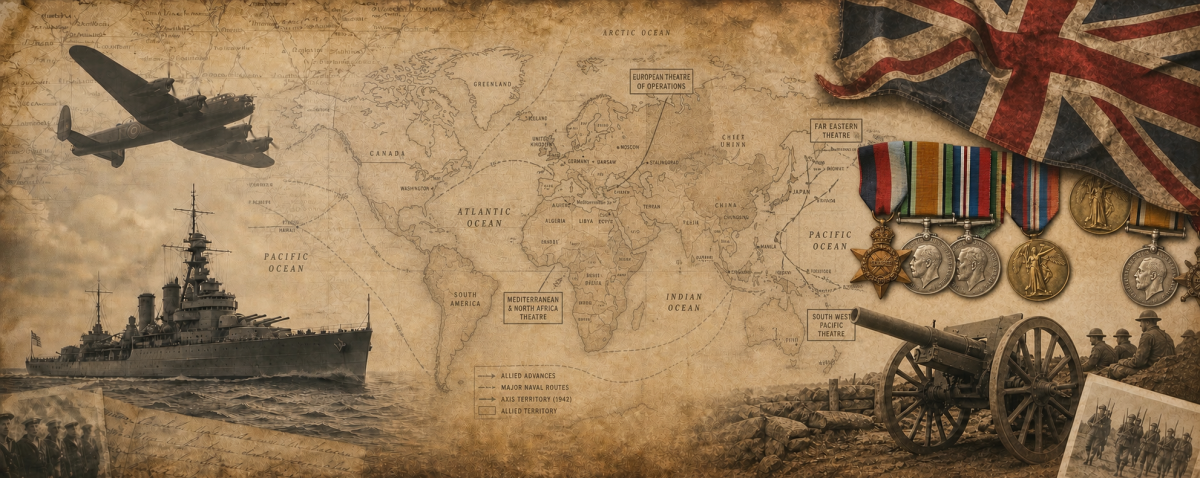

John Henry Morley was a Dover-born Merchant Navy seaman who served aboard the Liverpool-registered S.S. Laconia during the Second World War. When the ship was torpedoed in the South Atlantic on 12 September 1942, John escaped into a lifeboat but died at sea before the survivors could be rescued. His name is commemorated on the Tower Hill Memorial in London. [1][2]
John Morley survived the sinking of the Laconia, but not the long and perilous ordeal that followed in an open lifeboat.
Early Life and Family
John Henry Morley was born in Dover on 1 February 1920. His birth was registered in the first quarter of that year, and the family report identifies his parents as Thomas Morley and Emma Baxter. He grew up in the port town of Dover, a place shaped by the sea, cross-Channel trade and the movement of naval and merchant vessels. [1]
John married Theresa Maria Partridge at Dover on 4 October 1941. The marriage took place less than a year before his death, and no children are recorded in the supplied report. Later merchant-seaman records give his address as 29 Douglas Road, Dover, while the initial family report associates him with 1 Bowling Green Villas. These Dover addresses place his married and family life within the same maritime community from which he entered wartime service. [1]
John was twenty-two when he died. His marriage and young age emphasise how recently his adult life had begun when wartime service took him into the dangerous Atlantic supply routes. Although little survives in the available records about his civilian employment before joining the Merchant Navy, his rating as a sectionman indicates that he worked as part of the ship’s crew rather than as a passenger or soldier. [1]
Merchant Navy Service
John served as a sectionman under the number R18143 aboard S.S. Laconia, a Liverpool-registered vessel with official number 145925. The death register describes him more generally as a seaman, while the family report gives his rating as sectionman. The available material does not explain the precise department in which he worked, but the rating indicates membership of the ship’s operating crew and responsibility within one of its working sections. [1]
The Merchant Navy was a vital part of Britain’s war effort. Its ships transported troops, prisoners of war, food, fuel, military equipment and raw materials across waters patrolled by German U-boats. Merchant seamen were civilians serving under wartime conditions, but their work exposed them to the same hazards of torpedo attack, shipwreck, drowning, burns, injury and starvation that faced naval personnel. [3]
The Laconia itself had been a large passenger liner before being requisitioned for wartime use. During the Second World War it served as an armed merchant ship and then as a troop transport. By September 1942 it was carrying a large and complex human cargo: British military personnel, civilians, Polish guards and approximately 1,800 Italian prisoners of war. For the crew, this meant operating a ship whose wartime purpose was closely connected to the movement of people and military resources across the Atlantic. [2][4][5][6]
Unit and Ship Context at the Time of Death
John’s “unit” was not a regiment or naval warship but the Merchant Navy crew of S.S. Laconia. The vessel was sailing independently in the South Atlantic when it was attacked by the German submarine U-156 on the night of 12 September 1942. The ship was approximately 250 miles north-east of Ascension Island, far from immediate assistance and well beyond the protection of a nearby harbour. [2][7][8]
At approximately 22.07 hours, U-156 torpedoed the Laconia. The ship carried about 2,700 people, including its crew and passengers. Estimates vary, but approximately 1,083 people survived while between 1,600 and 1,700 died. The high proportion of casualties was linked to the large number of Italian prisoners of war aboard, many of whom were below decks when the ship was struck and found it difficult to escape as the vessel listed and sank. [2][7][9]
For John as a sectionman, the emergency would have involved abandoning his normal shipboard responsibilities and assisting, where possible, with evacuation. The record does not state exactly which lifeboat he entered or what duties he performed after the sinking. It does establish that he survived the loss of the ship long enough to be recorded as having died in a lifeboat. [1]
The sinking of the Laconia was not simply a shipwreck: it became a prolonged survival ordeal in the mid-Atlantic, with lifeboats adrift for weeks before rescue.
Circumstances of Death
John’s official date of death was 12 September 1942, the date on which the Laconia was torpedoed. The merchant-seaman death record adds the important qualification that he died between 12 September and 10 October in a lifeboat. This indicates that the official date represented the date of the sinking, while the precise date of his death from exposure, illness, thirst or exhaustion was unknown. [1]
After the sinking, the German submarine surfaced and attempted to rescue survivors. U-156 took survivors aboard and towed several lifeboats, but the rescue effort was interrupted when Allied aircraft attacked the submarine with depth charges. The submarine was damaged and the survivors had to be left behind or dispersed. Other U-boats later assisted, while French naval vessels eventually rescued many survivors from the lifeboats. [2][4][9][10]
Some lifeboats remained at sea for many days. One boat reached the African coast after twenty-seven days with only sixteen survivors from the sixty-eight people who had begun the journey; another was rescued after approximately forty days, with only four of its original occupants still alive. These figures show the conditions under which John died. He was not killed immediately by the torpedo but succumbed during the subsequent ordeal in an open boat. [6][9]
The Laconia sinking later became associated with the so-called Laconia Order, issued by German naval command after the rescue attempt was attacked. The order instructed U-boats not to rescue survivors from ships they had sunk. John’s death therefore occurred within an incident that had consequences far beyond the loss of one ship, influencing later submarine warfare and becoming part of post-war legal and historical debate. [11][12]
Burial and Commemoration
John has no known grave. He is commemorated on Panel 63 of the Tower Hill Memorial in London, which records Merchant Navy and fishing-fleet personnel who died in the two world wars and have no known burial place. Because he died at sea and his body was not recovered, the memorial provides his permanent place of remembrance. [1]
John was awarded the 1939–1945 Star and War Medal 1939–1945. These awards recognise his wartime service in the Merchant Navy. His commemoration also appears in the Commonwealth War Graves Commission records and in the Find a Grave index under memorial number 15242176. [1]
The Tower Hill Memorial is particularly appropriate for John because it commemorates people whose lives were lost through the hazards of maritime war. Unlike a cemetery, it does not mark a recovered body. Instead, it preserves the names of men whose remains remained in the sea or whose places of death could not be given an individual grave.
Legacy
John Henry Morley’s life was short, but the surviving records connect him to Dover, his marriage to Theresa Maria Partridge and the wider history of the Atlantic war. He was a young husband, a Merchant Navy seaman and a member of the crew of a troopship carrying people and wartime responsibilities across the ocean. [1]
His story also illustrates the distinctive risks faced by Merchant Navy personnel. John’s death was caused by enemy action, but not necessarily at the moment of impact. He survived the sinking and entered a lifeboat, only to die later from the environmental and medical dangers of prolonged exposure at sea. [1][6]
The report’s inclusion of the 1945 newspaper account is important because it preserves the later historical significance of the incident. The article records evidence given by Admiralty official John Mossop during the Hamburg proceedings and links the sinking of the Laconia with the German order to abandon attempts to rescue survivors. For John’s family, however, the central fact remained personal: a young man from Dover left home as a married seaman and never returned. [1]
John is remembered today through the Tower Hill Memorial, the Commonwealth War Graves Commission and the Merchant Navy records of the Second World War. His name ensures that the human cost of the Laconia incident is not reduced to statistics. Behind the figures was John Henry Morley, a sectionman from Dover whose final journey ended in a lifeboat far out in the Atlantic. [1]
Sources and Further Reading
- Commonwealth War Graves Commission: John Henry Morley
- Find a Grave: John Henry Morley
- Commonwealth War Graves Commission: Tower Hill Memorial
- United States Naval Institute: The sinking of the Laconia
- Uboat.net: S.S. Laconia
- BBC People’s War: The loss of the Laconia
- University of Plymouth: The 1942 Laconia Order
- The National Archives: Merchant seamen medal records
- Findmypast: Merchant Navy and maritime records
- Compiled family report: Individual Report for John Henry Morley, including birth, marriage, Merchant Navy service, death and Tower Hill commemoration details.
Sources
[1] Individual-Report-for-John-Henry-Morley.pdf https://ppl-ai-file-upload.s3.amazonaws.com/web/direct-files/attachments/141549598/df4b16a6-8e18-40a4-bb16-17209842d1ea/Individual-Report-for-John-Henry-Morley.pdf
[2] Laconia (British Troop transport) – Ships hit by German U-boats during WWII https://uboat.net/allies/merchants/ship/2157.html
[3] The Merchant Navy – Prisoners of War of the Japanese 1942-1945 https://www.pows-of-japan.net/articles/105.html
[4] THE LACONIA INCIDENT https://the-bay-museum.co.uk/2022/09/13/the-laconia-incident/
[5] R.M.S. Laconia (II) – Great Ships https://greatships.net/laconia2
[6] Laconia – A Story of two Wallsend Ships https://www.wallsend-history.co.uk/laconia-a-story-of-two-wallsend-ships/
[7] Laconia Incident https://ww2db.com/battle_spec.php?battle_id=325
[8] THE LACONIA AFFAIR: A COALESCENCE OF TRAGEDIES – NSL Archive https://archive.navalsubleague.org/2003/the-laconia-affair-a-coalescence-of-tragedies
[9] Laconia incident https://en.wikipedia.org/wiki/Laconia_incident
[10] Werner Hartenstein – Wikipedia https://en.wikipedia.org/wiki/Werner_Hartenstein
[11] The 1942 Laconia Order, The Murder of Shipwrecked … https://pearl.plymouth.ac.uk/cgi/viewcontent.cgi?article=1035&context=solon
[12] Battle-of-the-Atlantic-Uboat-Laconia – HistoryNet https://historynet.com/battle-of-atlantic-laconia/
[13] The Sinking of the Laconia and the Survival of Tony Large https://www.usni.org/magazines/naval-history-magazine/2024/april/sinking-laconia-and-survival-tony-large
[14] RMS Laconia (1921) – Wikipedia https://en.wikipedia.org/wiki/RMS_Laconia_(1921)
[15] Volunteers bring historic ship back to life https://www.bbc.co.uk/sounds/play/p0p53q52
[16] The Loss of the Cunard Ship Laconia https://www.bbc.co.uk/history/ww2peopleswar/stories/16/a1945316.shtml
[17] Battle-of-the-Atlantic-Uboat-Laconia https://www.historynet.com/battle-of-atlantic-laconia/
[18] 404 – 12 SEPTEMBER 1942: THE “LACONIA” INCIDENT A … https://www.spink.com/lot/22003000404
[19] The Laconia | Remembering WWII https://mobile.coconuttimes.com/articles/Remembering-WWII/The-Laconia-
[20] The Laconia Affair https://wernerhartenstein.tripod.com/U156ClayBlair.htm
[21] May 2018 Sinking of the RMS Laconia – Cowbridge u3a. https://cowbridge.u3asite.uk/may-2018-sinking-of-the-rms-laconia/
[22] Papers Relating to the Foreign Relations of the United States, 1917, Supplement 1, The World War https://history.state.gov/historicaldocuments/frus1917Supp01v01/d164
[23] U-BOAT CAPTAIN CYNICAL TO SURVIVORS; Reproached for Attacking Women, He Said “They’ll Be AllRight for a Few Hours.” Saw Boat Smashed In. Hours of Suffering in Boats. Saw Mrs. and Miss Hoy Die. https://www.nytimes.com/1917/02/28/archives/uboat-captain-cynical-to-survivors-reproached-for-attacking-women.html
[24] Devon Family Saved by a U-Boat (Part 1) https://www.bbc.co.uk/history/ww2peopleswar/stories/94/a4262294.shtml


