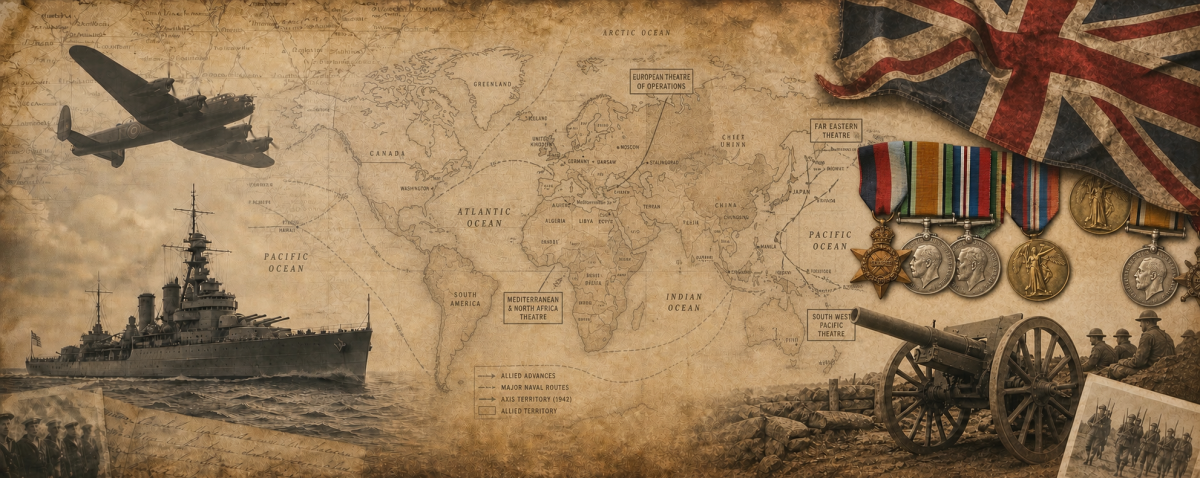

Piper Edward James Frederick Chilcott was an Edinburgh-born soldier of the 2nd Battalion, The Queen’s Own Cameron Highlanders, who died in Scotland on 25 August 1945, only weeks after the end of the Second World War in Europe. He was twenty years old and was buried in a joint grave at Edinburgh (Comely Bank) Cemetery, close to the city in which he was born and to the family who mourned him. [1][2]
Piper Edward James Chilcott, 14411222, 2nd Battalion, The Queen’s Own Cameron Highlanders, died on 25 August 1945, aged twenty.
Commonwealth War Graves Commission
Early Life and Family
Edward James Frederick Chilcott was born in Edinburgh, Midlothian, in 1925. He was the son of Frederick Knight Chilcott and Margaret Nisbet Bishop McNeill, and belonged to a family with established connections to the Scottish capital. The Commonwealth War Graves Commission records him as the son of Frederick and Margaret Chilcott of Edinburgh, and also identifies him as the nephew of James Brydon, likewise of Edinburgh. [2][1]
Although the surviving family report provides only limited detail about his childhood, it records a residence in Inverness in 1941, when Edward was about sixteen. That move or period of residence is especially significant in view of his eventual service with a Highland regiment, whose historic recruiting area included Inverness-shire and the wider Highlands. His life therefore connected Edinburgh, where he was born and later buried, with Inverness, one of the principal communities associated with the Cameron Highlanders. [1]
Edward came of age during the Second World War. He was still a child when Britain declared war in 1939, and he entered military service during the final phase of a conflict that had reshaped almost every aspect of British family and community life. No marriage or children are recorded, and his early death meant that his life remained closely defined by the homes, relatives and places in Scotland that had formed his upbringing. [1]
Military Service
Edward served as Piper 14411222 in the 2nd Battalion, The Queen’s Own Cameron Highlanders. A piper was not merely a ceremonial musician. Within a Highland infantry battalion, pipers formed part of the regimental tradition and helped sustain identity, morale and ceremonial life, while also serving as trained soldiers subject to the same military discipline, risks and responsibilities as other members of the unit. [2][1]
The Queen’s Own Cameron Highlanders was a distinguished Highland infantry regiment with strong associations with Inverness-shire. During the Second World War, its battalions served in several theatres, including North Africa, Italy and Greece. The 2nd Battalion had a particularly demanding wartime history: it served in the Middle East and North Africa, was caught up in the fighting around Tobruk in 1942, and was later re-formed in Britain after heavy losses and captivity among its earlier personnel. [3][4]
The re-formed 2nd Battalion returned to active service in the Mediterranean theatre, serving with the 11th Indian Infantry Brigade in the 4th Indian Division and taking part in operations in Italy before moving to Greece near the end of the European war. This wartime background is important to understanding the regiment in which Edward served, even though the surviving evidence does not establish whether he himself served overseas or joined the battalion during its later home-service period. [4][1]
Unit Context at Time of Death
At the time of Edward’s death, the 2nd Battalion was in the process of post-war transition. The official casualty material in the family report lists his duty location as “Home”, confirming that he died in Scotland rather than in an overseas theatre of operations. By late July 1945 the battalion was associated with the 6th Armoured Division, which was undergoing a period of reorganisation in the months following Germany’s surrender in May 1945. [5][1]
The end of fighting in Europe did not mean an immediate end to military service. Units had to be reorganised, personnel demobilised or redeployed, equipment accounted for, and regimental establishments adjusted to peacetime requirements. For the Cameron Highlanders, this period followed years of arduous service in the Mediterranean and involved the continuing administration, training and management of men at home and abroad. [3][5]
Edward’s role as a piper placed him within the cultural heart of a Highland battalion. Pipes and drums were central to the public identity of Scottish regiments, marking parades, church services, ceremonial occasions and the routines of military life. In the aftermath of the war, such traditions also carried particular emotional weight, providing continuity for soldiers and families as Britain moved from conflict towards remembrance and reconstruction. [1]
Edward died at home after victory in Europe, while his battalion and the wider Army were still adjusting from war to peace.
War Office casualty record and 2nd Cameron Highlanders unit history
Circumstances of Death
Piper Chilcott died in Scotland on 25 August 1945. The surviving casualty record classifies his fate simply as “Died” and notes that the information was reported to the War Office Casualty Branch in Casualty List No. 1849, for the reporting period ending on 4 September 1945. No surviving detail in the family report identifies the medical, accidental or other circumstance that caused his death, and it would be inappropriate to speculate beyond the evidence. [2][1]
His death occurred more than three months after Victory in Europe Day and shortly before the formal conclusion of the war against Japan. Britain remained on a full wartime footing in August 1945, with many servicemen still in uniform and with military deaths continuing to be recorded at home and overseas. Edward’s inclusion in the Commonwealth War Graves Commission register confirms that his death was accepted as attributable to his service during the qualifying war period. [2][1]
Burial and Commemoration
Edward was buried on 28 August 1945 in Edinburgh (Comely Bank) Cemetery, in joint grave M.397. The cemetery’s records identify him as Piper E. J. Chilcott of the 2nd Battalion, The Queen’s Own Cameron Highlanders, and state that his grave was marked by a cross and maintained by relatives. [6][1]
The inscription recorded for the grave reads: “At the going down of the sun / And in the morning / We will remember them.” Taken from Laurence Binyon’s well-known remembrance verse, these words formed a fitting expression of family grief and lasting commemoration for a young soldier who died at the end of the war. [1]
Edward shares the grave with Air Mechanic Second Class Jack Campbell Brydon, who had served in the Royal Navy aboard HMS Condor and died on 12 April 1945, aged nineteen. The shared grave therefore commemorates two young servicemen of the same generation, both of whom died before they could return to a full civilian life in post-war Scotland. [1]
Legacy
Edward James Frederick Chilcott’s brief life linked Edinburgh and Inverness with the wider story of the Queen’s Own Cameron Highlanders in the Second World War. Born in the capital, resident in Inverness during his youth and later buried in Edinburgh, he belonged to the communities from which Highland regiments drew both their soldiers and their enduring local support. [1]
His service as a piper represents an important aspect of Highland military tradition. The role embodied music and regimental identity, but it was also that of a serving soldier within a battalion shaped by hard campaigns in North Africa, Italy and Greece. His medals, the 1939–45 Star and War Medal 1939–45, formally acknowledge his wartime service. [4][3][1]
The family report identifies Edward as a half second cousin twice removed to the researcher. Though he left no wife or children, the combination of his Commonwealth grave record, family documentation and the continued history of the Cameron Highlanders ensures that he is remembered as more than a name on a casualty list: he was a son, nephew, Highland regiment piper and young Edinburgh man whose life ended in the uncertain weeks between war and peace. [2][1]
Sources and Further Reading
- Commonwealth War Graves Commission: Piper Edward James Chilcott
- Commonwealth War Graves Commission: Edinburgh (Comely Bank) Cemetery record
- Find a Grave: Edward James Chilcott
- National Army Museum: Queen’s Own Cameron Highlanders
- National Library of Scotland: Second World War Cameron Highlanders material
- The National Archives: Second World War British Army service records
Sources
[1] Individual-Report-for-Edward-James-Frederick-Chilcott.pdf https://ppl-ai-file-upload.s3.amazonaws.com/web/direct-files/attachments/141549598/9cadc98e-e462-45d0-9323-04c0368e3bfe/Individual-Report-for-Edward-James-Frederick-Chilcott.pdf?AWSAccessKeyId=ASIA2F3EMEYERYZ5BA4S&Signature=m6ry0p%2F3WOEiejfJPv8fH2cBDAk%3D&x-amz-security-token=IQoJb3JpZ2luX2VjED8aCXVzLWVhc3QtMSJHMEUCIB3l3NTh2Bo%2FbrS%2BxeGxLDL%2BN2Ph7BQ%2BwQYV0RhPRr82AiEAjHUO4HmSpDb93D4JTI2u10H18r8XJimfSvsa2wjyEs0q8wQIBxABGgw2OTk3NTMzMDk3MDUiDG3cA0I918xpdrt4KCrQBD0UZCeANG27SbHT72vGxnIqTn%2FxvABccpPC37tWPekHg625LFv0XcsUVzA4ShIiySaF7VBmmMSLrh3dRC00weI1UgZQeKBKWCgbL01NtoV3wYtMrBE0ypsldMZi%2BEDxWOVj9%2BPKbU4Nx8ND9lT3bRBWtRrVG06xgmCk9U6zTShCCg55vWOe3PCmCtuSVIS5DXG4%2B%2FD1WNwAO9J8gkNwRR9BkqL1byyEaRuuaOU3GtISKKarSFxonwWiZmEG3fEWarHXz57pqXy4znUuASmQS23dQliu7ahwcUEDPA9EEDdqretJh78%2FP%2FcR9dgvT299sDplz97xe%2BhG3wlJCYQ45BXKqVZKSWoJp49yW8oJg9qjQsGOHTterUOCGePmH3GC4d4aAT2UIN38rdgEVfaqNUulIkL4j%2BRR74su%2BCXekUUwY%2Bp12ll%2FtW2PK74oOZByzvI1bSA6%2F6DjquxtJyCPoNoGyJcC3ht%2BZFOud84MzBLelwyEQXFEoz7k%2BjQuxJd4N0gIhNVQ8FiQYHMZB3qDaBSlKgZj2odrPkeza4U9feWumibZ1fInAIKc4R7muEKcjp4ifw2tBfhX3q%2BBCAk2YV%2B1ULcgObt5sp7WHAa%2BLy1GN2VajJMuPI%2FHMdy7UVXh6WNXsmpcOE7YSIiyj5n9MXDT4i9muSOQ27JPglFqw0xsxOzXWWjMmKkQwV1%2FWPyl%2Fq1A3c5dcyXXIdGihKAZSkPB592QkQF61lYfbAO8nP3PjUe6UOzL%2Bg9q1wabBBROrflRs%2BR6bfGrahHsLpPAmjIwysK21AY6mAFAkU8iGwqOyaNasuVlU4NfLTpZ31FB0SvyzNpNJC4UzzY4iIE5gT1rJwZRgA8noSLUby03TwHfJGXfpGKBbhLEN30SNKQZ7Jr8raGBGYI1CGW%2Fj0Ugrlb0CepaY64nr%2B7Sjcm%2FdM3B3Yypnc7k7PZsBDb5Xw4x3DIij2wtjHPCrOJQPKTcjF8%2B6OgllvcmMWgItPJmvlgsQQ%3D%3D&Expires=1787668535
[2] Piper Edward James Chilcott | War Casualty Details 2451725 https://www.cwgc.org/find-records/find-war-dead/casualty-details/2451725/edward-james-chilcott/
[3] Queen’s Own Cameron Highlanders https://en.wikipedia.org/wiki/Queen’s_Own_Cameron_Highlanders
[4] Queen’s Own Cameron Highlanders https://military-history.fandom.com/wiki/Queen’s_Own_Cameron_Highlanders
[5] 6th Armoured Division https://www.quartermastersection.com/british/divisions/4071/6armdiv
[6] Piper Edward James Chilcott | War Casualty Details 2451725 | CWGC https://www.cwgc.org/find-war-dead/casualty/2451725/chilcott,-edward-james/
[7] Queen’s own cameron highlanders Stock Photos and Images https://www.alamy.com/stock-photo/queen’s-own-cameron-highlanders.html
[8] Queens own cameron highlanders Stock Photos and Images https://www.alamy.com/stock-photo/queens-own-cameron-highlanders.html
[9] Second World War (1939-1945). https://manuscripts.nls.uk/subjects/3008?&page=2
