
George Henry Hayward: A Detailed Biography
Private George Henry Hayward, G/28586, 6th Battalion, Queen’s Own (Royal West Kent Regiment), was a Kent‑born agricultural labourer who became an infantryman in the British Army and died of wounds in France on 28 March 1918 during the German Spring Offensive. [1][2][3] He is buried at Doullens Communal Cemetery Extension No. 1 on the Somme and is remembered on local memorials in Lowestoft and in regimental histories of the Royal West Kents. [1][4][3]
Early Life and Family
George Henry Hayward was born before 28 April 1878 at Hastingleigh, Kent; his birth was registered in the March quarter of 1878 in the Elham registration district (volume 2A, page 966). [1] He was baptised at Elmstone, Kent, on 28 April 1878, the son of Thomas Hayward and Frances Camilla (née Mills), linking him to a long‑established rural family in east Kent. [1]
The 1881 census records George, aged 3, living with his parents in Elmsted, Kent. [1] By 1891 the family had moved back to Hastingleigh, where George, aged 13, is listed in The Street as an agricultural labourer, reflecting the early age at which many village boys entered farm work in Victorian rural Kent. [1]
Early Life and Family (Marriage, Work and Children)
By 1901 George was still in Hastingleigh, living at Bishop Cottages in The Street and working as an agricultural labourer, a pattern that continued into the 1911 census where he appears as a general labourer at Bishop Cottages. [1] On 21 September 1901 he married Beliza Maud Tuthill at Hastingleigh (marriage registered Elham district, volume 2A, page 1767), anchoring him firmly in the local community through both birth and marriage. [1]
The couple had at least one child, William Thomas Hayward, noted in the individual report, and by 1918 the family was living at Grove Cottages, Grove Road, Carlton Colville, near Lowestoft, Suffolk. [1][5] Contemporary biographical notes from Lowestoft describe George as a native of Hastingleigh who had moved to the east coast for work, taking up residence at Grove Cottages with his wife Beliza Maud and their family before joining the Army. [1][5]
Military Service
George enlisted at Canterbury, Kent, joining the Queen’s Own (Royal West Kent Regiment) and being allocated the service number G/28586. [1][3] He served in the 6th (Service) Battalion, a New Army battalion raised at Maidstone in August 1914, which joined 37th Brigade, 12th (Eastern) Division and landed in France in early June 1915. [1][2][6]
The 6th Royal West Kents saw heavy action throughout the war. In 1915 they fought at the Battle of Loos and at the Quarries near Hulluch; in 1916 they took part in the Somme battles of Albert, Pozières and Le Transloy; in 1917 they were engaged in the Arras offensive at the First and Third Battles of the Scarpe and at Arleux, as well as in the Cambrai operations, including the Tank Attack and the fighting at Bourlon Wood. [1][2][6] In early 1918 the battalion, still with 12th (Eastern) Division, faced the full weight of the German Spring Offensive in the Somme sector and around the River Ancre. [1][2][7]
Circumstances of Death
The individual report records George’s death as 28 March 1918 in France, his fate noted as “Died of Wounds”. [1] Detailed divisional histories and contemporary summaries explain that on 25 March 1918 the 12th (Eastern) Division, as part of V Corps, was holding defensive positions on the west bank of the River Ancre north of Albert, with 6th The Buffs and 6th Queen’s Own (Royal West Kent Regiment) holding the front line from Aveluy Wood to Mesnil‑Martinsart. [1][2]
On 27 March the division repelled several strong German attacks, including low‑level strafing by aircraft, but remained in place despite heavy losses. [1][2][7] The attack was renewed on the morning of 28 March – the First Battle of Arras 1918 in British terminology – when German forces again assaulted along the Ancre and further north; at Aveluy the 6th Royal West Kents were pushed back on the left before the line was re‑established by counter‑attack, and the division as a whole suffered 1,634 casualties in holding the German advance. [1][2][8] George’s death from wounds on that date almost certainly resulted from injuries sustained in this intense fighting around Aveluy and the Ancre valley, either on 27 March or in the renewed attacks on 28 March. [1][4][3]
Burial and Commemoration
After his wounding George was evacuated to medical care in the rear area and died in France, being buried in Doullens Communal Cemetery Extension No. 1, Somme, France, in grave V.D.6. [1] The cemetery contained several casualty clearing stations, and many of those interred there were soldiers who had been brought back from the Somme and Ancre battlefields for treatment, which accords with George’s recorded cause of death as “Died of wounds”. [1][4]
The Commonwealth War Graves Commission entry records him as “HAYWARD, GEORGE HENRY, Private G/28586, 6th Bn., Queen’s Own (Royal West Kent Regiment), died 28 March 1918, aged 40, Son of Thomas and Frances Hayward, native of Hastingleigh, Kent; husband of B. M. Hayward, of Grove Cottages, Grove Rd., Carlton Colville, Lowestoft.” [1][4][3] A Find a Grave memorial (ID 56532564) reproduces these details and marks his grave within the cemetery, while local Lowestoft remembrance projects list him among the “People of Lowestoft 1914–45” as a private of the 6th Royal West Kents, service number G/28586. [1][5][4]
Legacy
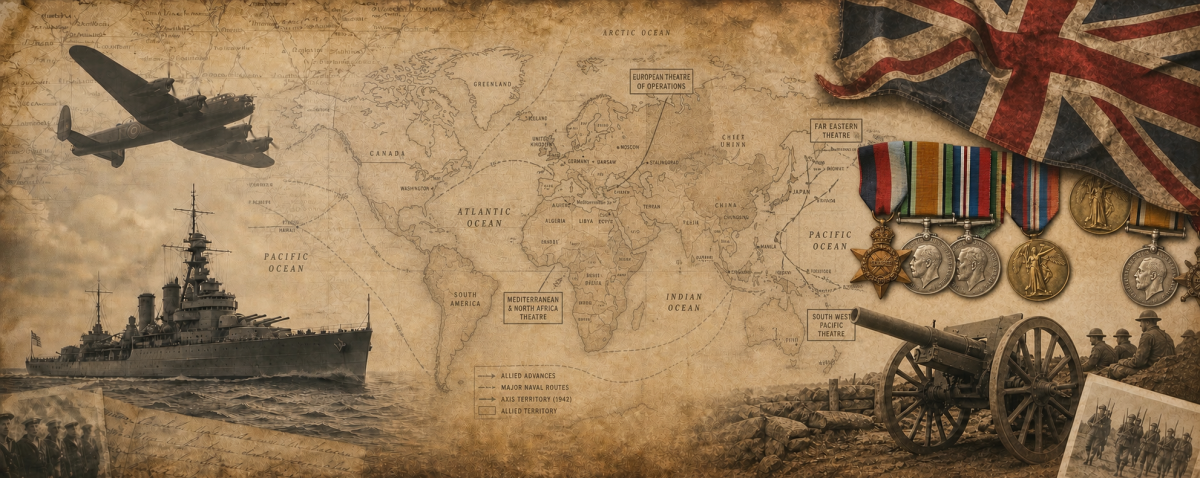
Within family research, George is identified with a FamilySearch profile under ID LCK4‑Y1R, tying him into the broader Hayward and Mills family network originating in Hastingleigh and the Elham district. [1] His medal entitlement includes the British War Medal, Victory Medal and Memorial Death Plaque, typical for a soldier who served overseas and died in action, and his story appears in genealogical and regimental websites dedicated to the Queen’s Own (Royal West Kent Regiment). [1][6][3]
Local history initiatives in Lowestoft and Carlton Colville remember him as “George Henry Hayward of Grove Cottages, Grove Road, Carlton Colville, Private, Queen’s Own (Royal West Kent Regiment), died 28 March 1918, France, G/28586”, connecting the Somme grave at Doullens back to the Suffolk street where his widow Beliza Maud and their son William Thomas lived. [1][5][4] Through CWGC records, regimental histories and community memorials, Private George Henry Hayward’s service with the 6th Royal West Kents and his death in the First Battle of Arras 1918 remain part of both Kentish and Lowestoft remembrance of the First World War. [1][2][3]
Key External Links
- Commonwealth War Graves Commission – Private George Henry Hayward:
https://www.cwgc.org/find-war-dead/casualty/82968/hayward,-george-henry/ [1] - 12th (Eastern) Division – narrative of March 1918 and First Battle of Arras 1918:
https://www.longlongtrail.co.uk/army/order-of-battle-of-divisions/12th-eastern-division/ [2] - Lowestoft “Our Fallen” biography – George Henry Hayward:
https://ourfallen.lowestoftoldandnow.org/grove-road/1918-03-28/george-henry-hayward [4] - Queens Own Royal West Kent Regiment page (includes 6th Battalion and casualty notes):
https://www.janetandrichardsgenealogy.co.uk/Pte%20G%20H%20Hayward.html [3]
Sources
[1] Individual-Report-for-George-Henry-Hayward.pdf
[2] 12th (Eastern) Division https://www.longlongtrail.co.uk/army/order-of-battle-of-divisions/12th-eastern-division/
[3] The Queens Own Royal West Kent R https://www.janetandrichardsgenealogy.co.uk/Pte%20G%20H%20Hayward.html
[4] George Henry Hayward https://ourfallen.lowestoftoldandnow.org/grove-road/1918-03-28/george-henry-hayward
[5] People of Lowestoft 1914-45 https://ourfallen.lowestoftoldandnow.org/full/msword?page=10
[6] The Queens Own Royal West Kent Regiment https://www.janetandrichardsgenealogy.co.uk/QORWK%20C%20T%20Atkinson.html
[7] Gowerton County School War Memorial – WW1.Wales https://ww1.wales/other-counties/glamorgan-memorials/gowerton-county-school-war-memorial/
[8] WW1 Home News in March 1918 http://lynsted-society.co.uk/research_ww1_home_news_1918_03.html
[9] Sergeant Thomas Harris VC MM http://www.hallinghistory.co.uk/community/halling-historical-society-18475/sergeant-thomas-harris-vc-mm/
[10] Roll of Honour – Kent County Association of Change Ringers https://kcacr.org.uk/association/ww1/roh/
[11] WW1 Roll of Honour – Ernest Cheeseman of Teynham http://lynsted-society.co.uk/research_ww1_casualties_cheeseman_e.html
[12] How to find a photo of a grandfather who died in WW1? https://www.facebook.com/groups/1117523195087247/posts/2701175966721954/
[13] Lives of the First World War https://livesofthefirstworldwar.iwm.org.uk/lifestory/1802494
[14] Battle of Arras (1917) https://en.wikipedia.org/wiki/Battle_of_Arras_(1917)
[15] “IF YOU SHED A TEAR” https://www.merseamuseum.org.uk/MMPDFs/IYS_PART3.pdf
[16] MCMXIX (1914-1919) ADAMS, JOSEPH. R https://www.ryebritishlegion.org.uk/wp-content/uploads/2023/01/Rye-RoH-v8-Jan-23.pdf
[17] pdpubs book pagemaster https://pembrokeandmonktonhistory.org.uk/documents/memorialbookfinalpagemaster.pdf
[18] Godalming, Charterhouse School – World War 1 Surnames H https://www.roll-of-honour.com/Surrey/GodalmingCharthouseSchool-WW1-H.html
[19] George W. Hayward – Wikipedia https://en.wikipedia.org/wiki/George_W._Hayward
[20] https://www.stokesubhamdoncouncil.com/shared/attac… https://www.stokesubhamdoncouncil.com/shared/attachments.asp?f=5d5f6938-900d-4431-b7cf-f4573c121fe1.docx&o=HAWKINS-Charlie.docx
[21] whaley bridge war memorial http://www.dustydocs.com/link/5/25105/181320/monumental-inscriptions-roll-of-honour.html