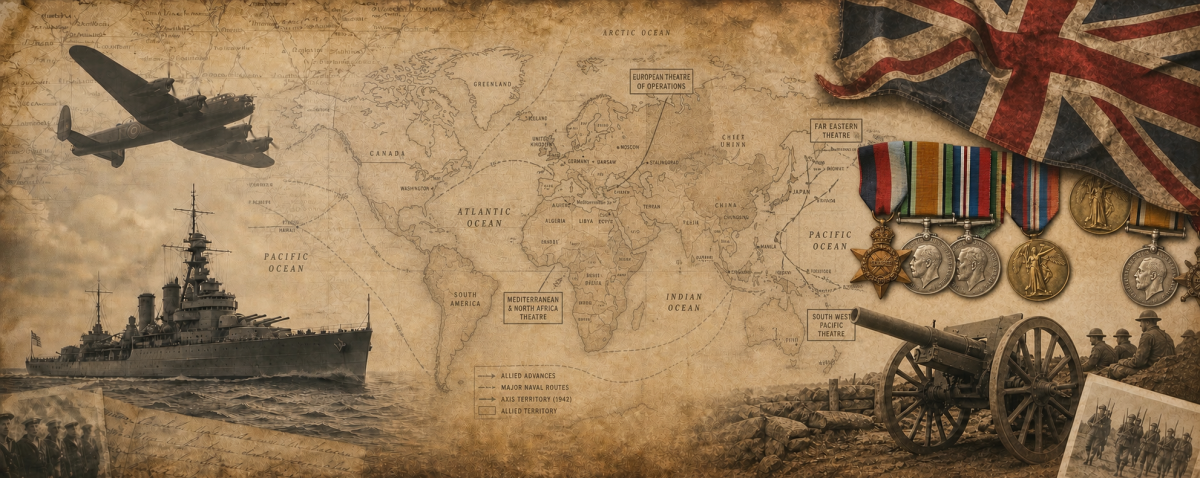

Marine Leslie Victor Rogers, CH/X104204, was a young Royal Marine from Dover who was killed during the raid on Axis-held Tobruk, Libya, on 14 September 1942. He served with the 11th Battalion, Royal Marines, in the amphibious assault force for Operation Agreement, and is commemorated on the Chatham Naval Memorial. [1][2][3]
At nineteen, Leslie Rogers left Dover for one of the most hazardous combined operations of the North African campaign: the raid on Tobruk.
Early Life and Family
Leslie Victor Rogers was born in Dover on 21 April 1923. His birth was registered in the Dover district during the second quarter of that year. He was the son of Thomas James Frederick Rogers and Bertha Florence Ballard, and grew up in the Tower Hamlets area of Dover, a community closely linked with the town’s port, railway and military life. [1]
The 1939 Register records Leslie at 39 Dickson Road, Dover, aged sixteen, single and employed as a butcher’s roundsman. This was practical, local work involving the delivery of meat and provisions around the town, likely by bicycle, handcart or van. It also places him within a working household at the beginning of the Second World War, when Dover was already becoming a frontline town exposed to the risks of the Channel conflict. [1]
By the time Leslie was serving overseas, his father had died and the local press described him as the eldest son of Mrs Rogers and the late Mr Thomas Rogers. His mother continued to live at 39 Dickson Road, while later remembrance notices name his brother and sisters Marjorie, Vera and Ena. Leslie did not marry and no children are recorded. His death therefore fell particularly heavily upon his mother and siblings, whose newspaper memorial notices continued for years after the war. [1]
Royal Marines Service
Leslie joined the Royal Marines and served as Marine CH/X104204. The “CH” prefix indicates a Chatham Division connection, consistent with his home in Kent and his eventual commemoration at Chatham Naval Memorial. Before the creation of a unified post-war corps structure, Royal Marines were administered through the historic divisional system centred on Chatham, Portsmouth, Plymouth and Deal. [1][3]
The family report identifies Leslie’s sub-unit as the 11th Battalion, Royal Marines. This was a wartime battalion formed for land operations within the expanding Royal Marines organisation. It was trained to operate alongside the Royal Navy and Army in combined operations, including amphibious landings, raids and attacks on coastal targets. [1][2][4]
Marine infantry were expected to fight ashore as well as carry out traditional shipboard duties. The report’s contemporary description of the Tobruk raiders evokes the equipment carried by the men: khaki clothing, steel helmets, heavy boots for silent movement, Tommy guns, Bren guns, rifles, grenades, sticky bombs and demolition charges. Such equipment shows that the 11th Battalion’s role at Tobruk was not defensive garrison duty but an assault and demolition mission against a fortified enemy port. [1]
Operation Agreement and Tobruk
Leslie died during Operation Agreement, a combined British, Rhodesian and New Zealand operation against Axis-held Tobruk on 13–14 September 1942. The operation took place during the North African campaign, at a time when the Axis forces of Germany and Italy used Tobruk as an important port and supply base. The Allied intention was to strike behind the front line, disrupt the garrison and damage the facilities that supported Axis operations in Libya. [5][6]
The objectives included destroying harbour installations, fuel stores, ammunition dumps, vehicles, shipping, airfields and repair facilities. The raid was designed to impose a disproportionate cost on the enemy through a surprise attack by sea and land. Its success depended on careful co-ordination between Royal Navy ships, landing craft, Royal Marines, soldiers, special forces and supporting aircraft. [6][7]
The 11th Battalion, Royal Marines formed the spearhead of Force A, the amphibious assault element of the operation. The battalion was to land from destroyers and landing craft north of the harbour under cover of darkness, establish itself ashore and assist in destroying the selected targets. This was a high-risk assignment: the attackers were heavily armed but greatly outnumbered by the German and Italian garrison and vulnerable to coastal artillery, aircraft and confusion during the landing. [1][2][7]
The destroyers H.M.S. Sikh and H.M.S. Zulu played a central part in landing and supporting the raiding force. They were joined by other naval vessels, motor launches, motor torpedo boats and landing craft. The newspaper account included in the family report describes the assault force boarding in darkness while Allied bombers attacked Tobruk for more than five hours, intended to suppress defences and assist the landing. [1][8]
Leslie’s battalion was the spearhead of Force A: Royal Marines sent ashore to attack a heavily defended Axis port and destroy the infrastructure that sustained enemy forces in North Africa.
Unit Context at the Time of Death
The raid did not unfold as planned. Italian shore batteries engaged the attacking vessels, and H.M.S. Sikh, which had helped deliver the landing force, was disabled and later sank off Tobruk during the morning of 14 September. The remaining naval forces came under further air attack. H.M.S. Coventry was lost and H.M.S. Zulu was damaged by bombing and later sank while under tow. [2][7][8][9]
Ashore, the landing force encountered stronger resistance than expected. The Axis garrison had been reinforced, and the assault failed to achieve its intended objectives. The 11th Royal Marines suffered particularly heavily: records of the operation report sixty-nine Royal Marines killed, while many more, including senior officers and other ranks, were missing or captured. The wider raid cost hundreds of Allied lives and resulted in many prisoners of war. [2][6][7]
Leslie was one of the Marines who died ashore. His death record gives Tobruk, Libya, as the place of death and identifies him as killed in action on 14 September 1942. The precise place and circumstances of his death are not preserved in the surviving family material. It is therefore not possible to state whether he died during the landing, in the fighting around the shore installations, or during the withdrawal and collapse of the raid. [1][3]
What can be said with confidence is that Leslie died as part of the 11th Royal Marines’ first major operation. The battalion’s role in Operation Agreement was direct assault, demolition and the seizure or destruction of targets within a fortified enemy-held port. His death was not a distant naval loss but the result of close-range combat in one of the most difficult combined operations attempted in the Middle East during 1942. [2][4]
Circumstances of Death
Initial news in Dover was uncertain. On 2 October 1942, the Dover Express reported that Leslie had been posted missing while on war service in the Middle East. For his mother and family, this meant many months without certainty as to whether he had been killed, wounded, captured or had somehow survived the raid. [1]
In September 1943, the newspaper reported that Leslie, then aged nineteen, had been officially confirmed as killed in action during the landing of Marines at Tobruk on 14 September 1942. The delay reflects the chaotic outcome of Operation Agreement, in which men were killed, taken prisoner, rescued, scattered during the withdrawal or left unaccounted for after ships and landing craft were lost. [1]
From 1945 onwards, the Dover Express carried repeated notices from Leslie’s family on the anniversary of his death. His mother, brother and sisters recalled him as a “dear son and brother” who had given his life at Tobruk. These notices reveal the long afterlife of the loss within the Rogers family and their determination that he should remain remembered in his home town. [1]
Burial and Commemoration
Leslie has no known grave. He is commemorated on Panel 84, Column 1 of the Chatham Naval Memorial in Kent. The memorial records naval and Royal Marines casualties of the Second World War who were lost at sea or whose bodies were not recovered for individual burial. His commemoration there connects his Dover origins, Chatham service division and death ashore in Libya. [1][3]
The family report includes a Find a Grave memorial, number 14379528, and identifies his entitlement to the 1939–1945 Star and War Medal 1939–1945. These medals recognise his wartime service, while the Chatham Naval Memorial provides the formal public place at which his name is preserved. [1]
Legacy
Leslie Victor Rogers’s story links the streets of Dover with the far-reaching conflict in North Africa. In 1939 he was a sixteen-year-old butcher’s roundsman living with his family at Dickson Road; three years later he was a Royal Marine taking part in an amphibious assault on Tobruk. His journey reflects the rapid transformation of young civilian workers into service personnel during the Second World War. [1]
His service with the 11th Royal Marines reveals the hazardous and adaptable role of the Corps in combined operations. The battalion was trained to work from naval vessels, land under fire and carry out ground combat and demolition tasks. In Operation Agreement, these duties placed Leslie directly in the assault force sent against an enemy base defended by far larger German and Italian forces. [2][4]
His loss remained present in family memory long after the war. The repeated anniversary notices published by his mother, sisters and brother show that the date of 14 September remained a lasting point of remembrance. For the family, Leslie was not merely one of the casualties of Operation Agreement; he was their eldest son and brother, a young man whose life had been rooted in Dover. [1]
Today, his name on the Chatham Naval Memorial ensures that his sacrifice is formally remembered. The surviving records, newspaper notices and unit history give further depth to that commemoration: Marine Leslie Victor Rogers, CH/X104204, was a nineteen-year-old Dover man who died ashore at Tobruk while serving with the 11th Battalion, Royal Marines, during Operation Agreement. [1][2][3]
Sources and Further Reading
- Commonwealth War Graves Commission: Marine Leslie Victor Rogers
- Find a Grave: Marine Leslie Victor Rogers
- Royal Marines Historical: Marine Leslie Victor Rogers, CH/X104204
- The National Archives: 11th Battalion at Tobruk, Operation Agreement
- Royal Marines History: 11th RM Battalion and the Tobruk raid
- Australian War Memorial: Operation Agreement, commando raid on Tobruk, 14 September 1942
- The Bay Museum: Operation Agreement
- BBC People’s War: H.M.S. Zulu at Tobruk
- Dover War Memorial Project: Second World War casualties
- Compiled family report: Individual Report for Leslie Victor Rogers, including civil registration, the 1939 Register, Royal Marines casualty information and Dover Express remembrance notices.
Sources
[1] Individual-Report-for-Leslie-Victor-Rogers.pdf https://ppl-ai-file-upload.s3.amazonaws.com/web/direct-files/attachments/141549598/f0d2c85e-2b05-4d29-a3ca-c76f6fc7ea42/Individual-Report-for-Leslie-Victor-Rogers.pdf
[2] 11th RM Battalion – Operation Agreement – Raid on Tobruk https://www.royalmarineshistory.com/post/11th-rm-battalion-operation-agreement-raid-on-tobruk
[3] Grave of Leslie Victor Rogers https://rmhistorical.com/index.php/grave/7743?page=514
[4] Sea Your History – Land service https://seayourhistory.org.uk/content/view/472/628/1/1/
[5] Operation Agreement : commando raid on Tobruk, 14 September … https://www.awm.gov.au/collection/LIB6411
[6] Operation Agreement – Wikipedia https://en.wikipedia.org/wiki/Operation_Agreement
[7] OPERATION AGREEMENT – The Bay Museum & Research Facility https://the-bay-museum.co.uk/2022/09/13/operation-agreement/
[8] HMS Sikh (F82) – Wikipedia https://en.wikipedia.org/wiki/HMS_Sikh_(F82)
[9] BBC – WW2 People’s War – HMS Zulu at Tobruk https://www.bbc.co.uk/history/ww2peopleswar/stories/07/a2705807.shtml
[10] Royal Marines officers – The National Archives https://www.nationalarchives.gov.uk/help-with-your-research/research-guides/royal-marines-officers/
[11] `Agreement’: 11th Battalion at Tobruk | The National Archives https://discovery.nationalarchives.gov.uk/details/r/C2954679
[12] D-Day | Daily Maverick https://www.dailymaverick.co.za/article_tag/d-day/?dm_source=article-keyword&dm_medium=link&dm_campaign=inform
[13] The Marine | Daily Maverick https://www.dailymaverick.co.za/article_tag/the-marine/?dm_source=article-keyword&dm_medium=link&dm_campaign=inform
[14] British Expeditionary Force | Daily Maverick https://www.dailymaverick.co.za/article_tag/british-expeditionary-force/?dm_source=article-keyword&dm_medium=link&dm_campaign=inform
[15] British Military | Latest News & Features – Northsound 1 https://www.hellorayo.co.uk/northsound/tags/british-military
[16] 14th September 1942 – Operation Agreement – Commando Veterans https://forum.commandoveterans.org/cdoForum/posts/list/3578.page
[17] 14th September 1942 – Operation Agreement https://forum.commandoveterans.org/cdoForum/posts/list/3578.page;jsessionid=4DF9B12C2AA955C26F5EEDC635C6AED4
[18] Leslie Charles Rogers https://www.awm.gov.au/collection/R1574112
[19] Major Victor Rogers | War Casualty Details 93385 | CWGC https://www.cwgc.org/find-records/find-war-dead/casualty-details/93385/victor-rogers/
[20] Able Seaman Arthur Rogers | War Casualty Details 3049958 https://www.cwgc.org/find-records/find-war-dead/casualty-details/3049958/arthur-rogers/
[21] Company Sergeant Major Reginald Clarence Rogers https://www.cwgc.org/stories/stories/company-sergeant-major-reginald-clarence-rogers-mm-royal-marine-light-infantry/
[22] World War II https://www.sas.rochester.edu/his/sites/campus-history/History/World_War_II_The_Definitive_Encyclopedia.pdf
[23] Graves of lost World War 1 Marines identified in France … https://www.gov.uk/government/news/graves-of-lost-world-war-1-marines-identified-in-france-and-belgium
[24] Leslie Rogers https://www.ancestry.com/search/categories/bmd_death?name=Leslie_Rogers
[25] First World War cemetery at CHATHAM NAVAL MEMORIAL – view casualties – A Street Near You https://astreetnearyou.org/cemetery/142000/CHATHAM-NAVAL-MEMORIAL
[26] ROGERS Leslie 449787 https://aviationmuseumwa.org.au/afcraaf-roll/rogers-leslie-449787/
[27] Kent, Chatham Naval Memorial | ͏ https://www.commandoveterans.org/Chatham-Naval-Memorial
[28] † Victor Richard Rogers – WRECK WRAK EPAVE WRACK … https://www.wrecksite.eu/peopleView.aspx?130522
[29] Biography of Brigadier Thomas Leslie Rogers (1886 https://generals.dk/general/Rogers/Thomas_Leslie/Great_Britain.html
[30] Casualties on the Town Memorial – Surnames M to P http://www.doverwarmemorialproject.org.uk/Casualties/WWII/SurnamesMtoZ.htm
[31] Roy Leslie Rogers (1892–1919) • FamilySearch https://ancestors.familysearch.org/en/KFYD-DD6/roy-leslie-rogers-1892-1919
