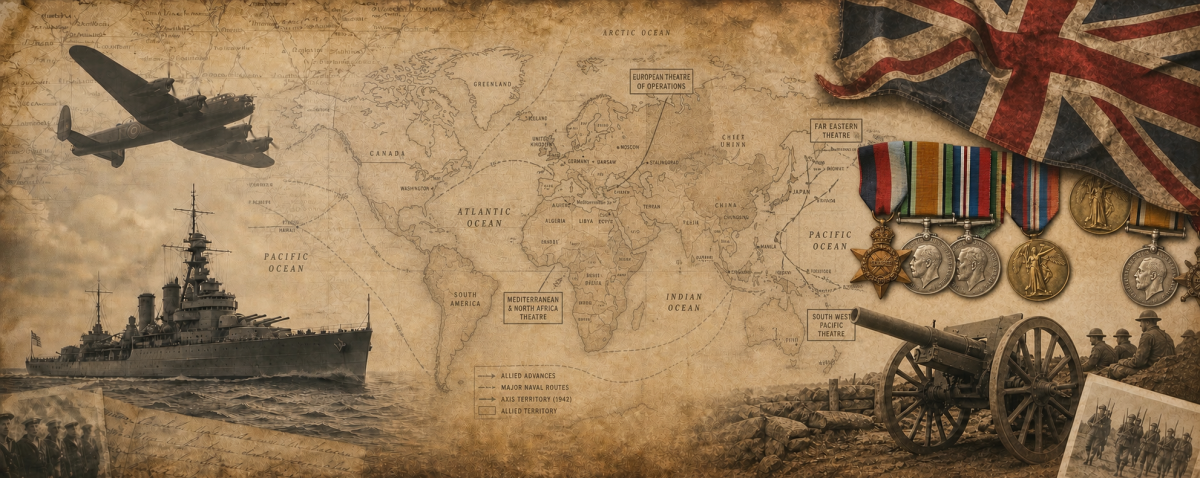

Ernest Walter Swann was a Royal Air Force airman, police sergeant and wartime civilian casualty whose life connected London, Folkestone, RAF Hawkinge and service in Iraq. His eventual death in 1947 was linked to injuries sustained during the devastating parachute-mine attack on Folkestone in May 1941, placing him among those civilians whose wartime suffering continued long after the end of hostilities. [1][2]
Ernest Walter Swann served his country first as an RAF airman and later as a Folkestone police officer, before injuries received in wartime air attack contributed to his death in 1947.
Early Life and Family
Ernest Walter Swann was born on 11 June 1904, with his birth registered in the Holborn district of Middlesex during the third quarter of that year. The family report identifies his parents as Ernest Arthur Swann and Lilla Lamey, while the 1911 census places the six-year-old Ernest at 29 Millman Street, in the parish of St Andrew Holborn above the Bars with St George the Martyr. [1]
There is a discrepancy in the supplied RAF transcription, which gives his birthplace as Belper, Derbyshire, rather than Holborn. For the purposes of family history, the civil birth registration and the 1911 census provide firm evidence of his early association with Holborn, while the RAF record remains valuable for the detailed account of his later service. [1]
Before joining the RAF, Ernest worked as a clerk for Marwood & Co. at Corinthian Buildings, 14 South Castle Street, Liverpool, between August 1921 and July 1922. The employment shows that he had already entered responsible clerical work as a young man, before pursuing the technical and administrative career that would define his military and civilian service. [1]
Royal Air Force Service
Ernest attested for the Royal Air Force at RAF Depot Uxbridge on 8 August 1924, undertaking a twelve-year engagement. He entered as an Aircraftman Second Class, service number 352061, and was initially enrolled as a fitter before receiving training connected with the Mechanical Transport Section. [1]
His first posting was to No. 1 School of Technical Training at RAF Halton, where he served from 8 August to 2 October 1924. RAF Halton was central to the training of airmen in technical trades, and the posting provided the foundation for a career that combined mechanical training, clerical qualifications and service in operational and overseas establishments. [1]
From Halton, Ernest was posted to No. 25 Squadron at RAF Hawkinge, serving there from 2 October 1924 until 15 August 1927. During this period he advanced to Aircraftman First Class on 2 October 1924 and to Leading Aircraftman on 15 August 1927. His RAF record also records a consistently “Very Good” character assessment, alongside satisfactory trade proficiency. [1]
Ernest later qualified in clerical and mechanical work. He completed a Clerk Special Duties course on 7 July 1927 and passed a motor-mechanics course on 25 September 1929, demonstrating the versatility expected of personnel serving in the inter-war RAF. Although the report’s summary describes him as AC2–Clerk GD, the detailed record confirms that he attained the rank of Leading Aircraftman during his active service. [1]
No. 25 Squadron at Hawkinge
No. 25 Squadron was an established RAF fighter unit with a distinguished First World War record. It re-formed at RAF Hawkinge after the war and remained there for several years, operating the Sopwith Snipe before converting to the Gloster Grebe in October 1924 and later to the Armstrong Whitworth Siskin. [3][4]
Ernest’s posting to Hawkinge therefore placed him in an important part of Britain’s inter-war air-defence system. The station lay high above Folkestone on the Kent coast, a strategically significant position close to the Channel and continental Europe; in the 1920s, its fighter squadron contributed to the defence and readiness of the RAF in south-east England. [3][1]
The connection to Hawkinge also became important later in Ernest’s civilian life. After joining the Folkestone Borough Police, he worked in a town where the aerodrome, coastal defences and wartime air activity were woven into local life; in 1934 he and two fellow constables were formally commended for their conduct in connection with an aircraft tragedy. [1]
Service in Iraq
On 15 August 1927, Ernest left No. 25 Squadron for No. 2 Armoured Car Company at Hinaidi, Iraq, where he served until 17 November 1929. He then remained at RAF Hinaidi until 15 October 1930. His service in Iraq took place during a period when the RAF performed a prominent role in Britain’s imperial defence system, combining aircraft operations with armoured-car patrols and ground support across a vast and difficult landscape. [5][6][1]
RAF armoured-car formations were used in Iraq, Palestine and Transjordan after the First World War to support air bases, undertake long-distance reconnaissance, assist communications and respond to security threats. In Iraq, armoured-car organisation was being reshaped during 1927, with several companies disbanded and an Armoured Car Wing created at RAF Hinaidi Cantonment. [5]
It is important to distinguish between Ernest’s recorded posting to “No. 2 Armoured Car Company, Hinaidi” and the wider organisational history of RAF armoured-car units. No. 2 Armoured Car Company is commonly associated with Transjordan and Palestine, while Hinaidi was a principal RAF base in Iraq; the precise administrative arrangement of his posting would need confirmation from the original RAF service record or unit records. Nonetheless, the surviving evidence clearly establishes that Ernest served within the RAF’s armoured-car and mechanical-support environment in Iraq during the late 1920s. [7][1]
From fighter defence at Hawkinge to armoured-car support at Hinaidi, Ernest Swann’s RAF career illustrates the global reach of the inter-war service.
Marriage and Police Career
Ernest married Constance Edith Gurr at St John’s Church, Folkestone, on 9 April 1930. The local press described Constance as the only daughter of Councillor and Mrs G. A. Gurr of “Gainsboro’”, 30 Morehall Avenue, Folkestone, and noted that the Folkestone Borough Police Force was well represented at the ceremony. [1]
The wedding was conducted by the Reverend E. C. Galpin, curate of St John’s. A reception followed at Hewson’s Restaurant, after which the newly married couple left for a honeymoon in Bournemouth. Ernest and Constance had three recorded children: Derek Ernest Swann, Sheila Kay Swann and Colin G. Swann. [1]
Ernest entered the Folkestone Borough Police Force in 1928 and remained in local policing until his death in 1947, ultimately becoming a police sergeant. He and Constance lived at 13 St Winifred Road by 1934, and the 1939 Register recorded them at the same address, with Ernest aged thirty-five and married. [1]
His police service brought repeated commendation. In 1930, the Watch Committee highly commended Police Constable E. W. Swann for stopping a runaway horse. Four years later, Swann, Allard and Setterfield were similarly commended for the manner in which they carried out their duties following an aircraft tragedy, recognition reported by the Deputy Borough Coroner and Chief Constable. [1]
Wartime Folkestone
During the Second World War Folkestone was an exposed coastal town within reach of air attack from occupied Europe. The local police, alongside the Auxiliary Fire Service, civil-defence organisations and the Home Guard, had vital responsibilities in maintaining order, assisting casualties and responding to bombing incidents. [1]
Ernest was serving as a Folkestone police officer when a parachute mine killed his parents-in-law, Mayor George Gurr and Mayoress Matilda Gurr, on 29 May 1941. A family recollection states that Ernest himself survived the incident with injuries, but that the effects of a fractured skull sustained in the blast later contributed to his death following a cricketing accident in August 1947. [1]
This account should be read as family testimony rather than a substitute for medical or inquest evidence. It nevertheless provides an important explanation for why the CWGC recognises Ernest as a Civilian War Dead casualty, despite his death occurring more than two years after the war had ended.
[2][1]Circumstances of Death
Ernest Walter Swann died on 30 August 1947 at Joyce Green Hospital, Dartford, aged forty-three. At the time, he lived at 113 Surrenden Road, Folkestone, and was recorded in the civil death record as the husband of C. S. Swann. [1]
The Commonwealth War Graves Commission lists him as a Civilian War Dead casualty, with his death date of 30 August 1947. This commemoration reflects the enduring consequence of wartime injury and acknowledges that civilian war deaths could arise from injuries or events whose effects continued beyond the formal end of the conflict. [2]
Burial and Commemoration
Ernest was buried on 4 September 1947 in Hawkinge Cemetery, Folkestone, in Plot BB, Section C, Grave 957. The burial register described him as a Sergeant in the Kent County Constabulary, recorded that his body was brought from 1 Dover Road, Folkestone, and named Frank Hutchinson as the officiant. [1]
He is also commemorated in Watling Street Cemetery, Dartford, reflecting his death at Joyce Green Hospital and his formal recognition among the Civilian War Dead. The CWGC provides the official record of his civilian-war-dead commemoration, while a Find a Grave memorial is listed under the identifier 24369235. [2][1]
Probate was granted in London on 21 October 1947 to his widow, Constance Edith Swann. His estate was recorded as £1,736 14s. 5d., a record that underlines both the administrative aftermath of his death and the responsibilities assumed by his widow and family. [1]
Legacy
Ernest Walter Swann’s story is that of a technically trained airman, a committed police officer and a family man whose life was permanently affected by war. His RAF career ranged from training at Halton and service with No. 25 Squadron at Hawkinge to overseas duty within the RAF’s armoured-car organisation at Hinaidi, Iraq. [3][5][1]
In Folkestone, he earned public commendations for courage and professional duty before serving his community through the dangerous years of the Second World War. His CWGC recognition ensures that his death is remembered within the wider history of civilian sacrifice, while his burial at Hawkinge and his family’s local connections keep his story rooted in Kent. [2][1]
For family historians, his biography also demonstrates the value of reading civil, military, local-newspaper and memorial records together. They reveal not only dates and postings, but a fuller portrait of a man who served in Britain and overseas, married into a prominent Folkestone family, raised children and continued to protect his community during wartime. [1]
Sources and Further Reading
- Commonwealth War Graves Commission: Ernest Walter Swann — official Civilian War Dead commemoration.
- Find a Grave: Ernest Walter Swann — memorial reference.
- Royal Air Force: No. 25 Squadron history — official squadron background.
- No. 25 Squadron RAF — background on the squadron’s inter-war service at RAF Hawkinge.
- RAF Armoured Car Companies — background on RAF armoured-car operations in Iraq and the Middle East.
- No. 2 Armoured Car Company RAF — unit history and later service background.
- Individual Report for Ernest Walter Swann — family report containing civil registration, census, RAF service transcription, local newspaper extracts, burial register and probate information.
Sources
[1] Individual-Report-for-Ernest-Walter-Swann.pdf https://ppl-ai-file-upload.s3.amazonaws.com/web/direct-files/attachments/141549598/62e14ba2-af1d-4d1f-a39d-a0ff6d6c84e5/Individual-Report-for-Ernest-Walter-Swann.pdf?AWSAccessKeyId=ASIA2F3EMEYEQ4TOXPQH&Signature=teKbnjT2y9QJz44nNWWSPdjNUxw%3D&x-amz-security-token=IQoJb3JpZ2luX2VjEJ%2F%2F%2F%2F%2F%2F%2F%2F%2F%2F%2FwEaCXVzLWVhc3QtMSJHMEUCIHWr7MNdx52NBeMMY%2FYd%2FW4TEZxcKnijyWsEhZX80ViGAiEAnwf67Xl0PMqUISWvz%2FD24weyt%2FOaqaDFHohODcOuTO0q8wQIZxABGgw2OTk3NTMzMDk3MDUiDE5FWA8JzBxC6ijnhirQBIfqNr8stZmvOvM8RX%2FHMsAxhd5ml0pYKraVAKteGGdIi9YuSVZ82IJrNbne9rvZFBREAYxsUT7wsY3UJh2s1tZyWrhSUTcLS%2BsarTOwCzXNv79brN14BFvgafass1SwR%2F6W%2BRbOo3GlJ95bxoDSPfktO0Lf63ZBQX8n0MVKR6XkzLlRXWQUxYj78sfR%2FEPU9mR1%2Fgdo19e5nziEhHS8q8C17z%2FG%2FfAK6Qo%2F85lQUrlEJizu%2B5EhOktrA3GaNi5MUQdRbnZgdvpdhHn4%2Byp0h9pQp0Fepgc436KXMJ1Y3gooDr5Je5%2FnlOP5%2BkVgYpliiIo6W8EI%2FNCDGf1J6rgyGE855U8vAtPkk%2FJAtOXt%2ByfGPmtKitgG139uB6v7sh4dSXLFjHxSqxLYWGdOo5cPCWmtHXUz8vIQoYj70gg2AZthjxwDTz9i2IjhMVyhcsNRR1YFROiFJa9q%2FUmMV%2BkwwGckLGmZEAqvdCk3kW%2BkIh66KIvc5PMKqK1cAgVWd3TsnY7fNduKMDWr71EGcY7BOz8gCnx%2F4nz8XPsGLuqhPQfEtXN25hJQyK8%2BUR4TX%2FaP%2FV5WLJ7x4DLtxIV%2B6ZEaI4Sc6T3RJqxcOjcjtQiQn3BGiay%2BFghnqOSkKXpuV1cdWcWxDFgjTujmZYHp1oWOnnpqwJ%2BjD7I2xHBAl90l%2FBdstc%2FioM2cmL4%2BDrlA15hM5tbQjg90NEIADHZjhG6eygVTWzDicSNmxln%2Bcq%2F1%2FUr50I%2Br3JSuT4Jxr2YgrXytVxhCA8mYUdBwvmalpA1jKIAw49LL1AY6mAE8fs5uordK8evYTWRhYPfqMMGmyIvF4qHsEOW%2FJRDiyiSkj2h1egj1pfmwcRPSaogPGUWqtKqsGv0aUGnyByCDy%2F8FaHDMjygew%2BztvGF%2ByqcrfUyrb%2FwhBCi8bJGibEohNmXvu90y93iYWY0UvI1AqaRWPrg7Jqn%2B1ma3qiO2157xw3q8U5P8oScWML4MkK28%2BsmxcMO%2F8w%3D%3D&Expires=1788014201
[2] Civilian Ernest Walter Swann | War Casualty Details 3115122 | CWGC https://www.cwgc.org/find-records/find-war-dead/casualty-details/3115122/ernest-walter-swann/
[3] No. 25 Squadron RAF https://en.wikipedia.org/wiki/No._25_Squadron_RAF
[4] No.25 Sqn RAF – Squadron Details – Aviation Directory https://www.worldnavalships.com/directory/squadronprofile.php?SquadronID=358
[5] RAF Armoured Car Company – Wikipedia https://en.wikipedia.org/wiki/RAF_Armoured_Car_Company
[6] No 1 Armoured Car Company | RAF Hinaidi | stevebusterjohnson https://www.stevebusterjohnson.com/raf-no1-armoured-car-company
[7] No. 2 Armoured Car Company RAF – Wikipedia https://en.wikipedia.org/wiki/No._2_Armoured_Car_Company_RAF
[8] No. 25 Squadron returning to fly the Hawk T2. https://www.raf.mod.uk/news/articles/no-25-squadron-returning-to-fly-the-hawk-t2/
[9] Private Walter Edgar Swan | War Casualty Details 379156 | CWGC https://www.cwgc.org/find-records/find-war-dead/casualty-details/379156/walter-edgar-swan/
[10] Allied Air Force Graves (non British) in Europe Managed by CWGC … https://aircrewremembered.com/AlliedNonBritishAirForceGravesEurope.CWGC/AlliedNonBritish.cwgc-alpha-list.html
[11] Haringhe War Memorial Records | PDF | History – Scribd https://www.scribd.com/doc/58908255/The-Queens-Ww1
[12] 1 – 25 Squadrons RAF | The Battle of Britain Historical Timeline https://battleofbritain1940.com/raf-squadrons-of-the-battle-of-britain/1-25-squadrons/
[13] Imperial War Museum (IWM) Department of Documents https://discovery.nationalarchives.gov.uk/details/a?_ref=62
[14] RAF Armoured Car Companies – Iraq, Kurdistan and Palestine https://ww2talk.com/index.php?threads/raf-armoured-car-companies-iraq-kurdistan-and-palestine.90136/
[15] Private Walter Swan | War Casualty Details 1671732 | CWGC https://www.cwgc.org/find-records/find-war-dead/casualty-details/1671732/walter-swan/
[16] No. 25 Squadron RAF https://military-history.fandom.com/wiki/No._25_Squadron_RAF
