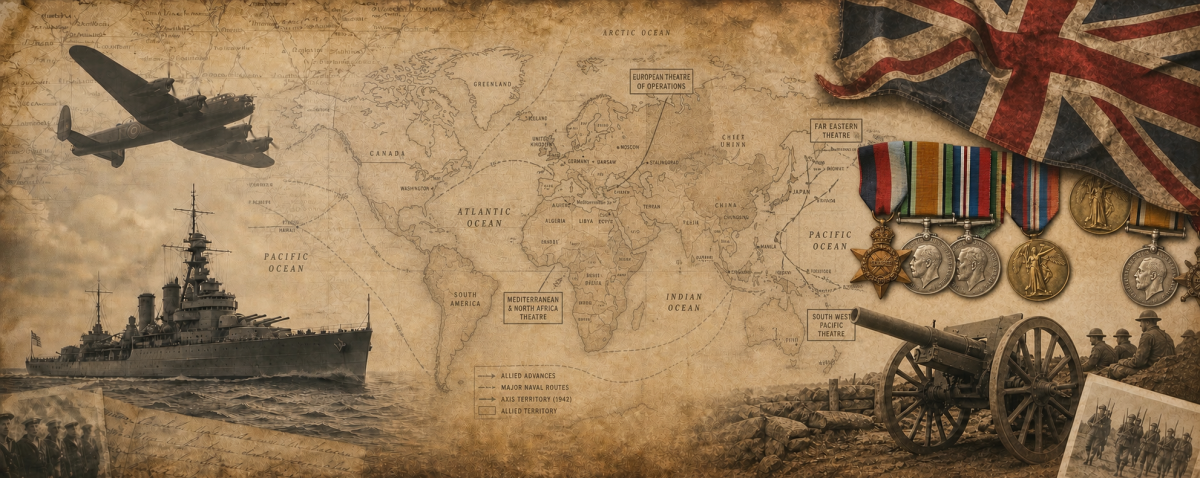
Remembering Henry Thomas Hansford: The Battle of the Somme

Henry Thomas Hansford was a Dorset farm labourer who became a soldier in the Dorsetshire Regiment and was killed on the first day of the Battle of the Somme. He was born before 10 July 1892 in Shipton Gorge, Dorset, the son of Esau Hansford and Elizabeth Hannah Parsons, and was baptised at Loders on 10 July 1892. By 1901 he was living in Bridport, and by 1911 he was recorded in Bothenhampton as a 19-year-old general labourer, already part of the rural working life that shaped so many young men in West Dorset. [1][2]

He married Fanny Annie Raynes on 27 April 1914 at Bradpole, Dorset, and the couple later had two children, John Reginald Raynes Hansford and Rosie Caroline Elizabeth Hansford. His home at the time of his death was 9 Ellens Row, East Street, Bridport, where his wife remained with the family while he served overseas. The surviving record gives a small but vivid sense of the man: blue eyes, brown hair, and a height of 5 feet 6½ inches. [1]

Early Life and Family

Hansford’s early years were spent in the farming communities of south Dorset, in a landscape of small settlements, coastal villages, and labouring work. His obituary-style family record shows him at home in both 1901 and 1911, moving from child to working man in a county where local employment was often seasonal and physically demanding. That background helps explain why men like Hansford were well suited to the field army: they were accustomed to hard work, discipline, and long hours before the war even began. [1]

Nothing survives here of a formal education or trade apprenticeship, but the available evidence points to a life rooted in ordinary Dorset employment rather than military ambition. Like many men from the county, he entered the Army from civilian labour, bringing with him practical stamina rather than social status. His family ties, especially his marriage and children, make his loss in 1916 all the more personal and immediate. [1]

Henry Thomas Hansford was one of the many Dorset men whose ordinary rural life was interrupted by the demands of war.

Military Service

Hansford enlisted at Dorchester for three years on 11 August 1914, having previously served in the Dorset Battalion of the Territorial Force. He was posted on active service with the 1st Battalion, Dorsetshire Regiment, on 27 May 1915, was wounded on 7 September 1915, and rejoined the battalion in the field on 10 January 1916. His service number was 9903, and he earned the 1914–15 Star, British War Medal, and Victory Medal. [1]

These details show a soldier who had already seen hard fighting before the Somme offensive. The 1st Battalion had been on the Western Front since August 1914 and by late 1915 and early 1916 was part of 14th Brigade in 32nd Division, giving it a long and difficult combat history before the great attack on 1 July 1916. Hansford was therefore not a new recruit when he died, but an experienced infantryman who had already been blooded in action. [2][1]

Unit Context at Time of Death

At the time of Hansford’s death, the 1st Battalion, Dorsetshire Regiment, was engaged in the opening assault of the Somme, fighting west of Ovillers and targeting the Leipzig Salient between Thiepval and Authuille Wood. The battalion was part of the wider British effort to break the German line after a prolonged artillery bombardment, but the battlefield conditions heavily favoured the defenders: deep trenches, strong wire, machine-gun fire, and commanding ground made advance extremely costly. The Dorsetshire Regiment’s role on 1 July was therefore not a minor supporting action, but part of one of the most famous and tragic infantry assaults of the First World War. [2]

According to the Dorset History Centre’s account, the 1st Dorsets attacked through Authuille Wood, where progress was quickly checked by enemy fire and the difficulties of the terrain. Their experience reflects the general pattern of the Somme’s first day: men advancing in open ground under fire, with units often suffering severe casualties before they could reach the German position. The battalion history and later summaries place the Dorsetshire Regiment among the units that paid a heavy price in the futile effort to force a decision on that first day. [2]

On 1 July 1916 the 1st Battalion Dorsetshire Regiment attacked the Leipzig Salient, one of the most fiercely defended sectors of the Somme battlefield.

Circumstances of Death

Henry Thomas Hansford was killed in France on 1 July 1916, the first day of the Battle of the Somme. The precise circumstances of his death are not given in the family record, but the battalion’s action that morning was exceptionally severe, with the men moving through Authuille Wood and then into open ground exposed to German machine-gun fire. In such conditions, many casualties were suffered before soldiers could even close with the enemy, and Hansford was among those who did not survive the attack. [2][1]

The date of death alone places him in one of the deadliest 24 hours in British military history. The Somme’s opening day cost the British Army almost 60,000 casualties, and the Dorsetshire Regiment was one of many battalions to suffer grievously in the assault. Hansford’s death is thus both a personal family tragedy and part of a larger national story of sacrifice. [2]

Burial and Commemoration

Hansford has no known grave and is commemorated on the Thiepval Memorial, Pier and Face 7 B, which bears the names of the missing from the Somme battlefields. This is an appropriate resting place for men who were killed during the confused fighting of 1 July 1916 and whose bodies were never recovered or identified. The memorial stands as one of the principal sites of remembrance for those lost in the battle. [1][2]

For his family in Bridport, the official notice of death would have been accompanied by the painful reality that there was no grave to visit. Instead, remembrance passed through the memorial inscription, family memory, and the medals issued for his service. His inclusion on the Thiepval Memorial ensures that his name remains part of the lasting record of the missing of the Somme. [2][1]

Legacy

Hansford’s life reflects the experience of many Dorset men of his generation: a background in rural labour, a young marriage, children, service in a local regiment, and death in the industrialised slaughter of the Western Front. What survives is fragmentary, yet enough remains to restore his place as a husband, father, son, and soldier rather than simply a name on a memorial. His story also highlights the wider contribution of the Dorsetshire Regiment, whose 1st Battalion was thrown into one of the war’s most difficult assaults at the very moment Hansford died. [1][2]

Sources and Further Reading

William Piddock’s Legacy: From Coalfield to Normandy

Private William George Piddock, 6408787, 1st Battalion, Dorsetshire Regiment, was killed in action on D‑Day, 6 June 1944, and lies in Bayeux War Cemetery.

Family report, CWGC data and Normandy campaign histories

Early Life and Family

William George Piddock was born on 7 May 1922 in the Eastry registration district of Kent, his birth registered in the second quarter of 1922 (Volume 2A, Page 1917).[file:334] He was the son of George Piddock and Helen Hayward, and thus part of a Kent family with roots in the east of the county around Eastry and Canterbury.[file:334] No marriage or children are recorded for him, and the report lists him without spouse or issue, indicating that he died as an unmarried young man.[file:334]

By the time of the 1939 Register, William was living at 32 Deansway Avenue, Sturry, near Canterbury, where he is described as an engine driver in a colliery working below ground.[file:334] Sturry lay within reach of the Kent coalfield, whose collieries at Betteshanger, Snowdown and Tilmanstone provided industrial employment in an otherwise mainly rural area.[file:334] His pre‑war occupation as a skilled colliery worker placed him among those whose labour supported both local economies and national rearmament on the eve of the Second World War.[file:334]

Work in the Kent Coalfield

The report’s explanatory notes describe an engine driver in a colliery below ground as responsible for operating haulage engines that pulled coal tubs or wagons along underground tracks, ensuring that machinery, brakes and cables all functioned correctly.[file:334] Such workers had to follow strict safety procedures, since equipment failure could lead to runaway wagons, trapped miners or serious underground accidents.[file:334] They also communicated with shaft workers and pit deputies using bells, signals or telephones to coordinate the movement of men and coal through the mine.[file:334]

Conditions underground in the Kent coalfield were hot, cramped and often hazardous, with risks from roof collapse, gas explosions and mechanical failures, and shifts commonly lasted eight to ten hours.[file:334] By 1939 these mines were an important part of Britain’s industrial base, supplying fuel for factories, railways and power stations at a time when war seemed increasingly likely.[file:334] Many miners were classed as essential workers, but as the war went on a significant number, including William, nevertheless entered the armed forces.[file:334]

Military Service with the Dorsetshire Regiment

The individual report records William’s service in 1944 as a Private in the Dorsetshire Regiment, with service number 6408787.[file:334] His sub‑unit is given as the 1st Battalion, Dorsetshire Regiment, an infantry battalion that by 1944 formed part of 231st Infantry Brigade within the British 50th (Northumbrian) Infantry Division.[file:334][web:305] His list of campaign medals—1939–45 Star, Africa Star, Italy Star, France and Germany Star, and War Medal 1939–45—shows that he had already seen active service in North Africa and Italy before being committed to the invasion of north‑west Europe.[file:334][web:313]

The 1st Dorsets were a seasoned battalion by the time they returned to Britain to train for Operation Overlord, and 50th Division as a whole was chosen for the initial assault on the Normandy coast because of its battle experience.[web:305][web:310] William’s transfer from colliery work into such a unit reflects how men with physical resilience and industrial discipline were absorbed into frontline infantry roles during the later stages of the war.[file:334][web:305]

Unit Context on D‑Day: Gold Beach

On 6 June 1944, the 1st Battalion Dorsetshire Regiment landed on Gold Beach, the central of the five Allied landing beaches in Normandy.[web:307][web:310] Gold Beach had been allocated to the British 50th (Northumbrian) Infantry Division, with 231st Infantry Brigade, including the 1st Dorsets, assigned to the Jig sector of the beach.[web:305][web:311] Their tasks included securing the beachhead between the German strongpoints near Le Hamel and Asnelles‑sur‑Mer and then advancing inland to cut key roads and high ground.[web:305][web:314]

Within 231st Brigade, the 1st Hampshire Regiment landed on the right while the 1st Dorsets went ashore slightly further east.[web:305][web:311] The sector was heavily defended with concrete bunkers, machine‑gun positions, anti‑tank ditches, minefields and beach obstacles, and a stiff onshore wind and tide complicated the arrival of supporting tanks and specialised armoured vehicles.[web:304][web:311] While the Hampshires were initially pinned down under fire near Le Hamel, the Dorsets were able to make better progress inland and helped to outflank the main German defences, contributing to the successful establishment of the Gold Beach bridgehead.[web:304][web:311]

This was the combat environment in which William’s battalion fought on the day of his death, and it explains why accounts of Gold Beach emphasise the intensity of the opening assault and the crucial role of 231st Brigade in securing the British left flank.[web:305][web:313] For soldiers like William, the first hours ashore involved crossing mined, obstacle‑strewn beaches under artillery and small‑arms fire before fighting through coastal villages and fields against well‑prepared German positions.[web:305][web:314]

As part of 231st Brigade on Gold Beach’s Jig sector, the 1st Dorsets landed under fire on 6 June 1944 and fought inland to secure the left flank of the British beachhead.

Gold Beach operational histories and brigade narratives

Circumstances of Death

The report records that William George Piddock was killed on 6 June 1944 in Basse‑Normandie, France, the region in which Gold Beach and Bayeux are located.[file:334] No separate description of the exact incident survives in the summary, but his date and place of death, battalion and brigade make it clear that he died during the D‑Day assault or the immediate inland fighting on that same day.[file:334][web:305] Many fatalities in the 1st Dorsets occurred in the first hours of the landings, when men were exposed on the beaches or advancing through heavily defended coastal terrain.[web:305][web:311]

Because infantry operations on D‑Day were fast‑moving and confused, detailed circumstances were rarely recorded for other ranks, and the standard phrase “killed in action” in William’s case encapsulates a moment in a wider battle rather than a fully documented incident.[file:334][web:313] For his family in Kent, news of his death would have linked the mining communities of the Kent coalfield and suburban Sturry directly to the largest amphibious assault in history.[file:334][web:307]

Burial and Commemoration

After his death William was buried in Bayeux War Cemetery, Normandy, in Plot XI, Row M, Grave 16.[file:334] The headstone inscription, as transcribed in the report, reads: “6408787 Private W. G. Piddock, The Dorsetshire Regiment, 6th June 1944, Age 22”, beneath which a cross symbol is engraved.[file:334] Bayeux War Cemetery is the largest Commonwealth cemetery of the Second World War in France, containing 4,648 burials, mostly from the Normandy campaign.[web:306][web:318]

The cemetery lies on the south‑western outskirts of Bayeux, opposite the Bayeux Memorial, which commemorates more than 1,800 Commonwealth soldiers who died in the campaign and have no known grave.[web:306][web:315] Together, the cemetery and memorial form a major focal point for remembrance of the Battle of Normandy and are regularly visited during D‑Day anniversary commemorations.[web:309][web:318] William’s grave stands among those of many comrades from 50th Division and other units who died during and after the landings.[file:334][web:306]

Legacy

Within the compiled family history William is identified as a second cousin once removed to the researcher, showing how his story fits into a wider network of Kent families whose members served overseas in the Second World War.[file:334] His life links the industrial world of the Kent coalfield with the seaborne assault on Normandy, illustrating how communities far from the sea nevertheless sent their sons to fight on the beaches of France.[file:334][web:307] The contrast between his work deep underground and his final role as an infantryman in an exposed assault underlines the breadth of experience compressed into his short life.[file:334][web:313]

Sources and Further Reading

See his brother at https://msyoung.org/2025/12/10/douglas-piddock/