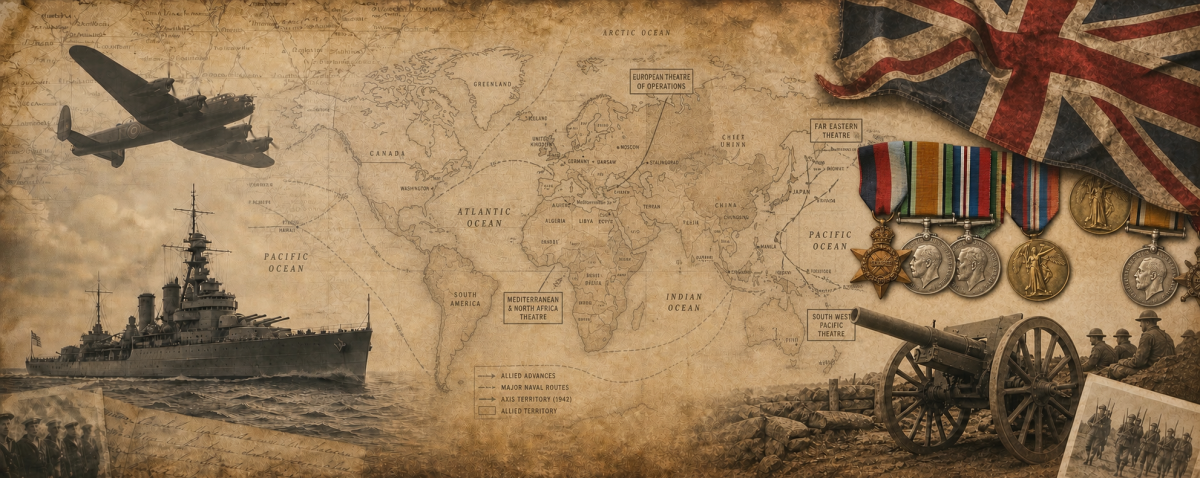

William Andrew Black: A Detailed Biography
Flight Lieutenant William Andrew Black (service number J/7980) was a Vancouver‑born pilot in the Royal Canadian Air Force who flew Halifax heavy bombers with No. 408 “Goose” Squadron, RCAF, within No. 6 (RCAF) Group, RAF Bomber Command. He was killed on the night of 3/4 February 1943 when his aircraft, Halifax II BT680 (often recorded as DT680) coded EQ‑D, was lost during a raid on Hamburg, and he now lies in Hamburg Cemetery, Ohlsdorf, Germany. [1][2][3]
Early Life and Family
William Andrew Black was born on 5 January 1920 in Vancouver, British Columbia, Canada, the son of William Black and Dorothy Ellen, née Castle. [1] The 1921 Canadian census records him at Vancouver, aged one, single, and living as a son in his parents’ household, confirming that his early childhood was spent in the growing Pacific port city that would remain his home base. [1]
By 1930 and again in the 1931 census, William was still resident in Vancouver, appearing aged 11 as a single son in the family home. [1] These repeated census entries indicate a stable upbringing in Vancouver through the inter‑war years, and later records describe his residence as Vancouver, British Columbia, with a relationship to head of household noted as “Father,” suggesting that as a young adult he continued to live with, or was closely associated with, his parents there. [1]
Military Service
At some point after the outbreak of war, William enlisted in the Royal Canadian Air Force and qualified as a pilot, eventually rising to the commissioned rank of Flight Lieutenant. His RCAF service number was J/7980, the “J” prefix denoting a commissioned officer in the Canadian air force. [1][2][3] He was posted to No. 408 (Bomber) Squadron, RCAF, popularly known as “Goose Squadron” from its badge, whose motto was “For Freedom.” [1][3][4]
No. 408 Squadron was formed in 1941 and operated from bases in Britain under RAF operational command as part of Bomber Command’s Main Force. From June 1941 until the end of the war it undertook night bombing raids against targets in Germany and occupied Europe. In September 1942 the squadron converted from Hampden bombers to the Merlin‑engined Handley Page Halifax, and from January 1943 it became part of No. 6 (RCAF) Group, the Canadian bomber group within RAF Bomber Command. [1][4][5]
During the period relevant to William’s service, 408 Squadron was based at RAF Leeming in North Yorkshire, from 20 September 1942 to 12 August 1943. [1] From December 1942 to October 1943 the squadron operated Halifax B Mk II aircraft, including Halifax II BT680 (often recorded as DT680) in which Flight Lieutenant Black served as pilot. [1][4][6] The squadron code allocated to 408 Squadron was “EQ,” and BT680 carried the individual aircraft letter “D,” making its full code “EQ‑D.” [1]
The Halifax II was an early heavy‑bomber variant of the Halifax series, powered by Rolls‑Royce Merlin engines and used in a variety of roles including night bombing, paratroop‑dropping, glider towing and special operations. [1][7][8] As a Halifax captain in a Canadian bomber squadron, Flight Lieutenant Black would have been responsible for a mixed Canadian and RAF crew of seven, navigating long night sorties across the North Sea and over heavily defended German territory.
Circumstances of Death
On the night of 3/4 February 1943, Flight Lieutenant Black was the pilot of Halifax II BT680 EQ‑D on a Bomber Command raid against Hamburg. [1][4][6] Bomber Command War Diaries record that 263 aircraft—84 Halifaxes, 66 Stirlings, 62 Lancasters and 51 Wellingtons—from all groups were dispatched, the first raid of over 200 aircraft for more than two weeks. [1]
Weather and technical difficulties plagued the operation. Severe icing conditions in cloud over the North Sea forced many bombers to turn back early, and the Pathfinders, using the then‑new H2S radar, were unable to provide concentrated and sustained target marking over Hamburg. As a result, the main force’s bombing was scattered across the city. The raid started 45 fires classified as “large,” including two in oil depots and one in a warehouse near the Elbe waterfront; German records cited 55 killed and 40 injured. [1][9]
Despite the poor conditions, German night fighters operated effectively, and Bomber Command lost 16 bombers on this raid—8 Stirlings, 4 Halifaxes, 3 Wellingtons and 1 Lancaster—an overall loss rate of 6.1 per cent of the attacking force. [1] Halifax BT680 EQ‑D, with Flight Lieutenant Black at the controls, was among the aircraft that failed to return. A losses database entry for this aircraft records that BT680 (often recorded as DT680 in some sources) of 408 Squadron took off from Leeming for Hamburg and was “lost over Germany,” with Black killed and several of his crew taken prisoner of war. [1][10][11][6]
Later sources, including the International Bomber Command Centre losses database and Cranwellian memorial material, confirm the basic details: Halifax II BT680 EQ‑D of 408 Squadron, RCAF, airborne from Leeming for night operations against Hamburg on 3 February 1943, failed to return, Flight Lieutenant William Andrew Black of Canada killed in action, other crew members becoming POWs. [1][10][11][12][6] The slight discrepancy between BT680 and DT680 in various serial lists is generally treated as a transcription issue, with both references clearly pointing to the same loss. [1]
Burial and Commemoration
Following the loss of his aircraft, William’s body was recovered and buried in Germany. He now rests in Hamburg Cemetery, Ohlsdorf, in Grave 10A. M. 8., a large Commonwealth war cemetery created after the war to hold the graves of airmen and other servicemen who died in operations over northern Germany. [1][3]
The Commonwealth War Graves Commission entry for Flight Lieutenant William Andrew Black confirms his age as 23, his unit as 408 Squadron, Royal Canadian Air Force, and his nationality as Canadian, with his parents named as William and Dorothy Ellen Black of Vancouver, British Columbia. [1][3] Through this record, his grave is maintained in perpetuity and his details are accessible to researchers and relatives.
He is also commemorated on the Canadian Virtual War Memorial, which provides a profile summarising his service and sacrifice and linking to images of his panel or headstone. [2][3] A further biographical memorial appears on Find a Grave (Memorial ID 20939511), noting his rank as Flight Lieutenant (Pilot), his service number J/7980, his age 23, and his resting place at Hamburg Cemetery. [1][13]
Legacy
His life traces a distinct Canadian wartime journey—from Vancouver childhood to training as an RCAF pilot, then service in a Canadian bomber squadron flying from Yorkshire bases deep into enemy territory.
No. 408 Squadron itself went on to play a sustained role in the Bomber Command campaign. After its period on Halifax IIs, it re‑equipped with Lancaster IIs in October 1943 and later with Halifax III and VII, eventually converting to Canadian‑built Lancaster B Mk X after the war in Europe as part of the projected “Tiger Force” for operations against Japan. [1][4][5] Within that broader history, the loss of BT680 EQ‑D on the Hamburg raid of 3/4 February 1943 represents one of the many heavy blows the squadron absorbed.
For Canada, Flight Lieutenant Black stands among the thousands of young Canadian aircrew who died flying with Bomber Command. His medals—the War Medal 1939–1945 and the 1939–45 Star—attest to his operational service in the air war over Europe. [1] His grave in Hamburg, and his commemoration on Canadian and Commonwealth memorials, ensure that his name endures as part of the shared Anglo‑Canadian story of sacrifice in the strategic bombing campaign of the Second World War. [1][2][3][4]
The Province, 17 Sep 1943, Page 34
BOMBER CRIPPLED
City Flyer Died Saving Crew
The swiftly-moving events in the fighting life of Flight-Lieutenant William Andrew Black is the saga of a Canadian warrior. His ultimate great sacrifice for his country and his bomber crew, is now disclosed.
Loss of Flight Lieutenant Black was listed in one of the latest Royal Canadian Air Force casualty lists. He was the son of William Black, M.C., and Mrs. Black, 5510 Blenheim Street, and a nephew of Hon. George Black, M.P. for Yukon.
Two years almost to the day after young Black’s enlistment in the R.C.A.F., he was reported missing after a mass bombing raid on Hamburg.
What happened to Flight Lieutenant Black and his crew on that fateful night has been conveyed to his parents in a letter received from a member of his crew now a prisoner of war in Germany. The heavy gunfire from the German anti-aircraft batteries crippled Lieutenant Black’s bomber. A salvo of shells ripped out two engines and part of a wing.
With his big bomber now completely powerless and helpless, Black ordered his crew to bale out. Thus, in his last courageous moment, he saved his crew mates, but himself crashed down to earth with his stricken plane.
Lieutenant Black’s commanding officer, Wing Commander E. W. Ferris, states in a letter to his parents that Black was deputy flight commander at the time of his death… that he could not have picked a better man… that “Bill” fulfilled all expectations.
Mr. and Mrs. Black have received several extremely commendatory letters—all tributes to the courageous behaviour, popularity and the high regard all ranks held for their son.
Flight Lieutenant Black received his wings from Edward, Duke of Windsor, at Claresholm, Alta., in October, 1941. He was commissioned a Pilot Officer. In November, 1941, he went overseas and was promoted to Flying Officer in August, 1942. Last August he was promoted to Flight Lieutenant and group bombing commander, Squadron 408, R.C.A.F., in Great Britain. Before his enlistment young William Black attended Lord Byng High School and St. George School.
Sources
[1] Individual-Report-for-William-Andrew-Black.pdf
[2] Flight Lieutenant William Andrew Black – Veterans Affairs Canada https://veterans.gc.ca/en/remembrance/memorials/canadian-virtual-war-memorial/633375
[3] William Andrew Black – The Canadian Virtual War Memorial https://www.veterans.gc.ca/en/remembrance/memorials/canadian-virtual-war-memorial/detail/2199802
[4] RAF owned, RCAF operated DK100 – Walker Military Insights https://www.rwrwalker.ca/raf-owned-rcaf-operated-dk100/
[5] [PDF] Appendix B 62e Base (Linton-on-Guse) Commodore de l’ Air C.M. … https://www.canada.ca/content/dam/themes/defence/caf/militaryhistory/dhh/popular/creuset-guerre-1939-1945-14.pdf
[6] RAF COLLEGE CRANWELL “WW2 Look Up Table” https://www.cranwellian-ian.com/look-up/ewExternalFiles/LUTWWIIbySpecial%20Feature.pdf
[7] Handley Page Halifax https://caspir.warplane.com/aircraft/serial-search/aircraft-no/200000843/group/HR654_HR988
[8] Handley Page Halifax Serial Groups Specifications – CASPIR https://caspir.warplane.com/aircraft/serial-search/aircraft-no/200000843
[9] Bombing of Hamburg in World War II – Wikipedia https://en.wikipedia.org/wiki/Bombing_of_Hamburg_in_World_War_II
[10] UK and Allied Countries, Index of International Bomber Command … http://www.ancestry.com/s121023/key/rd.ashx?key=Uhttps%3A%2F%2Fwww.ancestry.com%2Fsearch%2Fcollections%2F70893%2Frecords%2F16751%3Fclient%3Dfindagrave
[11] [PDF] A Tribute to Bomber Command Cranwellians https://www.cranwellian-ian.com/ewExternalFiles/CranwellianMany1.0.pdf
[12] [PDF] RAF COLLEGE CRANWELL “The Cranwellian Many” https://cranwellian-ian.com/library-navigation/ewExternalFiles/CranwellianManyv2.0.pdf
[13] Flight Lieutenant ( Pilot ) William Andrew Black (1920-1943) – Find a … https://www.findagrave.com/memorial/20939511/william-andrew-black
[14] _cascards.txt http://www.airhistory.org.uk/rfc/files/_cascards.txt
[15] 49 Squadron Association https://www.49squadron.co.uk/personnel_index/detail/Black_AW
[16] November | 1941 https://beforetempsford.org.uk/1941/11/
[17] 427 Squadron Wartime Log – February 1943 https://www.427squadron.com/history/wartime_logs/feb_1943.html
[18] Johns Flight Lieutenant (37 results) https://www.abebooks.com/book-search/author/johns-flight-lieutenant/
[19] CMHS :: DLAW :: Category :: Fleet Air Arm – University of Exeter https://cmhs-data.exeter.ac.uk/cmhs-data/dlaw/category/69/
[20] Operations https://beforetempsford.org.uk/category/all/operations/
[21] The Flight Engineer Memorial https://raffeaea.com/history-2/the-flight-engineer-memorial/
Discover more from Mike's Cousins
Subscribe to get the latest posts sent to your email.