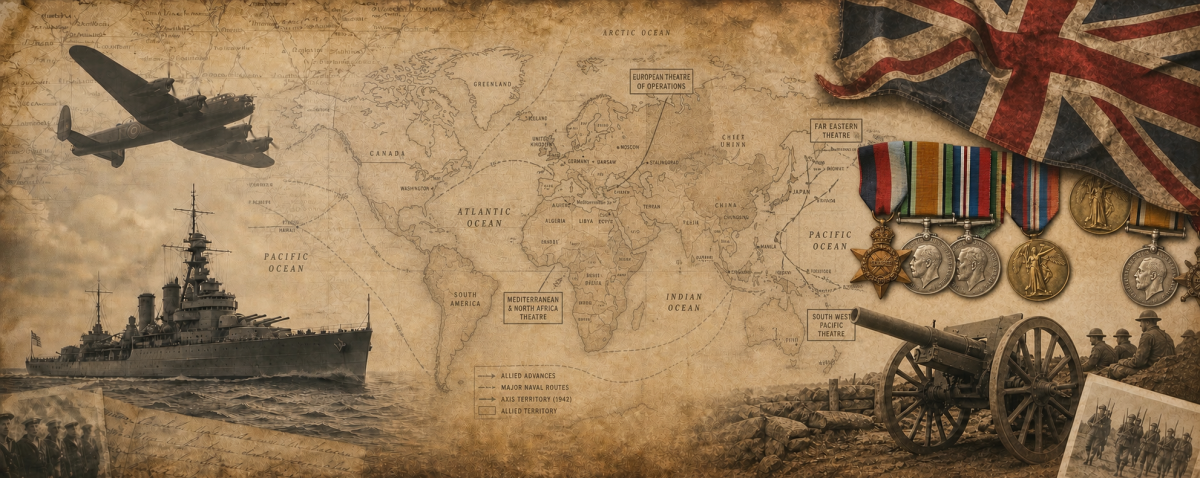

Frederick William Bowlt: A Detailed Biography
Early Life and Family
Frederick William Bowlt was born on 30 June 1898 in Dover, Kent, England, his birth registered in the Dover registration district (volume 2A, page 1035, line 127). [1] He was baptised on 16 July 1898 at St Andrew’s Church, Buckland, Dover, the son of Frederick William Bowlt and Olive Louisa Aldridge. [1] As a boy he lived in York Place, Chapel Hill, Dover, where his parents maintained a stable home throughout the 1901–1911 period; by 1911 he was recorded as a scholar (schoolboy) resident at 7 York Place. [1] The Bowlt family were established Dover residents, their address shifting to 17 Union Row by 1918, suggesting gradual movement within the garrison town.
Frederick came of age in the shadow of the First World War. His relationship to the Behan family—John Joseph Behan married Maria Elizabeth Bowlt in 1912—placed him within a circle of military and seafaring connections across Dover’s working and professional classes. [1] Unmarried and without children, Frederick embodied the cohort of young men who enlisted in the Royal Navy as the war progressed, stepping forward at an age when he was little more than a teenager.
Military and Naval Service
Frederick William Bowlt enlisted in the Royal Navy between 8 January 1914 and 23 April 1918, though the exact date of entry is not specified in the record. [1] He served as an Able Seaman, bearing the naval service number J/29331. [1] His posting included service aboard three vessels: HMS Collingwood (which fought at the Battle of Jutland in 1916), HMS Hindustan, and most notably HMS Vindictive. [1] His designation as part of a “Seamen Storming Party” indicates he was trained as an assault specialist, a role requiring both physical courage and close-quarters combat training for the amphibious operations that became the hallmark of advanced naval tactics in the final years of the war. [1]
HMS Vindictive was an obsolete Arrogant-class protected cruiser, built at Chatham Dockyard and launched in 1897. [2] By 1918 she had been converted specifically for the daring Zeebrugge and Ostend raids, fitted with supplementary armament including howitzers, Stokes mortars, and Lewis guns to provide fire support for the marines and sailors tasked with storming the enemy mole. [2] As an Able Seaman in the seamen storming party, Frederick would have trained intensively with his shipmates, understanding that the mission—to block the German-held Belgian port and disrupt U-boat operations—would demand extreme sacrifice. [1][3]
The Zeebrugge Raid: 23 April 1918
On 22–23 April 1918, St George’s Day, the raid was launched. The operation was conceived to block the Belgian port of Bruges-Zeebrugge and the parallel attempt on Ostend, thereby denying the Imperial German Navy access to ports used as bases for U-boats and light forces that threatened Allied shipping. [4] Frederick and his shipmates embarked aboard HMS Vindictive on the afternoon of 22 April as the flotilla assembled for the assault. The plan was to land storming parties of Royal Marines and naval ratings on the long concrete mole that protected the harbour entrance, destroy German gun positions, and enable three blockships to be sunk in the canal to prevent further German operations. [3][4]
The raid itself was a triumph of courage but at terrible cost. As the flotilla approached just after 11 p.m., the wind shifted without warning, dispersing the protective smokescreen and revealing HMS Vindictive to German gunners on the mole at point-blank range—only a few hundred metres distant. [5][4] The German heavy guns opened fire and, despite Vindictive’s return fire, several of her guns were knocked out and the ship was heavily damaged. One contemporary account described the scene: a terrific report and crash as shell fragments fell among the crowded men, “killing and maiming the brave fellows as they stood to their arms, crowded together as thick as bees.” [6] The assault parties of marines and ratings suffered catastrophic casualties as they came under massed fire. [3]
Estimates vary, but broadly consistent sources record that of the 1,700 men engaged in the Zeebrugge and Ostend operations combined, approximately 227 were killed and 356 wounded—a casualty rate of over 30 per cent. [4][7] The Royal Marines bore the heaviest losses, with the 4th Battalion Royal Marine Light Infantry suffering 119 dead from a force of 730 men (casualty rate of 50 per cent). [6] Frederick William Bowlt, an Able Seaman of HMS Vindictive, was among those killed on 23 April 1918 during the operations against Zeebrugge. [1]
Burial and Commemoration
Frederick’s body was returned to his native Dover and buried after 23 April 1918 in St James Cemetery, Copt Hill, Dover, Kent, in plot P.W. 12a. [1] The Zeebrugge plot of St James’s Cemetery contains nine unidentified men and fifty named servicemen who died on 23 April 1918, and most of the dead from the raid were returned to their families for local burial rather than interred in continental cemeteries—a reflection of the importance of family connection and the scale of losses in a single day. [4]
His medal entitlements, issued posthumously to his father William Bowlt, comprised the 1914/15 Star, the British War Medal, the Victory Medal, and the Memorial Death Plaque (officially issued in accordance with Royal Navy casualty number 857/1918 and record number 5515/18). [1] The Commonwealth War Graves Commission holds his record as casualty number 365453, accessible through the CWGC database at https://www.cwgc.org/find-war-dead/casualty/365453/bowlt,-frederick-william/. [1][3] A parallel memorial entry exists on Find a Grave (Memorial ID 24364980), preserving his name in digital remembrance. [1]
Legacy and Significance
Frederick William Bowlt died just four days short of what would have been the final German offensive of the war, the Spring Offensive launched on 21 March 1918. His sacrifice, and that of the Zeebrugge raiders as a whole, has become emblematic of the Royal Navy’s daring in the closing phase of the First World War. The Zeebrugge Raid, though costly and only partially successful in its immediate strategic objective (the blockships did partially obstruct the harbour), achieved its broader goal of disrupting German operations and provided a morale boost to the British nation at one of the war’s most critical moments. [8][4] The raid is now regarded as a precursor to the amphibious assault tactics that would define the Second World War. [6]
Frederick’s sister Maria Elizabeth Bowlt married Corporal John Joseph Behan of the Royal Irish Rifles (also killed on active service, four days earlier on 23 April 1916). [1] Two young men from the same Dover family circle, both killed on the same calendar date two years apart—a poignant coincidence of loss. Frederick’s memory endures in official records, cemetery registers, and digital platforms that honour the dead of the Great War.
Key links:
- Commonwealth War Graves Commission casualty record
- Find a Grave memorial (Memorial ID 24364980)
- Wikipedia article on the Zeebrugge Raid
- Royal Navy Heritage on the Zeebrugge Raid
Sources
[1] Individual-Report-for-Frederick-William-Bowlt.pdf
[2] HMS Vindictive (1897) – Wikipedia https://en.wikipedia.org/wiki/HMS_Vindictive_(1897)
[3] The Zeebrugge Raid – Royal Marines Heritage Trails – Deal & Walmer https://royalmarinesheritagetrails.org/the-zeebrugge-raid/
[4] Zeebrugge Raid – Wikipedia https://en.wikipedia.org/wiki/Zeebrugge_Raid
[5] The Zeebrugge Operation – War History https://warhistory.org/@msw/article/the-zeebrugge-operation
[6] Private Alfred Berry and the Zeebrugge Raid 1918 https://www.westernfrontassociation.com/world-war-i-articles/private-alfred-berry-and-the-zeebrugge-raid-1918/
[7] Background https://kiwix.hampton.id.au/content/wikipedia_en_all_maxi_2025-08/Zeebrugge_Raid
[8] Second Ostend Raid https://en.wikipedia.org/wiki/Second_Ostend_Raid
[9] Private Alfred Berry and the Zeebrugge Raid https://www.westernfrontassociation.com/world-war-i-articles/2022/may/private-alfred-berry-and-the-zeebrugge-raid/
[10] Vindictive alongside the Mole, Zeebrugge, 23 April 1918 https://www.rmg.co.uk/collections/objects/rmgc-object-204089
[11] On 23 April 1918, the raid on the German naval base at Zeebrugge … https://www.facebook.com/NatMuseumRN/posts/on-23-april-1918-the-raid-on-the-german-naval-base-at-zeebrugge-took-place-this-/2966720816686270/
Discover more from Mike's Cousins
Subscribe to get the latest posts sent to your email.