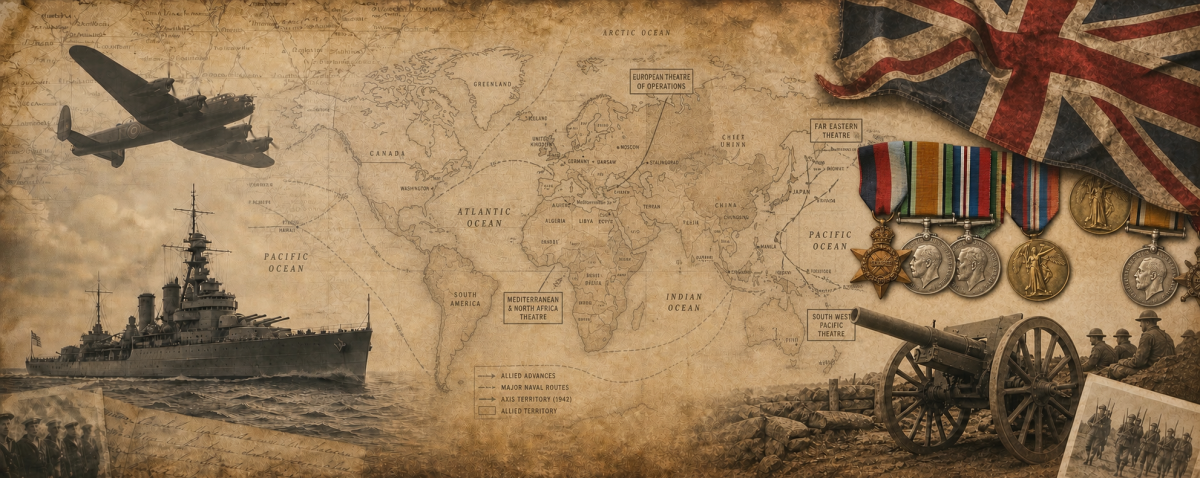

Leonard Frank Gale: A Detailed Biography
Leonard Frank Gale was born on 28 September 1892 in Dorking, Surrey, England, to parents George and Annie Gale.[1] The 1901 England Census records him residing in Dorking at age eight, listed as the son in the household.[1] Little is documented about his early education or childhood pursuits, though as a labourer prior to naval enlistment, he likely contributed to local work in the Surrey market town known for its rural economy and leather trade.[2]
Growing up in Dorking, a picturesque Surrey town nestled in the North Downs, Leonard would have experienced a quintessentially English childhood amid rolling hills and market traditions.[1] By 1910, at eighteen years old, he sought opportunity beyond local labouring, enlisting in the Royal Navy on his birthday in Portsmouth for a twelve-year term as Boy 1st Class, service number J/8830 (Po).[1][2] His physical description noted brown hair, blue eyes, and a fresh complexion, traits befitting a young seafarer embarking on rigorous training.[2] Family Tree Maker records and Ancestry sources confirm his birth registration in Volume 2A, Page 148, underscoring his roots in a modest working-class family.[1]
Early Life and Family
Leonard Frank Gale entered the world on 28 September 1892 in Dorking, Surrey, a historic market town celebrated for its annual livestock fairs and leather industry since medieval times.[1] Christened to George and Annie Gale, he grew up in a household shaped by Victorian working-class values, where the 1901 Census captures him at age eight residing as “Son” in Dorking, amidst Surrey’s verdant landscapes.[1] Though specific schooling records elude direct mention, boys of his station often attended local board schools, learning basic literacy and arithmetic before apprenticeships; Leonard’s pre-enlistment role as a labourer suggests practical toil in fields or tanneries, common for Dorking youth.[2][1]
Dorking’s community, with its tight-knit parishes and seasonal fairs, likely fostered Leonard’s resilience, preparing him for naval discipline. By adolescence, economic pressures in rural Surrey propelled many young men seaward, and on his eighteenth birthday in 1910, Leonard enlisted in Portsmouth, committing to twelve years’ service as Boy 1st Class, J/8830 (Po).[1][2] His fresh complexion, blue eyes, and brown hair, 5 feet 6 inches in height, marked him as a sturdy recruit, ready for the rigours of HMS Ganges II initial training.[1] Personal ties remained strong; years later, CWGC notes affirm George and Annie as parents “of Dorking,” while his brief marriage in June 1918 to Nellie Rosina Culmer (née Dicks – her previous husband, Samuel Dresser Dicks being killed at Jutland on 31 May 1916) in Dover produced son Frank Ernest Gale, born posthumously on 28 August 1919—ensuring family continuity amid tragedy.[1][2]
This union, registered in Volume 2A, Page 239, reflected wartime haste, with Nellie residing at 13 De Burgh Street, Dover, by 1919—a modest terraced home typical of naval families near Kent ports.[1] Leonard’s role as husband and impending father intertwined personal milestones with duty, embodying the sacrifices of Great War sailors whose domestic lives were upended by service.[1]
Military Service
Leonard enlisted on 7 June 1910 (or precisely his birthday, per local accounts), serving until his death, amassing over eight years in the Royal Navy.[1][2] As Able Seaman J/8830, he progressed through HMS Ganges II for boy training, HMS Dolphin submarine base, and depot ship HMS Lucia, ultimately assigned to HM Submarine L11—an L-class vessel commissioned in 1916 as a minelayer for coastal patrols and North Sea operations.[1][3][4] Royal Navy Registers confirm his service record in ADM 188 Piece 664, highlighting endurance through the Battle of Jutland 1916 where L11 crew lists note his presence amid the war’s pivotal naval clash.[1]
HM Submarine L11, one of five L-class minelayers, patrolled relentlessly from 1917, laying mines off enemy coasts while evading U-boats in hazardous waters.[3] Leonard’s attachments included Ganges II for initial drills and Lucia as tender, supporting submarine flotillas post-Armistice when L11 shifted from Berehaven to Portland, preparing for US transit.[1][5] No major casualties marred L11’s wartime record; instead, post-1918 operations involved routine maintenance in British docks, qualifying Leonard for Victory Medal, British War Medal, and Memorial Death Plaque—honours for sailors lost to non-combat causes.[1] His pension ledger (Western Front Association reference 075/0346/GAL-GAL) attests to verified service, while Jutland crew lists cement his role in the Grand Fleet’s fateful encounter.[1]
Submarine life demanded unparalleled skill; L11’s minelaying runs exposed crews to depth-charge hunts and poor visibility, yet Leonard survived the war’s fury, only to face peacetime perils. Dover Express and naval histories portray a sailor of steadfast character, transitioning from boy to able seaman amid technological leaps in underwater warfare.[1][6]
Circumstances of Death
On 1 January 1919, mere weeks after Armistice, Able Seaman Gale fell accidentally overboard from HM Submarine L11 into a dry dock, fracturing his skull in the mishap.[1][2][6] L11, then at a British dockyard—likely near Middlesbrough or Dover for post-war refit—underwent maintenance; naval records specify “killed or died by means other than disease, accident or enemy action – at sea,” though accounts clarify a dockside fall.[1][4] He lingered two days, succumbing on 3 January 1919 at Cleveland House Navy Hospital, Grangetown, aged 26.[2][1]
No enemy action precipitated this tragedy; January 1919 saw Royal Navy submarines like L11 in demobilisation phase, with operations limited to patrols or transit preparations—no recorded casualties from combat that month.[7][6] Naval-history.net logs Gale among L11 losses that day, alongside unrelated incidents, underscoring peacetime hazards like slippery docks and heavy weather.[6][4] Dorking Museum details the accident’s stark simplicity: a fall during routine duties, far from battlefields, yet emblematic of naval risks persisting beyond 11 November 1918.[2] His death notice in Dover Express (1930 retrospective) and CWGC entry affirm non-combat status, with wife Nellie at 13 De Burgh Street receiving official notification.[1]
Burial and Commemoration
Leonard was buried shortly after 3 January 1919 in Charlton Cemetery, Dover, Kent—Section Y.S. 9, Plot 6569—near his Dover marital home.[1] The Commonwealth War Graves Commission records him as Able Seaman J/8830, Royal Navy, HM Submarine L11, with inscription: “Son of George and Annie Gale, of Dorking; husband of Nellie Rosina Gale, of 13, De Burgh St., Dover.”[https://www.cwgc.org/find-war-dead/casualty/365384/gale,-leonard-frank/][1] Find A Grave Memorial ID 24364859 preserves his plot, accessible to descendants.[https://www.findagrave.com/memorial/24364859][1]
Commemoration extends via Memorial Death Plaque, issued to families of naval dead, alongside his Victory and British War Medals.[1] British Armed Forces and Overseas Deaths register confirms burial details, while submarinefamily.uk lists him among L11 honoured dead.[4] Locally, Dorking Museum profiles him as a “Dorking Sailor,” linking to Dover War Memorial Project for accident context.[2] Ancestry’s UK Royal Navy War Graves Roll (ADM 242/8) ensures his sacrifice endures in genealogical archives.[1]
Legacy
Leonard Frank Gale’s untimely death at 26 left Nellie widowed with infant Frank Ernest, born seven months later on 28 August 1919 in Dover— a son who never knew his father’s embrace yet carried the Gale name forward.[2][1] As husband of a second cousin twice removed to researcher Mike, Leonard bridges family histories, his story unearthed via Family Tree Maker 2024, Ancestry.co.uk, and CWGC—tools vital for preserving such narratives.[1] His medals, pension records, and Jutland listing affirm a life of duty, outlasting the guns of August 1914.
In broader terms, Gale exemplifies the 1919 “silent casualties”—over 1,000 Royal Navy deaths post-Armistice from accidents, illness, and minesweeping, often overlooked amid victory parades.[6] Dorking’s remembrance, via museum exhibits and Surrey war memorials, honours locals like him, while ForcesWarRecords and Newspapers.com (Dover Express) contextualise submarine perils.[2][1] Today, descendants access his service via Jutland Crew Lists, ensuring Able Seaman Gale’s resilience inspires amid Remembrance Day silences.[1]
His legacy cautions against war’s long shadow: L11 continued service into the 1930s, but Leonard’s dockside fall reminds that peace harbours hazards.[3][4] Through genealogical platforms like Ancestry’s 1901 Census and pension ledgers, his Dorking roots and naval valour remain vivid, a testament to ordinary men’s extraordinary commitments.[1]
Sources
[1] Individual-Report-for-Leonard-Frank-Gale.pdf
[2] Leonard Frank Gale. Dorking Sailor. WW1 – Dorking Museum https://dorkingmuseum.org.uk/able-seaman-leonard-frank-gale/
[3] HMS L11 – Wikipedia https://en.wikipedia.org/wiki/HMS_L11
[4] HMS L11 – The Submarine Family https://submarinefamily.uk/submarines/hms-l11/
[5] L-11 (Submarine No. 51) – Naval History and Heritage Command https://www.history.navy.mil/research/histories/ship-histories/danfs/l/l-11.html
[6] Iolaire, Admiralty yacht, killed and died, other RN casualties, Jan … https://www.naval-history.net/xDKCas1919a.htm
[7] Caspian Sea and other Royal Navy killed and died, Jan-June 1919 https://www.naval-history.net/xDKCas1919aa.htm
[8] Royal Navy, HM Submarine E11 – First World War Casualties https://astreetnearyou.org/regiment/9720/Royal-Navy,-HM-Submarine-E11
[9] Losses – RN Subs http://rnsubs.co.uk/boats/losses.html
[10] American Ship Casualties of the World War https://www.history.navy.mil/research/library/online-reading-room/title-list-alphabetically/a/american-ship-casualties-world-war.html
[11] H-11 – Scottish Shipwrecks https://www.scottishshipwrecks.com/9321-2/
[12] 9th LCT Flotilla – A Tragedy at Sea – Combined Operations https://www.combinedops.com/9th%20LCT%20Flotilla.htm
[13] The ‘Battle’ of May Island January 1917 and K-Class Submarines of … https://www.westernfrontassociation.com/world-war-i-articles/the-battle-of-may-island-january-1917-and-k-class-submarines-of-the-first-world-war/
[14] USS L-11 (Submarine # 51) | laststandonzombieisland https://laststandonzombieisland.com/tag/uss-l-11-submarine-51/
[15] Stoker 1st Class Cecil Leonard Frank Gale (1923-1943) – Find a … https://www.findagrave.com/memorial/56693691/cecil-leonard_frank-gale
[16] RCN and RNCVR CASUALITES – FIRST WORLD WAR https://www.forposterityssake.ca/RCN-CASUALTIES-FWW.htm
[17] Royal Navy Organisation and Ship Deployment, Inter-War Years … https://naval-history.net/xGW-RNOrganisation1919-39.htm
[18] Search for “Gale,” in lastname | Lives of the First World War https://livesofthefirstworldwar.iwm.org.uk/searchlives/field/lastname/Gale,/filter/span%5B
[19] Lieutenant-Commander Martin Nasmith VC and HM Submarine E11 https://warandsecurity.com/2015/06/25/lieutenant-commander-martin-nasmith-vc-and-hm-submarine-e11/
[20] Royal Navy – Page 375 – The Submarine Family https://submarinefamily.uk/service/royal-navy/page/375/
[21] L class submersibles (1917) – Naval Encyclopedia https://naval-encyclopedia.com/ww1/uk/l-class-submersibles.php
Discover more from Mike's Cousins
Subscribe to get the latest posts sent to your email.