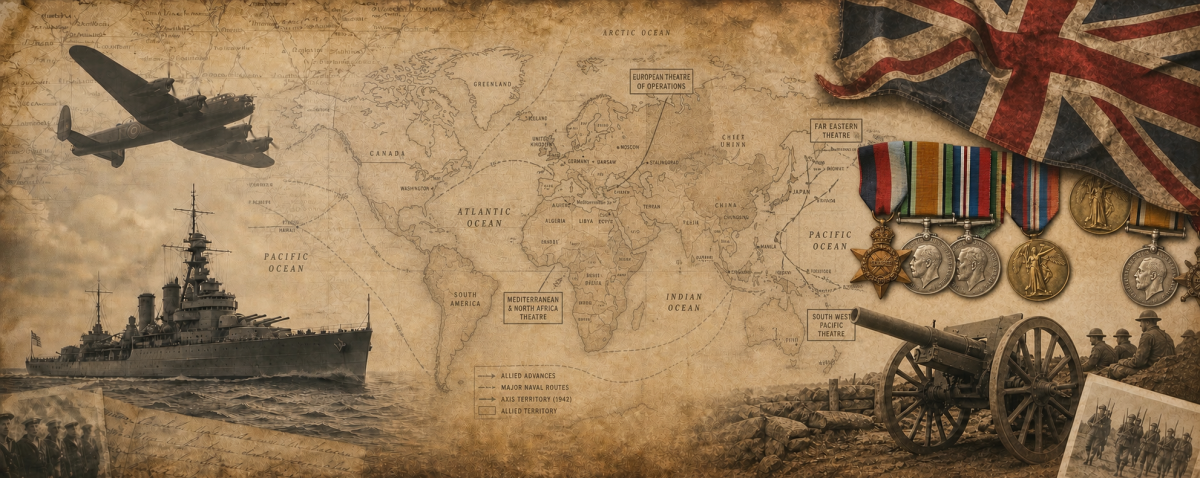

Philip George Swinerd: A Detailed Biography
Early Life and Family
Philip George Swinerd was born on 4 February 1919 in Dover, Kent, his birth registered in the March quarter of 1919 in the Dover registration district (volume 02A, page 1461) [1]. He was the son of John Swinerd and Louisa Emily, née Ballard, a Kentish family rooted in the port town of Dover [1]. Growing up between the wars, Philip belonged to the generation whose childhood was overshadowed by memories of the First World War and the economic and social upheavals of the 1920s and 1930s [1].
By June 1921 the family was living at 14 Chapel Hill, Dover, with Philip recorded as a two‑year‑old son in the household [1]. Chapel Hill lay in a historic part of Dover close to the town centre, in an area characterised by mixed residential streets reflecting the town’s long development as a garrison and port [1]. Residents of such addresses typically worked in local industries and services supporting the harbour, the garrison, and the town’s wider economy, suggesting that Philip’s early environment was shaped by both maritime and military influences [1].
The 1939 National Register shows Philip still living at 14 Chapel Hill on the eve of the Second World War, now a young man of twenty [1]. At this point his occupation was recorded as “Worker Heavy Underground Haulage”, indicating employment in physically demanding industrial work, perhaps associated with quarrying, tunnelling, or similar heavy industry in the region [1]. This background of hard manual labour would have given him the stamina and resilience that later proved vital during service with an infantry battalion in challenging overseas theatres [1].
Military Service
By 1945 Philip was serving as Private 6289205 in the 2nd Battalion, The Buffs (Royal East Kent Regiment), one of the county regiments with a long and distinguished history within the British Army [1][2]. His service medals—1939–45 Star, Africa Star, Burma Star, Defence Medal, and War Medal—show that he participated in campaigns across multiple theatres, including Africa and Burma, reflecting the wide deployment of The Buffs during the war [1]. The regiment’s battalions had already seen service in France in 1940 and in the Middle East and Western Desert before elements, including the 2nd Battalion, were redeployed to the Far East [1][2].
The 2nd Battalion, The Buffs, formed part of the 26th Indian Infantry Brigade, itself under the 36th Infantry Division during the Burma Campaign [1][3]. This division, composed of British and Indian units, played a key role in the Allied effort to drive Japanese forces out of northern and central Burma, operating in difficult jungle and river terrain [1][4]. In late 1944 and early 1945, the 2nd Battalion was heavily involved in operations along the Shweli River and around Myitson, where British and Indian troops forced crossings under fire and advanced through jungle country against strong opposition [1][5][6].
Newspaper extracts from the Thanet Advertiser and Dover Express describe how battalions of The Buffs, the 8th Punjab Regiment, and the 19th Hyderabad Regiment, all within the 36th Division, forced the crossing of the Shweli River in central Burma [1]. The reports emphasise that The Buffs made the initial attack before withdrawals and encircling moves by the Indian regiments, and that the combined force faced intense Japanese resistance including flamethrower attacks, with hundreds of enemy casualties in hand‑to‑hand fighting [1][5]. These accounts place Philip’s battalion in the forefront of the advance along the Shweli to Myitson, where they were among the first troops across the river [1][5][4].
Circumstances of Death
Philip George Swinerd was reported missing in Burma on 3 February 1945 and subsequently recorded as presumed killed in action on 1 February 1945 while serving with the 2nd Battalion, The Buffs [1]. Casualty lists for expeditionary forces in Burma confirm that Private 6289205 P. G. Swinerd, 2nd Battalion, The Buffs, previously listed as missing, was later reclassified as killed in action on that date [1]. The Commonwealth War Graves Commission records him as the son of John and Louisa Swinerd of Dover, Kent, reinforcing the link between the Dover family and the Burma casualty 1.
The timing of his death coincides with the period of intense fighting as 36th Division troops pushed along the Shweli River towards Myitson in early 1945 [1][5]. Film and photographic records from the Imperial War Museum show 2nd Battalion The Buffs crossing the Shweli under machine‑gun, mortar, and artillery fire in preparation for the assault on Myitson, highlighting the hazardous nature of these operations [5][6]. Given this context, it is likely that Philip fell either during the river‑crossing operations or in the associated advance and fighting in the jungle and riverine terrain of northern Burma, where casualties were heavy and the environment itself was unforgiving [1][3][4].
The Dover Express later confirmed that he was “killed in Burma” on 1 February 1945, reinforcing the official record and bringing news of his death to the local community [1]. His loss formed part of the wider human cost borne by The Buffs in Burma, where the battalion’s achievements in forcing river crossings and pushing the advance were later recognised in battle honours such as “Shweli” and “Myitson” [1][4]. For his family, the transition from “missing” to “presumed killed in action” would have been a prolonged and painful process, ending hopes of his return some months after the initial casualty notification [1].
Burial and Commemoration
Despite the circumstances of his death, Philip has no known grave, and instead is commemorated on the Rangoon Memorial in Myanmar, where his name appears on Face 4 [1]. This memorial honours more than 26,000 Commonwealth land forces who died during the Burma Campaign and have no known resting place, symbolising the difficult conditions and the frequent impossibility of battlefield recovery in jungle and mountain warfare [1][2]. His inclusion there places him among the many soldiers whose bodies were never formally identified but whose sacrifice is permanently recorded in stone.
The Commonwealth War Graves Commission entry provides key details of his identity, service number 6289205, rank of Private in the 2nd Battalion, The Buffs (Royal East Kent Regiment), and his parentage and home town of Dover [1]. A Find a Grave memorial (ID 17782453) also commemorates him, often including photographs and transcriptions that help family historians and researchers connect the official record with personal remembrance [1][3]. In addition, his FamilySearch ID, G3XB‑K3P, anchors him within an online family tree, ensuring that his life and service are accessible to future generations of relatives and genealogists [1].
Local newspapers kept his memory alive in the years immediately following the war. Notices in the Dover Express on 31 January 1947 and 6 February 1948 recorded loving tributes from his parents, brothers, sisters, and in‑laws, describing him as “our dear son and brother” and explicitly naming his service with the 2nd Battalion, The Buffs, and his death in Burma on 1 February 1945 [1]. These memorial notices show how his family continued to mark his anniversary, reflecting both their personal grief and their pride in his service.
Legacy
Philip George Swinerd’s legacy is that of a Kentish infantryman whose life traced a path from a modest home in Dover to some of the hardest‑fought campaigns of the Second World War [1]. His medals demonstrate service stretching from the early years of the conflict through campaigns in Africa and Burma, embodying the global nature of the war and the demands placed upon British infantry regiments like The Buffs [1][2]. As a worker in heavy underground haulage before enlistment, he brought to his battalion the toughness and determination forged in civilian labour, qualities that were essential in the gruelling conditions of jungle warfare [1][3].
Within regimental history, the 2nd Battalion, The Buffs, holds a distinguished place for its part in the crossing of the Shweli River and the advance on Myitson, operations later recognised in formal battle honours [1][4]. Photographic and film evidence of the battalion’s actions in northern Burma, preserved in collections such as the Imperial War Museum, allows modern audiences to visualise the environment in which men like Philip fought and died [5][6]. His death on the eve of his twenty‑sixth birthday adds a poignant note, reminding readers of the youth of many who fell in the later stages of the war [1].
For family historians and descendants, Philip’s story offers a powerful example of how civil records, military documentation, newspaper accounts, and war memorials can be brought together to reconstruct an individual life cut short by conflict [1]. His commemoration on the Rangoon Memorial and in local Dover newspapers ensures that his name endures both in the official record and in the collective memory of his home town [1][2]. Through ongoing research and remembrance, Philip George Swinerd continues to represent the sacrifice of The Buffs and of the many men from Kent who served and died in the “forgotten” Burma Campaign of the Second World War.
Sources
[1] Individual-Report-for-Philip-George-Swinerd.pdf
[2] Buffs (Royal East Kent Regiment) – Wikipedia https://en.wikipedia.org/wiki/Buffs_(Royal_East_Kent_Regiment)
[3] WW2 Roll of Honour – Leslie Frank Boorman of Teynham http://lynsted-society.co.uk/research_ww2_casualties_boorman_l_f.html
[4] [PDF] Frank Moth Service Number 6290307 B Company 2nd Battalion The … https://portal.sds.ox.ac.uk/ndownloader/files/46648405
[5] CROSSING THE SHWELI RIVER FOR ASSAULT ON MYITSON … https://www.iwm.org.uk/collections/item/object/1060036774
[6] ADVANCE ON MYITSON IN NORTHERN BURMA BY 2ND BUFFS … https://film.iwmcollections.org.uk/record/35079
[7] The 2nd Battalion of The Buffs, probably in Burma. – Dover – Facebook https://www.facebook.com/groups/DoverHistoryPages/posts/24597852623143462/
[8] The Queen’s Own Royal West Kent Regiment | National Army Museum https://www.nam.ac.uk/explore/queens-own-royal-west-kent-regiment
[9] Northern Burma, troops of 2nd Battalion The Buffs cross the Shweli … https://alanmalcher.com/2023/12/13/northern-burma-troops-of-2nd-battalion-the-buffs-cross-the-shweli-river-before-the-assault-on-myitson-with-machine-gun-mortar-and-artillery-fire-in-support-as-the-divisional-commander-watches/
[10] Nikka Whisky From the Barrel – 500ml https://sakelicious.com/nikka-whisky-from-the-barrel-500ml
[11] [PDF] Buffs (Royal East Kent Regiment) https://www.queensregimentalassociation.org/media/Buffs%20(Royal%20East%20Kent%20Regiment).pdf
[12] Info Please: Australian? in Allied Unit, James Ernest Kane, 321st … https://ww2talk.com/index.php?threads%2Finfo-please-australian-in-allied-unit-james-ernest-kane-321st-8th-batt-the-gordon-highlanders.34857%2F
[13] 5 buffs (royal east kent regiment) http://ww2talk.com/index.php?tags%2F5-buffs-royal-east-kent-regiment%2F
[14] Buffs (Royal East Kent Regiment) Facts for Kids https://kids.kiddle.co/Buffs_(Royal_East_Kent_Regiment)
[15] Service Availability https://archive.org/download/annualreportofbo1918smit/annualreportofbo1918smit.pdf
[16] [PDF] Historical Records of The Buffs 1919-1948 https://slaegtsbibliotek.dk/2025/947597.pdf
[17] Private Henry Tandey VC, DCM, MM awarded during the Great War. https://alanmalcher.com/2023/12/13/private-henry-tandey-vc-mm-dso-awarded-during-the-great-war/
[18] Buffs. https://ww2talk.com/index.php?threads%2Fbuffs.100865%2F
[19] Burma Conference | National Army Museum https://www.nam.ac.uk/whats-on/burma-conference
[20] Inventory Search https://collection.nam.ac.uk/inventory/objects/results.php?unit=buffs&page=52
[21] 2nd Burma Rifles https://indiaburmasoldiers.co.uk/2nd_burma_rifles_new.htm