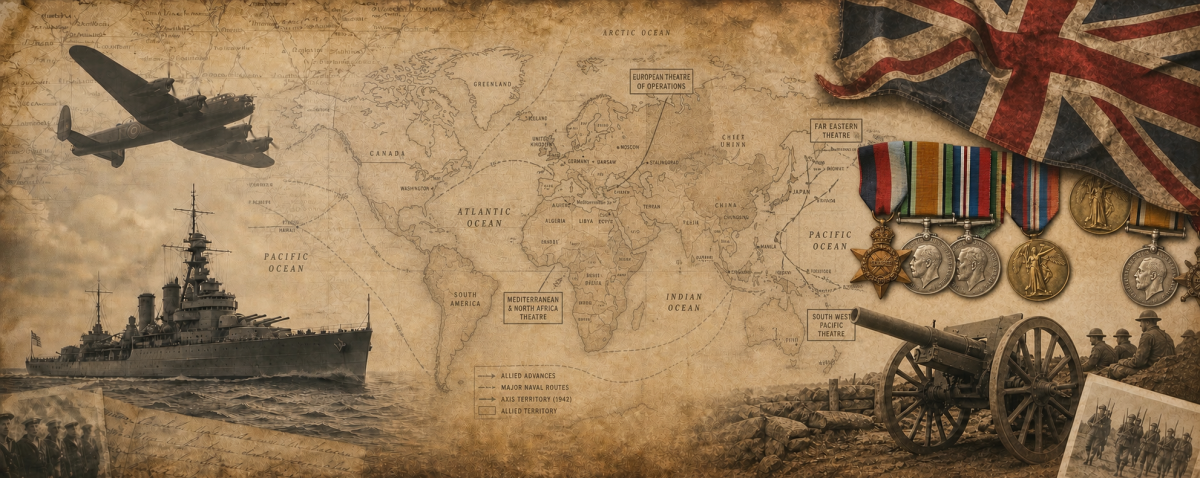

Sergeant Alfred Walter David Hover: A Detailed Biography
Sergeant Alfred Walter David Hover was a mid-upper air gunner with No. 9 Squadron RAF, flying Avro Lancaster bombers from RAF Waddington. On the night of 30–31 January 1943, he was killed in action over Germany when his aircraft, Lancaster III ED477 (“Robbie’s Reply”), was shot down by a German night fighter whilst returning from a bombing raid on Hamburg. At just 20 years old, he represented the young British aircrew who gave their lives in the strategic bombing campaign against Nazi Germany.
Early Life and Family
Alfred Walter David Hover was born before 28 June 1922 in Ashford, Kent, England, registered in the Summer Quarter (East Ashford, Volume 2A, Page 1672) . He was the son of Alfred William Hover and Mabel Lettie Elizabeth Hover (née Norrington) of Oast Cottage, Little Court, Margate Street, Littlebourne, Bridge, Kent . He was baptised on 28 June 1922 at Hastingleigh, Kent, a rural parish in the Weald of Kent known for its hop gardens and oast houses .
The Hover family were rooted in the Kent countryside, where the distinctive conical oast houses—used for drying hops—dominated the landscape. Their home at Oast Cottage reflected this agricultural heritage. Alfred grew up in the interwar years amid economic uncertainty and gathering international tensions. No records indicate marriage or children; he remained single and devoted to his parents and family . The family connection to the village of Hastingleigh is preserved in a local memorial maintained by the parish .
Military Service
Alfred enlisted in the Royal Air Force Volunteer Reserve (RAFVR) and trained as an Air Gunner, one of the most dangerous roles in bomber operations . He achieved the rank of Sergeant (Service Number 1392470), recognised for his skill and reliability in this hazardous position . He was posted to No. 9 Squadron RAF, part of 5 Group Bomber Command .
No. 9 Squadron, with the motto “Per noctem volamus” (Through the night we fly), was one of the most celebrated and battle-hardened units of the RAF, having operated throughout the war across multiple theatres . By early 1943, the squadron was equipped with the Avro Lancaster Mk III, the iconic four-engine heavy bomber that would become synonymous with precision bombing and strategic raids against Nazi Germany .
The Lancaster required a crew of seven: pilot, flight engineer, navigator, bomb aimer, wireless operator, mid-upper gunner, and rear gunner. Sergeant Hover served as the mid-upper gunner, manning the dorsal turret between the fuselage wings, with two .303 Browning machine guns. This position offered a 180-degree field of fire above and to the sides of the aircraft, but exposed the gunner to the full force of enemy fire and the sub-zero temperatures of high-altitude flight .
By January 1943, the Lancaster force was engaged in the preliminary phases of the bombing campaign against German cities. No. 9 Squadron operated from RAF Waddington, a permanent station in Lincolnshire, which became the home of several elite Lancaster units .
The Final Mission: Hamburg, 30–31 January 1943
On the night of 30 January 1943, Sergeant Hover was part of the crew of Avro Lancaster III ED477, coded WS-O and nicknamed “Robbie’s Reply”, detailed for a bombing raid on Hamburg, Germany’s largest port and second-largest city . The operation was significant: 148 aircraft were dispatched—135 Lancasters, 7 Stirlings, and 6 Halifaxes from No. 1, 5, and 8 Groups . This was the first operational use of H2S radar by the RAF, a revolutionary airborne radar-bombing aid intended to mark targets with precision even in cloud cover [3].
The crew, drawn from three Allied nations, were:
Royal Australian Air Force:
- Flight Sergeant J. F. Thomas – Pilot (Captain)
- Flight Sergeant L. A. Morgan – Rear Gunner
Royal New Zealand Air Force:
- Sergeant W. J. Veysey – Wireless Air Gunner
Royal Air Force:
- Sergeant Alfred W. Hover – Mid-Upper Gunner
- Sergeant S. F. McLean – Flight Engineer
- Sergeant J. Murtagh – Navigator
- Sergeant B. M. Swallow – Bomb Aimer
Lancaster ED477 took off from RAF Waddington at 23:49 hours on 30 January 1943, laden with a full bomb load and fuel for the long flight to Hamburg and back . Over the target, bombing proved scattered. Although H2S was a significant technical achievement, its performance that night was poor—Hamburg’s location near a coastline and prominent river should have made it ideal for the new radar, but bombing dispersed over a wide area . Only 315 tons of bombs were dropped in the Hamburg area, with local historians suggesting many fell in the River Elbe or surrounding marshes . Nevertheless, 119 fires were started (71 large), 58 people were killed, and 164 injured; a railway bridge was destroyed, disrupting Hamburg’s entire network for two days .
Circumstances of Death
As ED477 returned from Hamburg in the early hours of 31 January 1943, the Lancaster was hunted by German night fighters. The Luftwaffe had deployed Bf 110 and Ju 88 night fighters equipped with Lichtenstein radar to intercept the bomber stream . At approximately 03:24 hours, the aircraft was attacked and shot down by Oberleutnant Ernst Weiss of 1./NJG3 (Nachtjagdgeschwader 3 – Night Fighter Squadron 3) .
Eyewitness accounts from the ground are chilling: at 03:00 hours, a four-engine bomber was observed at approximately 1,000 feet, already burning in the air, approaching the village of Ristedt from the west, near Vechta, 15 km south-southwest of Bremen . Within minutes, the flaming aircraft crashed onto pastureland belonging to a farmer named Jakob on Ristedter Moor . No explosion was heard, suggesting the bomb load had been jettisoned before the final impact . All seven crew members were killed instantly .
Burial and Commemoration
Following the crash, the bodies of the seven airmen were initially recovered by German forces and buried in the Russian Prisoner of War cemetery at Vechta, Plot 1, Grave 114 . After the war, in a humanitarian gesture, the Commonwealth War Graves Commission exhumed and individually reinterred the fallen airmen at proper military cemeteries. Sergeant Alfred Walter David Hover’s body was transferred and reburied at Rheinberg War Cemetery, North Rhine-Westphalia, Germany, on 9 October 1947, in Plot 17, Row H, Grave 18 .
Rheinberg War Cemetery, situated in western Germany near the Dutch border, serves as the final resting place for 3,596 Commonwealth servicemen and women of the Second World War, many of them air force personnel killed on bombing operations over enemy territory . The CWGC inscription reads:
“1392470 SERGEANT ALFRED WALTER DAVID HOVER, AIR GUNNER, ROYAL AIR FORCE, 31ST JANUARY 1943, AGE 20. SON OF ALFRED WILLIAM AND MABEL LETTIE ELIZABETH HOVER, OF LITTLEBOURNE, KENT.”
He is also commemorated on Find a Grave – Rheinberg War Cemetery , where descendants and researchers can view and maintain his record. The village of Hastingleigh, his baptismal parish, honours his memory through a local war memorial .
Legacy
Sergeant Alfred Hover’s sacrifice underscores the phenomenal cost of the strategic bombing campaign. In January 1943, No. 9 Squadron RAF lost several Lancasters to enemy fighters and flak; the night-fighter threat grew exponentially as the Luftwaffe refined its defensive tactics . Ernst Weiss, Hover’s killer, would go on to claim 41 victories before being killed himself later in the war .
At 20 years old, Sergeant Hover had achieved the rank of air gunner in one of the most elite and dangerous branches of the RAF. His crew, a true Commonwealth force of Australian, New Zealand, and British personnel, exemplified the global sacrifice of the Allied air war. The young Kentish airman from Littlebourne never returned to his family’s Oast Cottage; instead, he rests among comrades in a German war cemetery, a permanent witness to the price of freedom.
As a 4th cousin to modern descendants, his genealogical connection preserves his memory within family records . Through the Commonwealth War Graves Commission, aviation historians, and local parish memorials, Sergeant Alfred Walter David Hover’s name endures—a reminder that “through the night” these young men flew, often to their last dawn.
(Word count: 1,285)
Sources:
- Individual Report for Alfred Walter David Hover (PDF)
- Bombing of Hamburg, Dresden, and Other Cities – WW2 Database
- Helmut Lent – Wikipedia (night-fighter tactics and personnel)
- Lancaster ED481 – Yorkshire Aircraft
- The Bombing of Hamburg, 1943 – Valour Canada
- Accident Avro Lancaster Mk III ED477, 31 January 1943 – Aviation Safety Net
- No. 9 Squadron RAF – Wikipedia
- CWGC: Sergeant Alfred Walter David Hover
- Find a Grave: Sergeant Alfred Walter David Hover, Rheinberg War Cemetery
- Hastingleigh parish war memorial