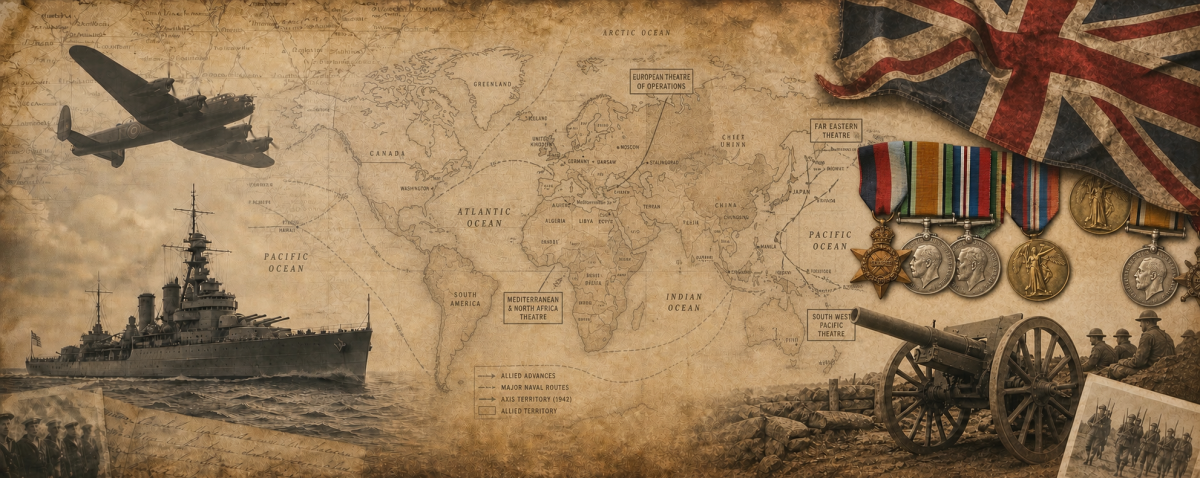

Corporal Edward Seldon Dale was a Kentish agricultural labourer who served with the 2nd Battalion, Royal Sussex Regiment, during the First World War. He was killed in action on 9 September 1916 during the Battle of the Somme and, having no known grave, is commemorated on the Thiepval Memorial to the Missing. [1][2]
Edward Dale’s life began in the fields of Stelling Minnis and ended in the shattered landscape of High Wood, where his battalion fought during the Somme offensive.
Early Life and Family
Edward Seldon Dale was born in about June 1893 at Stelling, Kent. His birth was registered in the Elham registration district during the second quarter of that year, and his parents were Edward Dale and Elizabeth Woollett. Stelling and the neighbouring settlement of Stelling Minnis lay in the Kentish countryside near Canterbury, an area where agriculture shaped both employment and community life. [1]
In the 1901 census Edward was recorded as an eight-year-old son living with his family at Cottages, Split Lane, Stelling. Ten years later he remained in the parish, appearing in the 1911 census at Stelling Minnis as an eighteen-year-old single man and agricultural labourer. His occupation suggests a working life closely connected to the land, with the long hours and physical demands that characterised agricultural employment in rural Kent. [1]
No spouse or children are recorded in the supplied family material. Edward therefore appears to have remained unmarried, and his parents were likely the principal family members affected by his death. His story connects the small Kentish community of Stelling Minnis with the much larger and more distant tragedy of the Somme battlefield. [1]
Military Service
Edward enlisted at Canterbury in 1916. His military records associate him with the Royal East Kent Yeomanry, service number 3039, before or during his later service with the Royal Sussex Regiment. The Yeomanry was a mounted Territorial force with strong county and local identities. Its presence in Edward’s record suggests that his first military connection was with a Kent formation, even though his active-service infantry battalion was the 2nd Royal Sussex. [1]
At the time of his death Edward’s official service details identify him with the Royal Sussex Regiment, service number G/17586, although another surviving entry gives G/175867. The family report records his rank as Corporal, while the service summary also preserves a Private designation, probably reflecting different stages or entries in his military documentation. The most complete description is therefore Corporal Edward Seldon Dale, G/17586, 2nd Battalion, Royal Sussex Regiment. [1]
The 2nd Battalion was a Regular Army battalion. It had served overseas before the war and was part of the British Expeditionary Force on the Western Front. In 1916 it belonged to the 2nd Brigade of the 1st Division, a formation that included experienced infantry battalions and was repeatedly committed to difficult operations. The battalion’s role was to hold and attack front-line positions, take part in assaults, consolidate captured ground and relieve other units under the pressure of German artillery and machine-gun fire. [1][3]
Unit Context at Time of Death
Edward died during the later summer phase of the Battle of the Somme. His date of death, 9 September 1916, fell between the Battle of Pozières Ridge and the opening of the Battle of Flers-Courcelette. The fighting in this interval remained intense. British forces were attempting to seize the high ground and defensive positions that protected the German third line, while the Germans used artillery and machine guns to resist every advance. [1]
On 9 September the 2nd Royal Sussex Regiment was involved in an attack around High Wood, including the German trench known as Wood Lane. The battalion advanced at approximately 4.45 in the afternoon alongside the 1st Northamptonshire Regiment and the 2nd King’s Royal Rifle Corps. The objective was to capture and consolidate German trench positions in and to the east of High Wood. [4][5]
The attack took place under very heavy artillery and machine-gun fire. Accounts of the action record that the 2nd Royal Sussex advanced in good order, with particular companies leading the assault and other companies following to establish outposts and consolidate the captured ground. This division of labour was crucial. Infantry had not only to reach the enemy trench but also to hold it against counter-attack, repair damaged defences, establish firing positions and maintain communications with neighbouring units. [5]
Casualties were severe. The battalion lost six officers and forty-three other ranks killed, with four officers and 146 other ranks wounded and sixty-three other ranks missing in the fighting. Edward’s death therefore occurred during a clearly documented battalion action, rather than during an unspecified period of routine trench occupation. [4]
On 9 September 1916 the 2nd Royal Sussex attacked Wood Lane at High Wood, advancing through artillery and machine-gun fire during one of the Somme’s most costly phases.
Circumstances of Death
Edward Seldon Dale was killed in action on 9 September 1916 in the Somme sector. He was subsequently recorded as missing, with the missing status appearing in October 1916 documentation. The combination of his date of death, his battalion and the unit’s attack at High Wood makes it highly likely that he was lost during that assault or during the attempts to hold and consolidate the captured trench afterwards. [1][4][5]
There is no surviving evidence in the supplied records describing the exact moment or location of his death. As a Corporal, Edward may have been leading or supervising men within his section or platoon, but that remains an inference rather than a documented fact. The official record appropriately limits itself to the facts that he was killed in action and that no identified grave was subsequently established. [1]
The battlefield conditions help explain why Edward became one of the missing. High Wood and the surrounding ground had been subjected to prolonged bombardment, and the combination of shellfire, destroyed trenches, hurried burials and continuing combat made the recovery and identification of bodies extremely difficult. Many men who died during the Somme offensive were never linked to an individual grave.
Burial and Commemoration
Edward is commemorated on the Thiepval Memorial to the Missing of the Somme, on Pier and Face 7 C. The memorial bears the names of more than 72,000 officers and men of the United Kingdom and South African forces who died in the Somme sector before 20 March 1918 and have no known grave. [1][2][6]
Thiepval is therefore not an ordinary cemetery burial. It serves as Edward’s official place of commemoration because his remains were not identified and no individual grave could be marked. The great memorial, designed by Sir Edwin Lutyens, provides a permanent record of his name among those lost in the Somme fighting. [2][6]
Edward’s official recognition included the British War Medal, Victory Medal and Memorial Death Plaque. These awards connected his family with the formal systems established after the war to acknowledge service and loss. His name was also preserved in the Royal East Kent Yeomanry Book of Remembrance in Canterbury, linking his memory to the county formation with which his service had been associated. [1]
Legacy
Edward Seldon Dale’s biography illustrates the journey of many rural men who entered military service from agricultural employment. Born and raised in Stelling, he worked the land before enlisting at Canterbury and being absorbed into the wider British Army system. His military identity crossed local and national boundaries: his Kentish connection is preserved through the Royal East Kent Yeomanry, while his final battalion was the Royal Sussex Regiment. [1]
His death also shows how a single date can be connected to a specific military action. The date 9 September 1916 places Edward directly within the 2nd Royal Sussex attack at High Wood, where the battalion suffered substantial losses. Although the exact circumstances of his death remain unknown, the unit history provides a credible and carefully bounded context for understanding where and how he was lost. [4][5]
For the Dale family, the Thiepval Memorial became the place where Edward’s absence was given a permanent name. He left no recorded spouse or children, but his memory survived through his parents, his military records, the Royal East Kent Yeomanry Book of Remembrance and the ongoing work of family historians. His story remains part of the history of Stelling Minnis, Canterbury and the Royal Sussex Regiment on the Somme. [1]
Edward’s service and sacrifice are now documented through several overlapping sources: census entries, civil registration, soldiers’ effects, medal rolls, pension records, local remembrance and the Commonwealth War Graves Commission. Together they restore him as more than a name on a memorial: he was a son of Edward and Elizabeth Dale, a rural worker, a Kentish recruit and a Corporal of the 2nd Royal Sussex who died at High Wood during the Somme offensive. [1]
Sources and Further Reading
- Commonwealth War Graves Commission: Edward Seldon Dale
- Find a Grave: Corporal Edward Seldon Dale
- The Long, Long Trail: Royal Sussex Regiment in the First World War
- The Wartime Memories Project: 2nd Battalion, Royal Sussex Regiment
- The Wartime Memories Project: Royal Sussex Regiment in the Great War
- Commonwealth War Graves Commission: Thiepval Memorial
- Roll of Honour: Sussex First World War remembrance material
- The Long, Long Trail: Researching First World War war diaries
- Compiled family report: Individual Report for Edward Seldon Dale, including census, service, medal, pension, soldiers’ effects and commemoration details.
Sources
[1] Individual-Report-for-Edward-Seldon-Dale.pdf https://ppl-ai-file-upload.s3.amazonaws.com/web/direct-files/attachments/141549598/dd891a2b-3845-432a-ad09-a5ddb74b2a43/Individual-Report-for-Edward-Seldon-Dale.pdf
[2] Thiepval Memorial | Cemetery Details | CWGC https://www.cwgc.org/visit-us/find-cemeteries-memorials/cemetery-details/80800/thiepval-memorial/
[3] Royal Sussex Regiment – The Long, Long Trail https://www.longlongtrail.co.uk/army/regiments-and-corps/the-british-infantry-regiments-of-1914-1918/royal-sussex-regiment/
[4] Royal Sussex Regiment in the Great War https://www.wartimememoriesproject.com/greatwar/allied/regiment.php?pid=17645
[5] WW1 Roll of Honour – THomas William Beer of Lynsted http://www.lynsted-society.co.uk/research_ww1_casualties_beer_t_w.html
[6] Thiepval Memorial https://encyclopedia.1914-1918-online.net/article/thiepval-memorial/
[7] Royal Sussex Regiment – Wikipedia https://en.wikipedia.org/wiki/Royal_Sussex_Regiment
[8] 2nd (Rawalpindi) Division – The Long, Long Trail https://www.longlongtrail.co.uk/army/order-of-battle-of-divisions/2nd-rawalpindi-division/
[9] 2nd Battalion, Royal Sussex Regiment in the Great War https://www.wartimememoriesproject.com/greatwar/allied/battalion.php?pid=7319
[10] Roll of Honour – Sussex https://www.roll-of-honour.com/Sussex/Catsfield.html
[11] The Royal Sussex Regiment during WW1 https://chichesterinthegreatwar.wordpress.com/wp-content/uploads/2016/09/the-royal-sussex-regiment-during-the-first-world-war-by-nicola-paterson-brown.pdf
[12] Royal Sussex Regiment https://vickersmg.blog/in-use/british-service/the-british-army/royal-sussex-regiment/
[13] Storrington Local History Group https://www.storringtonlhg.org.uk/the-somme-100/
[14] (22) THE WAR DIARIES https://www.theorangelilies.com/22-the-war-diaries/
[15] 2nd Brigade Machine Gun Company https://vickersmg.blog/in-use/british-service/the-british-army/machine-gun-corps/machine-gun-corps-infantry/2nd-brigade-machine-gun-company/
[16] Lest We forget…. https://newickparishcouncil.gov.uk/the-village/lest-we-forget
[17] BATTLE OF THE SOMME https://somme-roll-of-honour.com/Units/index_battalions.htm
[18] THE NATIONAL COMMEMORATIVE EVENT TO MARK … https://assets.publishing.service.gov.uk/media/5b74366fed915d0aeb2ff33d/Final_Somme_Commemorative_Programme_1906__11_.pdf
[19] What is the largest WW1 memorial? | CWGC https://www.cwgc.org/our-work/blog/what-is-the-largest-ww1-memorial/
[20] Thiepval Memorial – Wikipedia https://en.wikipedia.org/wiki/Thiepval_Memorial
[21] Thiepval Memorial | International Encyclopedia of the First World War (WW1) https://encyclopedia.1914-1918-online.net/pdf/1914-1918-Online-thiepval_memorial-2014-10-08.pdf
[22] Thiepval Memorial: 72195 Names, The Somme & How To … https://visitflandersfields.com/northern-france-ww1-sites/thiepval-memorial/
[23] THE THIEPVAL MEMORIAL AND THE BATTLE OF THE SOMME 1916 https://www.thiepval.org.uk/thiepval.pdf
[24] Thiepval, the Memorial to the Missing – World War One Battlefields https://www.ww1battlefields.co.uk/somme/thiepval/
[25] Thiepval Memorial to the Missing, Somme Battlefields, … http://www.greatwar.co.uk/somme/memorial-thiepval.htm
[26] Thiepval Memorial to the Missing of the Somme – Archaeology Travel https://archaeology-travel.com/france/thiepval-memorial-to-the-missing-of-the-somme/
[27] Carved in Memory: Discovering the Thiepval Memorial to … https://www.seeingthepast.com/blog/thiepval-memorial
[28] FRANCE – The Commonwealth Heritage Forum https://www.commonwealthheritage.org/commemorating-shared-sacrifice/
[29] Mémorial de Thiepval https://www.tripadvisor.com/Attraction_Review-g10401392-d286789-Reviews-Memorial_de_Thiepval-Thiepval_Somme_Hauts_de_France.html
Discover more from Mike's Cousins
Subscribe to get the latest posts sent to your email.