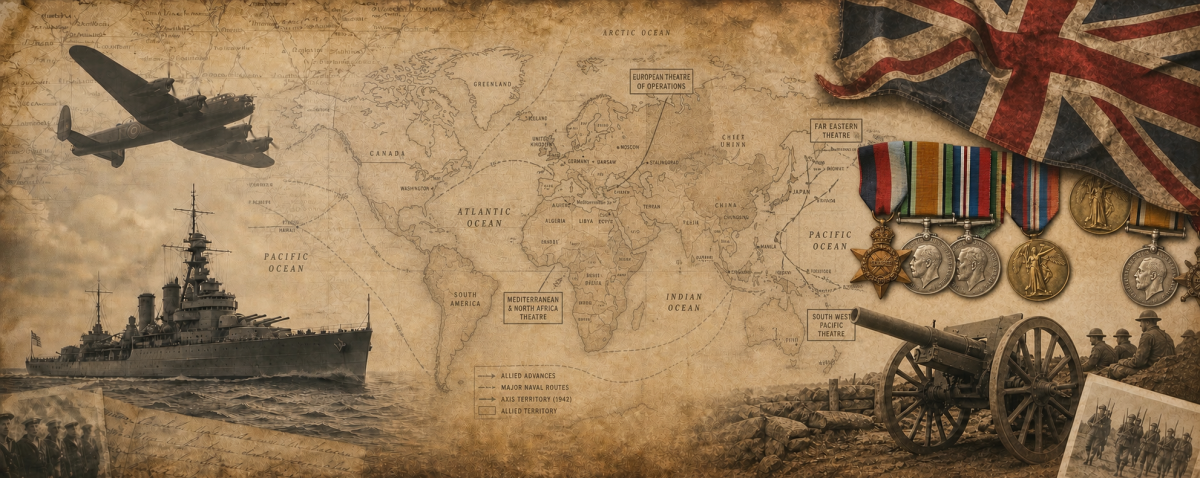

Franklyn Sterrett Wilder was born in Ashford, Kent, in about March 1919, the son of Francis Sterrett Wilder and Gertrude Annie Slingsby. As a small child he was living at 19 Cudworth Road, Willesborough, in 1921, and by 1941 he was recorded in Wiltshire, suggesting that his life before enlistment was already shaped by movement within wartime Britain. He never married and had no children, so the surviving record centres on his parents, his service, and the burial place in Egypt where he lies today. [1]
Wilder served as a Trooper, service number 7899190, in the 10th Royal Hussars (Prince of Wales’s Own), part of the Royal Armoured Corps. He was killed in action at El Alamein, Egypt, on 26 July 1942, and the official record notes that he died of wounds. His medals were the 1939–45 Star and War Medal 1939–1945, the standard campaign awards for service in the Second World War. [1]
He was a young Kent man who died in the Western Desert while serving with one of Britain’s armoured cavalry regiments.
Early Life and Family
Wilder’s early life began in Kent, where he was born in Ashford and later lived in Willesborough. The family record names his father, Francis Sterrett Wilder, and his mother, Gertrude Annie Slingsby, giving a clear family link to the Ashford district. The move to Wiltshire by 1941 suggests either employment, military posting, or wartime displacement before he entered active service overseas. [1]
There is no record here of marriage or children, so his biography is necessarily centred on his parents and wartime service. Even so, the details preserve the outline of a young man whose adult life was cut short before it had really begun. Like so many of his generation, he was drawn into service at a time when the war had already become global and immediate. [1]
Military Service
Wilder served in the Royal Armoured Corps with the 10th Royal Hussars, a regiment with a long cavalry heritage that had been adapted to armoured warfare in the Second World War. As a trooper, he would have served in a tank crew or armoured fighting vehicle crew, carrying out the demanding physical and technical tasks required of men operating in the desert. The Royal Armoured Corps was the Army’s core armoured arm, and in North Africa it played a decisive role in mobile warfare against German and Italian forces. [2][3][4][1]
The 10th Royal Hussars were part of 2nd Armoured Brigade in 1st Armoured Division during the North African campaign. By 1942 the regiment had already fought at Gazala and the retreat to El Alamein, suffering losses as the British tried to contain the Axis advance. Wilder’s service therefore placed him in one of the most hard-pressed and mobile formations in the theatre. [4][5][1]
Unit Context at Time of Death
At the time of Wilder’s death, the 10th Royal Hussars were part of the Western Desert campaign in Egypt and Libya, where British armoured forces were trying first to halt, and then to defeat, the Axis armies under Rommel. The campaign was fought in open desert over huge distances, with tank clashes, anti-tank guns, minefields, and very long supply lines shaping every operation. The 10th Royal Hussars had already experienced the strain of movement, combat, and replenishment in a theatre where casualties could be sudden and severe. [6][7][4]
By the summer of 1942 the British army had withdrawn to the Alamein line, where the fighting became a struggle to prevent the Axis from breaking through to the Nile Delta and the Suez Canal. Armoured regiments such as the 10th Hussars were central to that defence because they could move quickly between threatened sectors, support infantry, and counter enemy armour. Wilder’s unit was therefore part of the force that held the line in one of the war’s decisive campaigns. [5][4][6][1]
In 1942 the 10th Royal Hussars were part of the armoured spearhead and shield of the British line at El Alamein.
Circumstances of Death
Franklyn Sterrett Wilder died on 26 July 1942 at El Alamein, Egypt, from wounds received in action. The family record does not describe the exact incident, but the date places his death in the long and bitter struggle around the Alamein position, when British and Axis forces were still testing each other along the desert front. In such conditions, tank crews and armoured troops were exposed to shellfire, mines, anti-tank weapons, and the constant strain of battle. [4][5][6][1]
Wilder’s death thus reflects the nature of desert warfare: sudden injury, evacuation to medical support, and, too often, death from wounds before a man could return to the line. The fact that he is buried in Egypt rather than brought home also shows how far from Kent the war carried him. His passing was part of the wider human cost of the Western Desert campaign, in which every armoured advance and every defensive stand was paid for in lives. [6][4][1]
Burial and Commemoration
Wilder was buried in Alexandria (Hadra) War Memorial Cemetery in Egypt, in Plot 3, Row D, Grave 10. Hadra Cemetery was expanded during the Second World War and became a major Commonwealth burial ground for casualties from the Western Desert, Greece, Crete, and the Mediterranean theatres. The cemetery’s role as a military memorial site makes it one of the principal places of remembrance for the North African campaign. [8][1]
The CWGC record confirms his unit, rank, date of death, and burial location, ensuring that his name remains part of the permanent historical record. His burial in Alexandria connects him not only to the battlefields of Egypt but also to the network of wartime medical and burial services that operated across the Mediterranean. For his family in Kent, the distant cemetery would have stood as both a practical and emotional answer to his loss. [8][1]
Legacy
Franklyn Sterrett Wilder’s life was short, but it links Kent, Wiltshire, and the deserts of North Africa in a single wartime journey. He was one of the many young men who entered the Army in the early years of the Second World War and found themselves serving in an armoured regiment at the sharp end of a major campaign. His story helps to humanise the broad history of El Alamein by showing what that battle meant for one ordinary soldier. [3][6][1]
He also stands for the role of the Royal Armoured Corps in the Western Desert, where mobility, firepower, and endurance were all essential. The 10th Royal Hussars were one of the regiments that bore that burden, and Wilder died while serving in their ranks during a crucial phase of the war. His grave in Alexandria ensures that, although far from home, his sacrifice remains marked and remembered. [3][5][4][8][1]
Sources and Further Reading
- Commonwealth War Graves Commission: Franklyn Sterrett Wilder
- Alexandria (Hadra) War Memorial Cemetery | CWGC
- Horse Power Museum: North Africa and the Battle of El Alamein
- USHMM: Western Desert Campaign: Egypt and Libya
- Wartime Memories Project: Royal Armoured Corps in the Second World War
Sources
[1] Individual-Report-for-Franklyn-Sterrett-Wilder.pdf https://ppl-ai-file-upload.s3.amazonaws.com/web/direct-files/attachments/141549598/dc1b5693-5dd4-4747-91ba-44dac7b8a8e0/Individual-Report-for-Franklyn-Sterrett-Wilder.pdf?AWSAccessKeyId=ASIA2F3EMEYE7VPREZ6L&Signature=uEv3y%2FDP1EaZpiAWgDv6ZBupFUw%3D&x-amz-security-token=IQoJb3JpZ2luX2VjECYaCXVzLWVhc3QtMSJIMEYCIQDb4VrvDsFyWdgDx3FT1o1ZN8TZOzlDt6z9Pnx0Mm55BgIhANT3Od6fHhKgylIHBoerr5vCbu%2B0ExfmeIHmV3LfF4zXKvwECO7%2F%2F%2F%2F%2F%2F%2F%2F%2F%2FwEQARoMNjk5NzUzMzA5NzA1IgzqjeeVcpsQG7%2Bh1VIq0ATsYQiAl8ayRBPMiMUIIe7ercn5BV%2Frx9TcF%2BorPF1JHbl6RlQEHo%2FuszyZkVzadZxzQZcKfVNjOok80SsIMDGe75kEwNMZEkQIsrtB4DiMf6d71UhfDbszGhJQtARr5iHmR%2BzqFoxhJgFIdNK4ta8d7kV9YwFEBfcwP4bfpEILT1q7y%2FLuY0lYt2%2FCJgahRne2S4Z7qFy9DBSSMmuiQ0S3U26EOe9DfHCSv8kWsWV%2B5MzoYfo%2FeQjX0qa%2Ba1KWgIpp8LqZ3ibVeMAWDvIf2DZcxTuAMzzL%2Flw5qPW8Rofsf2cEgV1WeMfi7iqPhRb9a2jOZHILj7noLMXqQ5gt9JGWDcokwQTYlWkTGcJ8Q7rR5Qq2aTzLbvoPQowyuNe6zuzcPRAKtfbNyDRuf3B7fnKeqVsIyaFQRztI6xXb6UvMK1DqJpAl1z9Lbz4s%2FSJoApO34UblmmMepuquYyFpOhKUFpt3udrWT9O3gGEaekdfOpFqhAFIveSRFuYRxlxpnIg9Z6cMa%2FgEmnUIwWyMgNyAB4u%2BBdX6ipalMLM4rDWebVEPojFY8%2F%2FljA%2B1RUP11B%2BB7aRgbMJQmx%2FleSPdEzMffqTV%2BmDjQi7TnyxIl6SeTdVwohDYzagebWVDlU8TUOZ214l7IyuGVs9IgRakXGEhU62k0IHwroB9Z%2F4OzmvZosXT94Cjoik6HG6STFn5ZHrQf0OMYhG5%2FOFBpuuMpRKbE4nF5Gam8DuHGuQ5MTwBEHOzCsH0877m4agTs0kqEZuURr8FRnn0bohi50K4MIbNMPqliNMGOpcBHWezM6HICRavNHP1ym5HO2n1322cg0T4LYONz4zhvQ6PhK%2BjHAms%2BaQMjqTBncVxENaies2g9FLv9DvBYlzvHmAETXhvWLphGiW9EMYXyYv0v1VboB7r8F3VV2PHV3YYqjiW95cNPSjOQQNg%2FeF%2FPDUD4VoxgN8wgeGth3bvwDPyd9v1hL5U7mzXRyKWjPWgqnA0CJw0eQ%3D%3D&Expires=1784815248
[2] 10th Royal Hussars – Wikipedia https://en.wikipedia.org/wiki/10th_Royal_Hussars
[3] Royal Armoured Corps in the Second World War 1939-1945 https://www.wartimememoriesproject.com/ww2/allied/battalion.php?pid=1277
[4] North Africa and the Battle of El Alamein https://horsepowermuseum.co.uk/timeline/north-africa-and-the-battle-of-el-alamein/
[5] Alamein 1942 – Horse Power Museum https://horsepowermuseum.co.uk/alamein-1942/
[6] Western Desert Campaign: Egypt and Libya https://encyclopedia.ushmm.org/content/en/article/western-desert-campaign-egypt-and-libya
[7] Docs – Middle East 1930-1947 – Western Desert 1940-1943 Overview Higher Formations https://www.britishmilitaryhistory.co.uk/docs-middle-east-1930-1947-western-desert-1940-1943-overview-higher-formations/
[8] Alexandria (Hadra) War Memorial Cemetery https://www.cwgc.org/visit-us/find-cemeteries-memorials/cemetery-details/54600/alexandria-hadra-war-memorial-cemetery/
[9] Western Desert campaign – Wikipedia https://en.wikipedia.org/wiki/Western_Desert_campaign
[10] Search Results | CWGC https://www.cwgc.org/find-records/find-war-dead/search-results/
[11] [PDF] 1st Royal Dragoons, Greys, 22D & 25th Dragoons Royal Armoured … http://daimler-fighting-vehicles.co.uk/DFV-File%20Part%20D003a-RAC-COL%20Dragoons.pdf
[12] The Battle of Bir Hacheim, May 1942 – The Regiment https://www.qrhmuseum.com/the-battle-of-bir-hacheim-may-1942-the-regiment
[13] Seconde bataille d’El Alamein — Wikipédia https://fr.wikipedia.org/wiki/Seconde_bataille_d’El_Alamein
[14] The first and last battle of 2 Armoured Brigade – 23 … https://rommelsriposte.com/2013/01/23/the-first-and-last-battle-of-2-armoured-brigade-23-january-1942/
[15] Operation Compass Timeline (1940–1941) | North Africa Campaign https://worldwar-2.com/timelines/north-africa/compass/operation-compass.html
[16] British Brigades in World War II Order of Battle, United … https://fr.scribd.com/document/140751501/British-Brigades-in-World-War-II-Order-of-Battle-United-Kingdom
Discover more from Mike's Cousins
Subscribe to get the latest posts sent to your email.