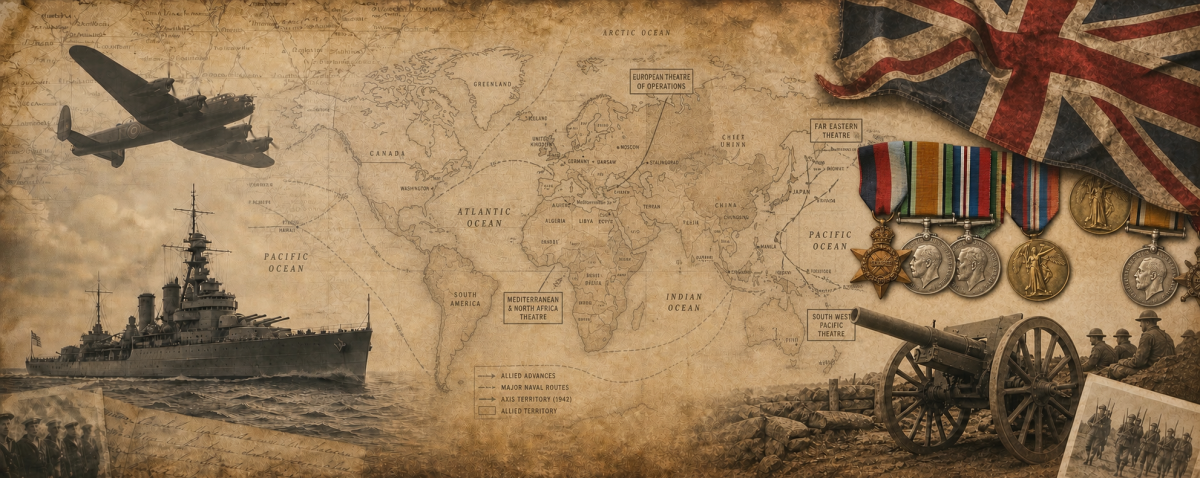

Leonard Collin Kesby was born in Margate, Kent, on 7 September 1920, the son of William Thomas David Kesby and Fanny Ayres. He was baptised at All Saints, Margate, on 31 October 1920, and his early childhood was spent in the Margate area at 2 Forge Cottages, Crow Hill Road. By 1942 he was living in Hall Green, Birmingham, having moved away from Kent before or during the war, and like many men of his generation he entered military service soon after the outbreak of the Second World War. [1]
Kesby served as a Sapper, service number 1880186, in the Royal Engineers. His medal entitlement was the 1939–45 Star, Africa Star, and War Medal, showing that his wartime service took him beyond Britain to the Mediterranean and the Middle East. He never married and had no children, so the surviving record centres on his parents, his service, and the military cemetery in India where he was buried. [1]
He was a Kent-born sapper who served with the Royal Engineers in North Africa and India before dying at just 21.
Early Life and Family
Kesby’s life began in Margate, where he was born in 1920 and baptised later that autumn. The family home at 2 Forge Cottages suggests a modest household, and the early census-style records place him firmly within the working communities of east Kent. His parents, William Thomas David Kesby and Fanny Ayres, remain the central figures in the family record, which preserves the basic facts of a life cut short by war. [1]
By 1942 he had moved to Birmingham, where the record shows him living in Hall Green. That move may have reflected wartime employment, military accommodation, or family circumstances, but whatever the reason it placed him far from his Kent birthplace when he died. The brief surviving details give a picture of a young man whose adult life was shaped almost entirely by wartime service. [1]
Military Service
Kesby enlisted at Chatham on 10 September 1939, only days after Britain entered the war. His initial posting was to 2 London Corps Troops, 12 Field Company, Royal Engineers, and by 24 February 1940 he was serving in that unit. Field companies of the Royal Engineers were responsible for a wide range of practical military tasks: bridging, demolition, obstacle clearing, field works, water supply, route maintenance, and general engineering support for frontline and corps formations. [2][1]
As a sapper, Kesby would have worked in one of the Army’s most versatile technical branches. Royal Engineers soldiers were expected to solve immediate battlefield problems and also to build the infrastructure that kept armies moving and supplied. That work was especially important for corps troops, where engineers helped sustain large formations in the field rather than serving only one infantry division. [3][1]
Unit Context at Time of Death
By 1941, the 12 Field Company had been sent overseas and Kesby disembarked in Egypt on 15 June 1941. This placed him within the Middle East theatre at a time when Allied engineering units were supporting operations across desert, coast, and rear areas, often under pressure from long supply lines and harsh climatic conditions. The Royal Engineers played a critical role in enabling desert warfare, where roads, water, fortifications, and communications were often as important as combat itself. [4][2][1]
Kesby later embarked for Bombay on 1 March 1942 and disembarked on 12 March 1942, indicating a transfer to the India theatre. In 1942, Royal Engineers companies in India were involved in training, infrastructure, route work, and support for operations in a region whose strategic importance was increasing as the war expanded into Burma and the wider Indian theatre. The 12 Field Company therefore formed part of the engineering backbone behind British and Commonwealth operations in Asia. [2][4][1]
The Royal Engineers kept armies moving, building, bridging, and maintaining the machinery of war in some of the most difficult conditions of the conflict.
Circumstances of Death
Leonard Collin Kesby died in India on 21 July 1942 from acute poliomyelitis. Unlike many wartime deaths, his was not caused by enemy action but by disease, which was still a major threat to service personnel in tropical and sub-tropical theatres. The family record and CWGC entry make clear that his death occurred while he was serving overseas, and that he was only 21 years old. [1]
Poliomyelitis could strike suddenly and severely, and in wartime conditions the movement of troops, crowded accommodation, and strain of service often made men vulnerable to infection and to the consequences of illness. Kesby’s death is therefore part of the wider history of non-battle casualties in the Second World War, a reminder that military service could be fatal even in the absence of combat. His age and the date of death underline how abruptly a life of promise and duty could end. [1]
Burial and Commemoration
Kesby is buried at Ranchi War Cemetery in Jharkhand, India, in grave 5.B.1. Ranchi War Cemetery was begun in June 1942 and became the principal Commonwealth burial ground for the region, containing the graves of service personnel who died in India during the Second World War. His burial there reflects the practical and humane work of the Commonwealth War Graves Commission in ensuring that even those who died far from home were given a lasting and dignified resting place. [5][1]
The CWGC record confirms his rank, regiment, date of death, and burial location, while the family record adds the personal details that make the entry more than a line in an index. His medals and memorialisation through Find a Grave and family history records help keep his name visible to later generations. For his parents in Margate, the grave in India would have been a distant but permanent marker of loss. [5][1]
Legacy
Leonard Collin Kesby’s life was short, but it spanned a dramatic wartime journey from Kent to Egypt and India. He was a young man of the Second World War generation, one of the many who enlisted immediately after Britain declared war and who served in technical units essential to the Army’s operations. His story is especially important because it shows the quieter side of war: engineering support, overseas movement, and death by disease rather than battle. [2][1]
As a Royal Engineer, Kesby belonged to a corps that enabled the wider war effort by solving practical problems under pressure. The work of field companies rarely receives the attention given to infantry or armour, but it was indispensable in the Middle East and India theatres where roads, bridges, camps, and communications had to be built and maintained. His biography deserves to be remembered both as a family story and as part of the wider history of the Royal Engineers in the Second World War. [4][2][1]
Sources and Further Reading
- Commonwealth War Graves Commission: Leonard Collin Kesby
- Ranchi War Cemetery | CWGC
- 12th Field Company Royal Engineers – Ubique Vir
- Wartime Memories Project: Royal Engineers in the Second World War
- Find a Grave memorial for Leonard Collin Kesby
Sources
[1] Individual-Report-for-Leonard-Collin-Kesby.pdf https://ppl-ai-file-upload.s3.amazonaws.com/web/direct-files/attachments/141549598/702a62a3-f36b-4491-9100-6f4628423c63/Individual-Report-for-Leonard-Collin-Kesby.pdf?AWSAccessKeyId=ASIA2F3EMEYE6W3KWIM7&Signature=XPmkx6sfF35kHRPBizTo8pnCWgw%3D&x-amz-security-token=IQoJb3JpZ2luX2VjEIX%2F%2F%2F%2F%2F%2F%2F%2F%2F%2FwEaCXVzLWVhc3QtMSJGMEQCIBTkjt1goGGE1rjYjBNblKTrPfss0Qr1Y0sMpU7V2WrkAiBVQtpk5YIeYiEY3CrKhT0WhIe50X%2BpQOLPPjrPS42%2FZCrzBAhNEAEaDDY5OTc1MzMwOTcwNSIMp1ndEqy5sricWfFWKtAE%2F3nmZqxO2gxU3RioJnRe7y1M6swJ%2FKcG3vP95TUlLGgNGCIMz5AFQ4XsVbxgJ1U3KzCj9BAUVAWP9QvGx%2B2GfsBZ%2BrosGAiEAASRaENdHFKKSFq%2BMCMYTNjCAEulrLluxx20KXua9ZNxwv1E%2FngHCbqfN8JoJD0T8TlYASZ4F%2BQngjxGoOO7BId9HlPc1ngBCkOcDnNsQu8HDyw1bl3ZTV%2FBWS4oZ0Wv2KdpOhZeuv3df3uNgdfRTenIW9ysRzKdqs6p%2FG%2BpykA1FgFLj0ZxEZXLrF4H%2Fbkj2zc16maHYk6eafTWdBZcAlE%2Fm6xUc9PODN2IgXnqebsUO0pvSDSLWvFeNh56vZCdlrcpMlhF8bVkudCJvHk0sz1VH%2BMmzjxpJiqHcL5C%2FyXfeCIDJOGSyBDX%2Bz8wdPkxeBjvOZj7shE1adwD9SlroYzt%2FSaxUzCNQnm6P1CvjX0NdbnVmdWzs7%2BMNrRYuuhbmo3OzEN5Ul5L%2FEIyMEY7dUUBx8pi6t1OZ%2F2yblkkKhqvP3Z90%2Fy%2F0hjUkcod0UgZPwPXkGo0WZbqeMsyKUcQ1e5AbcuLQDrMQPtX1bNaQGSeIb%2BDBXywL7jCeXsvcVUWHBAOZa1IvUdYCN6FCxIfwZwLiqrstFHVG%2FwRe%2FULsps%2Fh6IryUFnH9eVJiOPmCyKu12kbsPkE8XVKixBklEewMtOMau5BlTIU4ogOxGOO4nGZx0Y0Qwm9%2BgAeFth7bLei7jRabfcqjUGWtEaEvxZtnXP%2FxSgaxl7pMABNXCvsMraF9mfGJn25zCN%2BuTSBjqZAcrlPPvTXL%2Bomzggh3kP61i8MFxT5KglJqa2wYV9cabg%2FCSd7XuTPhXjUlrIe8fh%2BcSDUHntRNM3fSlCSi6XdIwx6a36dYtn2Up5%2F62dveAIx66S1nS86MZf%2B%2BNdqtR57ciFd8P0hJnwwI5FOZGL5ep5%2FF8OgglD0sKHnnZ8Bq3rgpb0AEI5LsuG8PeNZDJINUTET4FHjnSW%2Bw%3D%3D&Expires=1784234040
[2] Royal Engineers and Military Logistics from Britain to Burma and India https://www.taylorfrancis.com/chapters/edit/10.4324/9781003347989-13/royal-engineers-military-logistics-britain-burma-india-world-war-ii-michael-charney
[3] II Corps Troops, Royal Engineers – Wikipedia https://en.wikipedia.org/wiki/II_Corps_Troops,_Royal_Engineers
[4] 12th Field Company Royal Engineers – Ubique Vir – WordPress.com https://ubiquevir.wordpress.com/home/12th-field-company-royal-engineers/
[5] Ranchi War Cemetery | Cemetery Details | CWGC https://www.cwgc.org/visit-us/find-cemeteries-memorials/cemetery-details/2085500/ranchi-war-cemetery/
[6] Your search results for “” https://www.cwgc.org/search-results/
[7] Find Cemeteries & Memorials | CWGC https://www.cwgc.org/visit-us/find-cemeteries-memorials/
[8] 58 Field Squadron, Royal Engineers – Wikipedia https://en.wikipedia.org/wiki/58th_(Chemical_Warfare)_Company,_Royal_Engineers
[9] 12th Field Company Royal Engineers WWII India, Burma and Pakistan https://ubiquevir.wordpress.com/home/12th-field-company-royal-engineers/12th-field-company-royal-engineers-india-burma-and-pakistan/
[10] Royal Engineers in the Second World War 1939-1945 https://www.wartimememoriesproject.com/ww2/allied/battalion.php?pid=1282
[11] Find War Dead | CWGC https://www.cwgc.org/find-records/find-war-dead/
[12] Royal Engineers in the Second World War 1939-1945 https://wartimememoriesproject.com/ww2/allied/royalengineers.php
[13] WW2 War Diary https://www.re-museum.co.uk/wp-content/uploads/2015/09/Library-War-Diaries-WW2.pdf
[14] Hierarchy Browser https://archive.cwgc.org/TreeBrowse.aspx?src=CalmView.Catalog&field=RefNo&key=CWGC/LIB
[15] 208th (Sussex) Field Company, Royal Engineers – Wikipedia https://en.wikipedia.org/wiki/208th_(Sussex)_Field_Company,_Royal_Engineers
[16] The Story of the Sappers of 12 Field Company in the Second World … https://freeperception.com/the-story-of-the-sappers-of-12-field-company-in-the-second-world-war/
Discover more from Mike's Cousins
Subscribe to get the latest posts sent to your email.