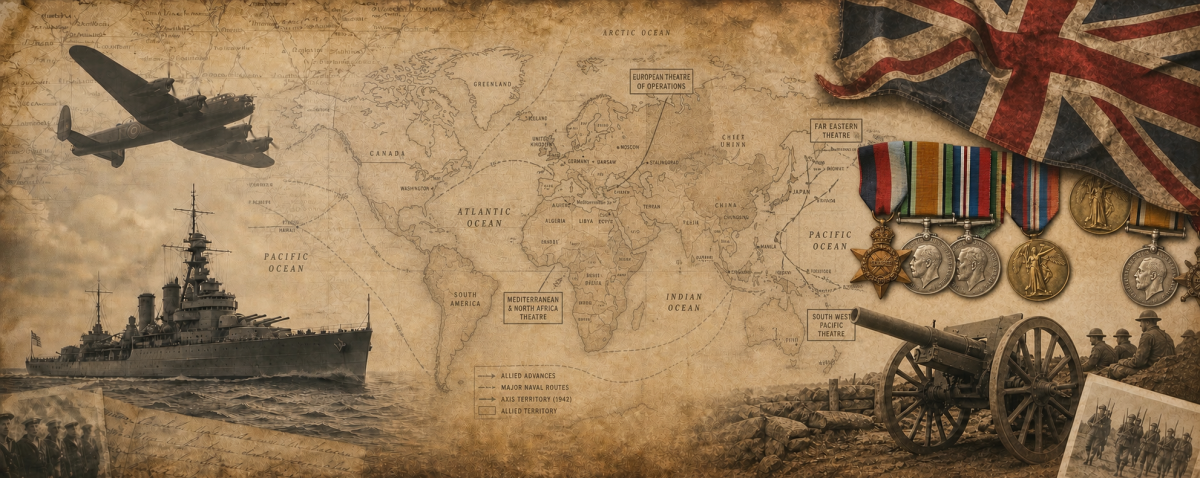

Benjamin Ernest Payne was born in Wandsworth, London, in about March 1890, the son of Thomas Spencer Payne and Mary Ann Kidder. As a small child he lived in Battersea, and by 1901 the family had moved to Swansea, where he was recorded in Rhondda Street at the age of 11. By 1911 he was living at 6 Rockville Terrace, West Cross, Oystermouth, and working as a clerk, a position that suggests a settled young adult life in the Swansea district before the war changed everything. [1]
Payne remained closely connected to his parents’ home in West Cross, Swansea, and the family record identifies his father, Thomas Spencer Payne, as a J.P., indicating a family of some local standing. He was unmarried and had no children, so the surviving story centres on his parents, his service, and the cemetery in which he was buried after death. His military medals were the Victory Medal and British War Medal, together with the Memorial Death Plaque sent to the family after his death. [1]
He was a Swansea clerk who became a corporal in a Welsh Yeomanry battalion serving as infantry in France.
Early Life and Family
Payne’s early life moved from London to south Wales, where his family settled in Swansea during his childhood. By the time of the 1901 census he was living on Rhondda Street, and a decade later he had become a clerical worker in Oystermouth, a village and parish on the Gower coast. This was the life of a young man making his way in civilian employment, probably with good education and office skills, rather than one born to a military career. [1]
The family home at Rockville Terrace, West Cross, remained central to his identity, and the casualty record explicitly names his parents there. The record of his burial in Oystermouth Cemetery also ties him back to that same coastal community. His biography is therefore rooted in Swansea as much as in the Army. [1]
Military Service
Benjamin Payne served as Corporal 215236 in the 24th (Denbighshire Yeomanry) Battalion, Royal Welsh Fusiliers. This battalion had originally been formed from the Denbighshire Yeomanry and, like other mounted units of the Territorial Force, had been converted to infantry for service overseas. By 1918 it was part of a Welsh formation that had already served in Egypt and Palestine before moving to France for the final Allied offensives. [2][3][4][1]
That conversion from yeomanry cavalry to infantry is important to understanding Payne’s service. Men who had once trained for mounted duties in Wales found themselves fighting as foot soldiers in very different conditions, first in the Middle East and later on the Western Front. Payne’s rank of corporal shows that he had gained responsibility within that reorganised battalion, likely supervising other men in the field. [3][2][1]
Unit Context at Time of Death
At the time of Payne’s death in July 1918, the 24th Battalion, Royal Welsh Fusiliers, was serving in France as part of the 74th (Yeomanry) Division after its transfer from Palestine earlier in the year. The division had arrived in France in May 1918 and was thrown into the great Allied defensive and then counter-offensive battles of the closing months of the war. Its battalions were now fighting on the Western Front after a long campaign in the desert, a dramatic shift from one theatre to another. [4][2]
The 24th Welsh had already seen major service in the Middle East, including the advance through Palestine and the fighting at Beersheba, Sheria, Jerusalem, and Nablus, before being sent to France to reinforce the line against the German offensives of 1918. In France the battalion took part in the Allied push northwards and in actions around the Somme sector, where the war’s final offensives were beginning to break German resistance. Payne’s unit therefore belonged to a formation with unusual breadth of service, fighting in both the Eastern and Western theatres of the war. [2][4]
The 24th Battalion had come from the deserts of Palestine to the battlefields of France in the last year of the war.
Circumstances of Death
Benjamin Ernest Payne died on 20 July 1918 at Blofield, Norfolk. The family record does not give the precise circumstances of death, and the locality suggests that he was in Britain rather than with his battalion overseas at the time. That in turn indicates that, like many servicemen, he may have died in hospital or during home service after illness or wounds rather than being killed in an action on the battlefield. [1]
The exact cause is not stated in the surviving summary, but his death came during a year in which the war still claimed lives both abroad and at home. The date also falls shortly after the period in which the 24th Battalion was engaged on the Western Front, showing how service and death could remain linked even when a man was no longer in the immediate line. His burial in Oystermouth Cemetery later brought him back, symbolically at least, to Swansea. [2][1]
Burial and Commemoration
Payne was buried in Oystermouth Cemetery, Mumbles, Swansea, in 1918. This municipal cemetery, established in 1883, contains Commonwealth war graves and remains an important local place of remembrance for families from the Swansea area. His burial there, rather than in France, reflects the fact that he died in England and was returned to his home district for interment. [1]
The CWGC record identifies him as a corporal of the Royal Welsh Fusiliers and preserves his service details for future generations. The family report also notes his memorial plaque and medals, tangible reminders of a short life cut off during wartime. In Oystermouth Cemetery he rests among other service personnel, where his grave continues to link the local community with the wider history of the First World War. [1]
Legacy
Benjamin Ernest Payne’s life captures the movement experienced by many British families in the late nineteenth and early twentieth centuries: born in London, raised in Wales, employed in Swansea, and then carried into war. He was a young clerk who became a corporal in a Welsh infantry battalion and whose service spanned the transition from empire warfare in the Middle East to the final campaigns in France. That breadth gives his biography a wider importance than the bare dates alone might suggest. [4][2][1]
He also represents the transformation of the Territorial Yeomanry into infantry under wartime pressure. The 24th Battalion’s journey from mounted roots in Denbighshire to campaigns in Egypt, Palestine, and France reflects the flexibility demanded of Britain’s wartime army, and Payne’s service sits squarely within that story. His burial in Swansea ensures that his memory remains part of both local and military history. [3][4][2][1]
Sources and Further Reading
- Commonwealth War Graves Commission: Benjamin Ernest Payne
- Prince Albert’s Own Yeomanry: 24th (Denbighshire Yeomanry) Battalion, Royal Welsh Fusiliers
- The Long, Long Trail: Royal Welsh Fusiliers
- WW1.Wales: 24th Battalion, Welsh Regiment and later service in France
- Find a Grave memorial for Benjamin Ernest Payne
Sources
[1] Individual-Report-for-Benjamin-Ernest-Payne.pdf https://ppl-ai-file-upload.s3.amazonaws.com/web/direct-files/attachments/141549598/ac2b1d81-03bc-4065-a7cd-429fb341f925/Individual-Report-for-Benjamin-Ernest-Payne.pdf?AWSAccessKeyId=ASIA2F3EMEYEYBFEANRY&Signature=ZvuScEcYuzLIxXisrFa6JIck92s%3D&x-amz-security-token=IQoJb3JpZ2luX2VjEIP%2F%2F%2F%2F%2F%2F%2F%2F%2F%2FwEaCXVzLWVhc3QtMSJGMEQCIGtsjW%2BC%2Fo8ny6tn1PX%2FPUcD%2FtNnWw8drbyDnK52psDvAiAHMyE3EBKwqsos2ouB97iXWr40okAGtzTOnxqrQbdUSirzBAhLEAEaDDY5OTc1MzMwOTcwNSIM28wurjpfCNGIedBzKtAE6KISpMtOsoD03NZTk%2Fd7E%2B4DRyvEE027bcrKMYpSG0k9LB%2BtH%2BzmHATb2STjBSZFb0Hdv316o2Wv3CyAje6lSRhnWRExZvgSafVg3s5rziG2nLoSAThZIj3075LjLzzjoATAh%2F4k%2BOCfzcSa%2B2nU4NesXODCfABEN0EQjpWzveMJ10ItZDCvv3ddOV2nZEyRPk3LyrvSUt%2F9dBe490CDoeVO73DWi9eIB9eOLSccoAiyxHKnr87CxHJ6mPJMefcMdarsfuEXPVHS6oSP2wSP9A1dtAsepKHydwggsiUR4BCU9nSqi5xeKHxWRPiJgkj8TYyAV1ywn0rcFItPDoJS87glRbI6i74FecQ7r%2B13QNSF72K1pemlc%2BQSnrwNNO%2FhQYxQPAociAP5Zh1kHvWR%2FWdgX3UDYqhfMo1UVm0LzLTSVEARbgWMT7VpqYgAdM%2FAlgApWBwENBAUwdDan61%2BqZvNpigc%2Fiz8MV1meXp12TGGtZUmN9SdOxA2mG9vxpBEliAV0RtyAzXkVlHvILkGHxyOt6U1g01fnNIyvRpERPIAwaoSFVgM8U7%2BHUjTr0Npa8JFMz70m2pRkf4NA6zZvk5yl2dCyr3fS9wWSk90CwiIMhaHopiFX1Uoql9nRPuGqjBZ0u9quBoOVVQbvnc6xWMyIuHolo8M9yj%2BPb4BiP5Rc6Gc89HcaAZABKiiDAVzbn0lzl3BaAqOXdjSQWVsx4r3Txwl%2Fq1%2FP7sgaP3m21TOFC7sOv2PRuHO8aYOmpgj9Lz1Z04E7kgeWefrqyBHNTCJvOTSBjqZAaX53XWzC74aF2qhUdYm%2BhL2yV0zDULTgsMyPGDvGV1ekhTpcT4kQ8KgLZHQcw9YwaMChs8ILmfolmxWuH6i6sAtFe4ip0tsilpsOQLK6Sg2s2DPQi9QdqwgRlN7%2BD76vM2b3kdUbrwjqZ0NbiogV7O5nukkLf1s7JQYZFuR5AHgtYUT8Cx5hSfSBoe3J06ujm0mXLq0jTghcA%3D%3D&Expires=1784226441
[2] 24th Battalion, Welsh Regiment – WW1.Wales https://ww1.wales/local-military-units/24th-battalion-welsh-regiment/
[3] Great War Wolseley Helmet of the Denbighshire Hussars https://metcalfemilitaryhistory.co.uk/2025/03/17/great-war-wolseley-helmet-of-the-denbighshire-hussars/
[4] WELSH YEOMANRY AT WAR A History of the 24th Pembroke and Glamorgan Yeomanry Battalion the Welsh Regiment – Naval & Military Press https://www.naval-military-press.com/product/welsh-yeomanry-at-wara-history-of-the-24th-pembroke-and-glamorgan-yeomanry-battalion-the-welsh-regiment/
[5] 24th (DHY) Btn, RWF. – Prince Albert’s Own Yeomanry https://www.paoyeomanry.org.uk/DenbighYeo24Btn.htm
[6] Royal Welsh Fusiliers https://www.longlongtrail.co.uk/army/regiments-and-corps/the-british-infantry-regiments-of-1914-1918/royal-welsh-fusiliers/
[7] Search Results | CWGC https://www.cwgc.org/find-records/find-war-dead/search-results/
[8] Denbighshire Hussars Yeomanry https://www.paoyeomanry.org.uk/DenbighYeo.htm
[9] 1/1st Denbighshire Hussars Facts for Kids https://kids.kiddle.co/1/1st_Denbighshire_Hussars
[10] Pembroke (Monkton) War Memorial – WW1.Wales https://ww1.wales/pembrokeshire-memorials/pembroke-monkton-war-memorial/
[11] Royal Welch Fusiliers – Wikipedia https://en.wikipedia.org/wiki/Royal_Welch_Fusiliers
[12] Llanfarian War Memorial – WW1.Wales https://ww1.wales/ceredigion-memorials/llanfarian-war-memorial/
[13] Officers of the 24th Welsh https://erenow.org/ww/welsh-yeomanry-war-history-24th-battalion-welsh-regiment/13.php
[14] Find Records | CWGC https://www.cwgc.org/find-records/
[15] Full text of “Regimental records of the Royal Welch Fusiliers (23rd … https://archive.org/stream/regimentalrecord04dudl/regimentalrecord04dudl_djvu.txt
[16] pdpubs book pagemaster https://www.pembrokeandmonktonhistory.org.uk/documents/warbookpagemasterNovember2.pdf
Discover more from Mike's Cousins
Subscribe to get the latest posts sent to your email.