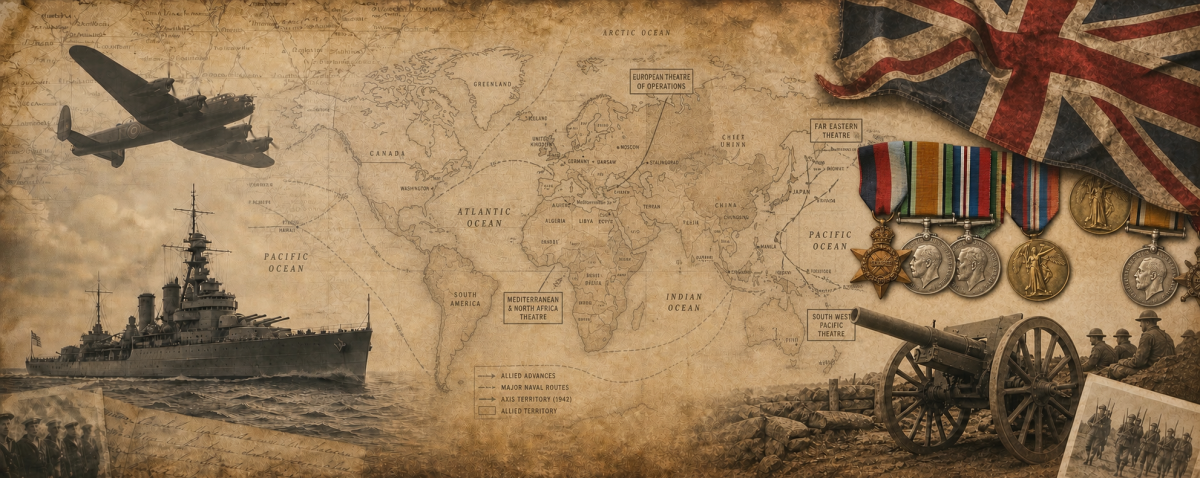

Samuel Arnett Foster was born in Newry, County Armagh, in about March 1893, the son of Joseph Foster and Mary Crowe. His early life took him from Rathfriland in County Down to South Africa, where by 1911 he was recorded in Cape Town and later in Benoni, Gauteng, working as a shop assistant and boot salesman before the war drew him into military service. He was still a young man in 1916, unmarried and without children, when he became one of the many men from across the Empire who found themselves in the trenches of the Western Front. [1]
His family record notes that he died on 10 July 1916 in France and that his name is commemorated on the Thiepval Memorial, Pier and Face 4 C. That memorial is the formal resting place for thousands of British and Commonwealth soldiers who died on the Somme and have no known grave. Foster’s story therefore joins a larger story of movement, migration, and imperial service, stretching from Ulster to South Africa and then to the battlefields of northern France. [1]
He was born in Ireland, lived in South Africa, and died on the Somme as a soldier of the South African Infantry.
Early Life and Family
The surviving record for Foster is brief, but it reveals a great deal about his background. He was the son of Joseph Foster and Mary Crowe, born in Newry and raised in the Rathfriland area of County Down before moving abroad as a young man. In 1901 he was living in Church Street, Rathfriland, and by 1911 he had reached the age of 18 and was described as a Presbyterian son in the household at Dromore Street. [1]
By the time he emigrated to South Africa, Foster had already begun adult working life. The record shows him in Cape Town in 1911 and later in Benoni in 1914, employed in retail as a boot salesman or shop assistant. That path is characteristic of many young migrant men who moved within the British Empire in search of work and opportunity before the outbreak of war changed their prospects. [1]
Military Service
Samuel Arnett Foster served as a Private, service number 3717, in the 4th South African Infantry Regiment, part of the South African Brigade. His division was the 9th (Scottish) Division, a British formation to which the South African Brigade was attached during the Somme offensive. The South African units were raised from volunteers and formed part of the wider Imperial war effort, with South African infantry fighting as a distinct brigade under British command. [2][3][4][1]
The South African Infantry Regiment carried with it the identity of men who had left the Union to serve overseas, many of them with a strong sense of national and imperial duty. By mid-1916 the brigade had been drawn into the Somme, where it was used in one of the war’s most brutal and strategically important battles. Foster’s service and death place him within that difficult campaign, where the South African Brigade would soon become famous for its stand in Delville Wood. [3][4][5][2]
Unit Context at Time of Death
At the time of Foster’s death on 10 July 1916, the 4th South African Infantry Regiment was serving with the 9th (Scottish) Division during the Somme offensive. The division was engaged in the hard fighting around Longueval, Bernafay Wood, and the approaches to Delville Wood, where the British aimed to clear German defenders from the area before pressing on towards the Switch Line. The South African Brigade’s role was to help secure and hold ground that could support later attacks, but the fighting quickly became a grinding battle of attrition. [4][5][1]
The importance of Delville Wood in this phase of the battle cannot be overstated. It was essential to the British to clear the wood before any further attack could be made on German defences, yet the ground was densely contested, cut by trenches, shell-holes, and broken timber. The South African Brigade would later be thrown into the wood itself, where it suffered enormous losses; even before that famous stand, its battalions were already part of the costly struggle around the Longueval sector. [5][4]
At the Somme, his regiment was part of the South African Brigade attached to the 9th (Scottish) Division, fighting around Longueval and Delville Wood.
Circumstances of Death
Foster died in France on 10 July 1916, but the family record does not specify the exact tactical circumstances of his death. Given the location and timing, it is highly likely that he was killed during the heavy fighting in the Somme sector immediately before the battle for Delville Wood reached its climactic phase. This was a period marked by intense artillery fire, exhausted infantry, and a battlefield in which even small advances were won at very high cost. [4][5][1]
His death came only days before the South African Brigade’s most famous ordeal in Delville Wood, where the brigade entered the wood on 15 July and suffered extraordinary casualties in the struggle to hold it. Foster did not live to see that fighting, but he was already part of the same offensive machinery that placed South African infantry in the centre of the Somme battle. In that sense, his death belongs to the wider human cost of the advance on Longueval and the preparation for the assault on the wood. [5][1]
Burial and Commemoration
Samuel Arnett Foster has no known grave and is commemorated on the Thiepval Memorial, Pier and Face 4 C. Thiepval is the central memorial for the missing of the Somme, and his name appears among the tens of thousands of British and Commonwealth soldiers whose bodies were never identified or recovered. For families, the memorial provides a place of remembrance where no individual headstone could be placed on a battlefield grave. [1]
The CWGC record identifies him as a casualty of the 4th South African Infantry Regiment, and Find a Grave preserves a separate memorial entry that helps keep his name visible to later generations. These memorials matter because they restore an individual identity to a man otherwise lost within the vast casualty lists of the Somme. Foster’s commemoration is therefore both official and personal, linking France, South Africa, and Ireland in a single act of remembrance. [1]
Legacy
Foster’s life was brief, but it traversed remarkable distances: from Rathfriland to Cape Town, from Benoni to the Somme. He belonged to a generation of young men who moved across the British Empire for work and who, when war came, found themselves serving in faraway theatres under imperial and dominion banners. His story is therefore not only a family history but also a reminder of the global nature of the First World War. [2][3][1]
Within the military history of the Somme, Foster’s name links him to the South African contribution to the battle, a contribution often overshadowed by better-known British formations. The 9th (Scottish) Division and its South African Brigade would soon become identified with the hell of Delville Wood, one of the most harrowing episodes of the campaign. Foster died just before that defining action, but he was part of the same divisional struggle and deserves to be remembered within that context. [4][5][1]
Sources and Further Reading
- Commonwealth War Graves Commission: Samuel Arnett Foster
- FirstWorldWar.com: The Battle of Delville Wood, 1916
- The National Archives Blog: South Africa and the Somme
- South African Legion: 9th (Scottish) Division and South African Brigade timeline
- Find a Grave memorial for Samuel Arnett Foster
Sources
[1] Individual-Report-for-Samuel-Arnett-Foster.pdf https://ppl-ai-file-upload.s3.amazonaws.com/web/direct-files/attachments/141549598/02f0af48-0fc0-49f5-af39-ca5008fd6933/Individual-Report-for-Samuel-Arnett-Foster.pdf?AWSAccessKeyId=ASIA2F3EMEYEYQBB6U4K&Signature=Ad7UGF%2B8PKZHWAAOzGqvreYRxV8%3D&x-amz-security-token=IQoJb3JpZ2luX2VjEIL%2F%2F%2F%2F%2F%2F%2F%2F%2F%2FwEaCXVzLWVhc3QtMSJIMEYCIQCUuGYRXu6obDOvTTEdzBo58pEEc4Z1OtgF2EKgFiS9bAIhAMuKPAj%2BdNE44zoWIyKQMzx3rPPOctJWAOYJu75xl8YVKvMECEoQARoMNjk5NzUzMzA5NzA1IgzGxldkpXR%2BUAQ8axEq0AQz%2F78AQYvxoV6%2B6sCE5BZUKhM6gW%2FmD0aHoH1%2BciRkv2E3SZjTW9prp%2FSO0Btu1w%2B4WhfUWu4OSOSZdSm%2FAHN7Z42FHB23%2F7%2B2A0F8fTN6GNb3HpETaLLPXMdUraYMClidqEhiEwyaA8Yr2YDZyYjF4QDIITFmI0HXl9U69QIoDQShYD8SoyuEg0nUWE8mWnESQD4k%2BPR9oawrbaOI2XHhvKWYihH5j5%2BReiCYpmyi66zTww0KjbOF7J91a4n49uj%2F%2B3DOvggmPHcIEutEF1K1x%2FmY2H%2Fw2dKCPT82ibGUXsO255o45VkNF0ErFWJ6Myx4kkw4OqRjGfX4pN25VMfNFCrnBosZHuvFavhGxU9mziUUmDW9uoPNnn5gGxFDqnqGowpIAPbeZz%2F17Ixcv2LybAKF9fXBw6vmysP3UhaW82ZABNv7cgFcsJllPnGp7aRntUTY9VEZmtx16BoXaTdIfDp7oDzknI63MKZYdzAEod0lgnkqfDX%2BAHn6vzvcl7FObsCtwqCJtRzXynTT6cgRmYd%2FisHaa%2BI9hK3HhY81SMGEZrju011u%2Fwtlk9fdbh6S6vwWO6hfZzBs9FixClZUWM5Xo7Vfm2KU9peb2QdAXHCucwSYByhcUVzgR55Q%2F5h1iDfwXRnCszUO8FV78HFwUAY9x7dIpe%2B79MDwSrWxQJrWoLfv%2BfKeIgdQJTFrQeoxm30bTfK%2FT3XySikkNyqMzWXUTnwPcxSG1GglIrbl9VYa1IiHvsiQKE4X0QFZ9TJ6dimf5HGTUHjzxvg9RwmmMMSj5NIGOpcBGspPqzYvX1NsHtchVS7uQYs9r8SjGAtClTNcWsXu%2F%2BJlpQ%2B9aCDLVSdZXDm5wkL70d6ouFsCf2vy78vvtj8Bb%2BR2VuH2CrrAI0qzxYEsaFHRmllPZbq091fwd%2FxyiOQBZ9dcdVqEreLvSkSW8oQQFf3ZAqqK5roQDvMVQhiuSotw5AEePesHxIJhaQBLgy4NuchO9P1rbw%3D%3D&Expires=1784224267
[2] 4th SA Infantry Regiment – Wikipedia https://en.wikipedia.org/wiki/4th_SA_Infantry_Regiment
[3] South Africa and the Somme – The National Archives blog https://blog.nationalarchives.gov.uk/south-africa-somme/
[4] HISTORY OF THE 9TH (SCOTTISH) DIVISION – Naval & Military Press https://www.naval-military-press.com/product/history-of-the-9th-scottish-division/
[5] The Battle of Delville Wood, 1916 https://www.firstworldwar.com/battles/delvillewood.htm
[6] DELVILLE WOOD http://www.delvillewood.com/bataille2.htm
[7] 9th (Scottish) Division in the Great War https://www.wartimememoriesproject.com/greatwar/allied/division.php?pid=11540
[8] South African Military History Society – Journal http://samilitaryhistory.org/vol082rb.html
[9] 31773 Sergeant Harold Thomas Malcolm, South African Engineer … https://www.reubique.com/31773.htm
[10] Delville Wood order of battle – Wikipedia https://en.wikipedia.org/wiki/Delville_Wood_order_of_battle
[11] sadfhist http://www.rhodesia.nl/sadfhist.htm
[12] 9th (Scottish) Division – Wikipedia https://en.wikipedia.org/wiki/9th_(Scottish)_Division
[13] The Role Of Empire And Commonwealth Troops During The Battle Of The Somme https://www.iwm.org.uk/history/the-role-of-empire-and-commonwealth-troops-during-the-battle-of-the-somme
[14] First World War : Order of Battle and Operational History Timeline of the 9th Scottish Dvision ( incorporating 1st South African Infantry Brigade ). – South African Legion – United Kingdom & Europe https://www.salegion.org.uk/first-world-war-order-of-battle-and-operational-history-timeline-of-the-9th-scottish-dvision-incorporating-1st-south-african-infantry-brigade/
[15] The return obtained by Colonel Mure of the state of the five … https://www.facebook.com/groups/ianknightszuluhistorygroup/posts/3572040623069909/
[16] UNIVERSITY OF T H E W I T W A T E R S R A N D https://core.ac.uk/download/pdf/39668155.pdf
Discover more from Mike's Cousins
Subscribe to get the latest posts sent to your email.