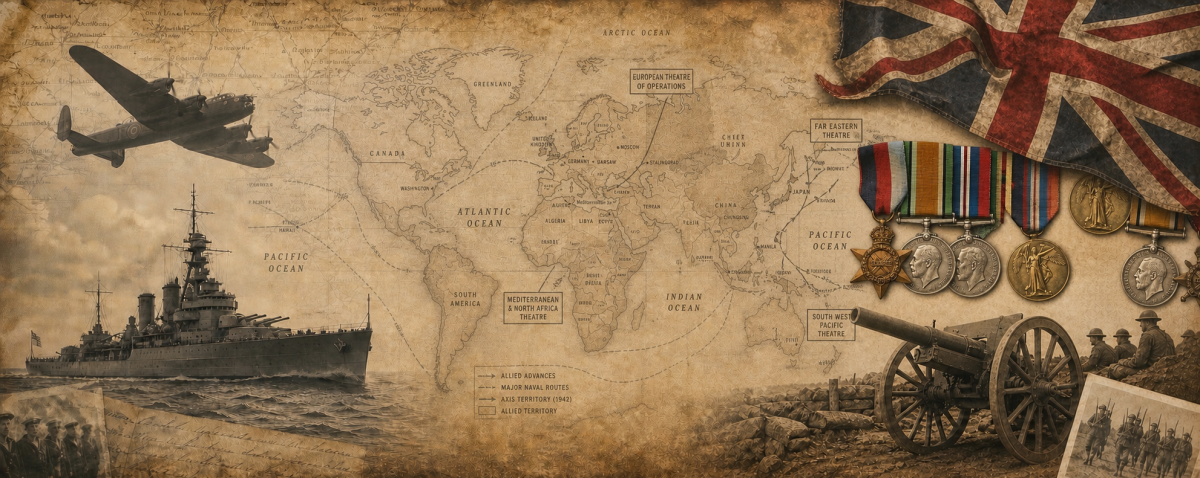
RAF Volunteer Reserve: James Godden’s North Africa Service

Leading Aircraftman James George Godden served in No. 221 Squadron, RAF Volunteer Reserve during World War II and died in Egypt on April 6, 1942, at age 28. He is buried in Halfaya Sollum War Cemetery. Godden was a family man, survived by his wife Eleanor and two children, reflecting personal sacrifice in war.

Leading Aircraftman James George Godden (service number 1176451) served with No. 221 Squadron, Royal Air Force Volunteer Reserve, during the North African campaign of the Second World War and died in Egypt on 6 April 1942, aged twenty‑eight.[file:72][web:80]

He is buried in Halfaya Sollum War Cemetery on the Egyptian–Libyan frontier, among many others who lost their lives in the Western Desert fighting of 1940–1942.[file:72][web:78]


Early Life and Family

James George Godden was born on 28 April 1913 in Kennardington, Kent, his birth registered in the Tenterden district in the 1913 June quarter (volume 2A, page 1812). He was the son of George Godden and Emma Jane (née Pellett), tying him to a long‑standing Kentish family in the Romney Marsh and Weald border country.[file:72]

By 19 June 1921 he was living at The Heath, Appledore, Kent, as part of the family household, reflecting a rural upbringing in a small village community close to the marshes. Later, by the time of the 1939 Register, he had moved away from his native county, living at 46 Douglas Road, Kingston upon Thames, Surrey.[file:72]

On 29 September 1939, the 1939 Register records him as a grocer’s van driver, an occupation that involved delivering provisions in the expanding suburbs of south‑west London in the early months of the war. In about May 1936 he had married Eleanor Slater in Surrey (volume 2A, page 326, line 60), and the couple went on to have at least two children, Mary Henrietta Godden and Peter J. Godden, whose lives would be shaped by their father’s wartime service and loss.[file:72]

From Kennardington and Appledore in rural Kent to Kingston upon Thames and wartime service overseas, James Godden’s life bridged both village and suburban England.

Reconstructed from civil registration and census data


RAFVR Service in North Africa

James enlisted in the Royal Air Force Volunteer Reserve (RAFVR) and served in the North Africa theatre, his military record noting service “Lg 89, Egypt” within the Middle East command structure. He held the rank of Leading Aircraftman (LAC), a junior non‑commissioned rank indicating an airman who had completed basic training and some specialist instruction, and his service number was 1176451.[file:72]

The individual report records his posting to No. 221 Squadron, RAFVR, as part of the North Africa division, placing him within a long‑range maritime reconnaissance and anti‑submarine unit rather than a purely land‑based army formation. His duties as an LAC would have depended on his exact trade, but in a Wellington‑equipped coastal squadron they typically ranged from groundcrew roles—maintenance, armoury, signals, and operations room support—to certain non‑commissioned aircrew posts.[file:72][web:77]

As a Leading Aircraftman with 221 Squadron, Godden served in a long‑range Wellington unit whose task was to find and shadow enemy shipping in the Mediterranean.

Summary of No. 221 Squadron’s operational role


No. 221 Squadron in Early 1942

No. 221 Squadron was reformed on 21 November 1940 at RAF Bircham Newton as part of Coastal Command and equipped with Vickers Wellington bombers adapted for long‑range maritime patrols. It began convoy‑escort patrols from February 1941 and soon added shipping reconnaissance off the Dutch coast, before moving to Northern Ireland to focus on anti‑submarine patrols over the Atlantic.[file:72][web:77][web:80]

Between September and December 1941 the squadron operated from bases in Iceland, continuing its anti‑submarine role in the North Atlantic’s harsh conditions. In January 1942 it was posted to the Middle East, with its aircraft flying out in January and February and ground crews following by sea; for a short period the Wellingtons were attached to No. 47 Squadron until the full 221 Squadron establishment re‑formed.[web:77]

From March 1942, once reunited in the theatre, No. 221 Squadron began Mediterranean operations, flying a mix of shipping reconnaissance, strike missions, and anti‑submarine patrols. Detachments also operated from advanced bases such as Malta, using torpedo‑armed Wellingtons to attack Axis convoys during operations like Vigorous, which attempted to resupply the besieged island.[web:77][web:80]

By the spring of 1942, 221 Squadron’s Wellingtons were patrolling the Mediterranean from Egyptian bases, searching for U‑boats and convoys instead of U‑boats in the Atlantic.

History of No. 221 Squadron’s move to the Middle East


Circumstances of Death

The individual report records that James George Godden died on 6 April 1942 in Egypt while serving with 221 Squadron in the North Africa theatre. The brief entry does not specify the precise cause of death—whether accident, illness, or operational loss—but the date falls very shortly after the squadron’s arrival in the Middle East and the start of its Mediterranean patrols.[file:72][web:77]

Given the intense tempo of operations in early 1942 and the strains of redeploying a Wellington squadron from the North Atlantic to the Middle East, losses at this time included aircraft accidents, operational incidents, and non‑battle deaths among both aircrew and ground personnel. Without additional squadron records it is not possible to be definitive, but his interment in Halfaya Sollum War Cemetery suggests that his death was associated with Western Desert or coastal operations in the Egypt–Libya border region rather than deep in the Nile Delta rear area.[file:72][web:78]


Burial and Commemoration

James is buried in Halfaya Sollum War Cemetery, Egypt, in grave 4.G.5, as recorded in his individual report and the Commonwealth War Graves Commission records. The CWGC database entry for Leading Aircraftman James George Godden confirms his unit as Royal Air Force Volunteer Reserve, 221 Squadron, and notes that he was the son of George and Emma Godden and the husband of Eleanor Godden, of Kingston Hill, Surrey.[file:72]

Halfaya Sollum War Cemetery is a Commonwealth War Graves Commission cemetery near Sollum on the Egypt–Libya border, created to concentrate burials from the Western Desert fighting. It contains the graves of 2,046 military personnel of the Second World War, mostly from the 1940–1942 period, including many who fell in the battles around Halfaya Pass, Fort Capuzzo, Bardia, and other key points in the frontier region.[web:78]

His CWGC casualty record can be viewed here: CWGC casualty details for Leading Aircraftman J. G. Godden. An additional online memorial, which may include photographs and personal tributes, is available at Find a Grave memorial 18971153.[file:72]


Family and Legacy

Unlike some of your other relatives who died unmarried, James left a widow, Eleanor (née Slater), and at least two children, Mary Henrietta and Peter J. Godden. For them, his name on the headstone at Halfaya Sollum War Cemetery symbolised not only a national sacrifice but a very personal loss—of husband and father—felt in Kingston and among the wider Godden and Pellett families of Kent and Surrey.[file:72]

More broadly, his story forms part of the collective history of No. 221 Squadron, whose Wellingtons shifted from the grey seas of the North Atlantic to the sunnier but no less dangerous waters of the Mediterranean in early 1942. As a Leading Aircraftman in that unit, James contributed to the long, demanding maritime patrols that sought to protect Allied shipping and interdict Axis supply lines at a critical stage of the North African campaign.[file:72][web:77][web:80]

For descendants and family historians, resources such as Ancestry and other genealogical databases, combined with CWGC and squadron histories, make it possible to set his short life—1913 to 1942—within the wider story of the Godden and Pellett families and of RAF operations in the Mediterranean theatre.[file:72][web:77]

Sources

  • Individual report for Leading Aircraftman James George Godden (family tree compilation, including birth and residence details, marriage to Eleanor Slater, children Mary Henrietta and Peter J. Godden, RAFVR service with 221 Squadron, and Halfaya Sollum War Cemetery grave reference 4.G.5).[file:72]
  • Commonwealth War Graves Commission – casualty record for Leading Aircraftman J. G. Godden, 1176451, RAFVR, 221 Sqn., buried in Halfaya Sollum War Cemetery, grave 4.G.5: CWGC casualty details.[file:72]
  • Find a Grave – memorial for James George Godden (includes grave reference and scope for photographs and tributes): Find a Grave memorial 18971153.[file:72]
  • No. 221 Squadron RAF – operational history in the Second World War, including re‑formation in 1940, Wellington maritime patrols from Britain and Iceland, transfer to the Middle East in early 1942, and subsequent Mediterranean operations: History of No. 221 Squadron (WWII) and No. 221 Squadron RAF.[web:77][web:80]
  • Halfaya Sollum War Cemetery – background and description of the cemetery near the Egypt–Libya border, including its role in concentrating 2,046 Second World War burials from the Western Desert fighting of 1940–1942: Halfaya Sollum War Cemetery and Commonwealth War Cemetery Halfaya Sollum.[web:78][web:92]
  • RAF casualty listing confirming that LAC James George Godden (1176451), RAFVR, age 29, was serving with No. 221 Squadron at the time of his death on 6 April 1942 (used to corroborate unit and date): RAFWeb – Casualties 4–6 April 1942.[web:93]

The Story of George Henry Hayward: From Kent to the Frontlines

Private George Henry Hayward, born in Kent in 1878, served in the 6th Battalion of the Queen’s Own (Royal West Kent Regiment). He died from wounds on 28 March 1918 in France during the German Spring Offensive, and is remembered at Doullens Cemetery and various local memorials. He left behind a wife and child.

George Henry Hayward: A Detailed Biography

Private George Henry Hayward, G/28586, 6th Battalion, Queen’s Own (Royal West Kent Regiment), was a Kent‑born agricultural labourer who became an infantryman in the British Army and died of wounds in France on 28 March 1918 during the German Spring Offensive. [1][2][3] He is buried at Doullens Communal Cemetery Extension No. 1 on the Somme and is remembered on local memorials in Lowestoft and in regimental histories of the Royal West Kents. [1][4][3]


Early Life and Family

George Henry Hayward was born before 28 April 1878 at Hastingleigh, Kent; his birth was registered in the March quarter of 1878 in the Elham registration district (volume 2A, page 966). [1] He was baptised at Elmstone, Kent, on 28 April 1878, the son of Thomas Hayward and Frances Camilla (née Mills), linking him to a long‑established rural family in east Kent. [1]

The 1881 census records George, aged 3, living with his parents in Elmsted, Kent. [1] By 1891 the family had moved back to Hastingleigh, where George, aged 13, is listed in The Street as an agricultural labourer, reflecting the early age at which many village boys entered farm work in Victorian rural Kent. [1]


Early Life and Family (Marriage, Work and Children)

By 1901 George was still in Hastingleigh, living at Bishop Cottages in The Street and working as an agricultural labourer, a pattern that continued into the 1911 census where he appears as a general labourer at Bishop Cottages. [1] On 21 September 1901 he married Beliza Maud Tuthill at Hastingleigh (marriage registered Elham district, volume 2A, page 1767), anchoring him firmly in the local community through both birth and marriage. [1]

The couple had at least one child, William Thomas Hayward, noted in the individual report, and by 1918 the family was living at Grove Cottages, Grove Road, Carlton Colville, near Lowestoft, Suffolk. [1][5] Contemporary biographical notes from Lowestoft describe George as a native of Hastingleigh who had moved to the east coast for work, taking up residence at Grove Cottages with his wife Beliza Maud and their family before joining the Army. [1][5]


Military Service

George enlisted at Canterbury, Kent, joining the Queen’s Own (Royal West Kent Regiment) and being allocated the service number G/28586. [1][3] He served in the 6th (Service) Battalion, a New Army battalion raised at Maidstone in August 1914, which joined 37th Brigade, 12th (Eastern) Division and landed in France in early June 1915. [1][2][6]

The 6th Royal West Kents saw heavy action throughout the war. In 1915 they fought at the Battle of Loos and at the Quarries near Hulluch; in 1916 they took part in the Somme battles of Albert, Pozières and Le Transloy; in 1917 they were engaged in the Arras offensive at the First and Third Battles of the Scarpe and at Arleux, as well as in the Cambrai operations, including the Tank Attack and the fighting at Bourlon Wood. [1][2][6] In early 1918 the battalion, still with 12th (Eastern) Division, faced the full weight of the German Spring Offensive in the Somme sector and around the River Ancre. [1][2][7]


Circumstances of Death

The individual report records George’s death as 28 March 1918 in France, his fate noted as “Died of Wounds”. [1] Detailed divisional histories and contemporary summaries explain that on 25 March 1918 the 12th (Eastern) Division, as part of V Corps, was holding defensive positions on the west bank of the River Ancre north of Albert, with 6th The Buffs and 6th Queen’s Own (Royal West Kent Regiment) holding the front line from Aveluy Wood to Mesnil‑Martinsart. [1][2]

On 27 March the division repelled several strong German attacks, including low‑level strafing by aircraft, but remained in place despite heavy losses. [1][2][7] The attack was renewed on the morning of 28 March – the First Battle of Arras 1918 in British terminology – when German forces again assaulted along the Ancre and further north; at Aveluy the 6th Royal West Kents were pushed back on the left before the line was re‑established by counter‑attack, and the division as a whole suffered 1,634 casualties in holding the German advance. [1][2][8] George’s death from wounds on that date almost certainly resulted from injuries sustained in this intense fighting around Aveluy and the Ancre valley, either on 27 March or in the renewed attacks on 28 March. [1][4][3]


Burial and Commemoration

After his wounding George was evacuated to medical care in the rear area and died in France, being buried in Doullens Communal Cemetery Extension No. 1, Somme, France, in grave V.D.6. [1] The cemetery contained several casualty clearing stations, and many of those interred there were soldiers who had been brought back from the Somme and Ancre battlefields for treatment, which accords with George’s recorded cause of death as “Died of wounds”. [1][4]

The Commonwealth War Graves Commission entry records him as “HAYWARD, GEORGE HENRY, Private G/28586, 6th Bn., Queen’s Own (Royal West Kent Regiment), died 28 March 1918, aged 40, Son of Thomas and Frances Hayward, native of Hastingleigh, Kent; husband of B. M. Hayward, of Grove Cottages, Grove Rd., Carlton Colville, Lowestoft.” [1][4][3] A Find a Grave memorial (ID 56532564) reproduces these details and marks his grave within the cemetery, while local Lowestoft remembrance projects list him among the “People of Lowestoft 1914–45” as a private of the 6th Royal West Kents, service number G/28586. [1][5][4]


Legacy

Within family research, George is identified with a FamilySearch profile under ID LCK4‑Y1R, tying him into the broader Hayward and Mills family network originating in Hastingleigh and the Elham district. [1] His medal entitlement includes the British War Medal, Victory Medal and Memorial Death Plaque, typical for a soldier who served overseas and died in action, and his story appears in genealogical and regimental websites dedicated to the Queen’s Own (Royal West Kent Regiment). [1][6][3]

Local history initiatives in Lowestoft and Carlton Colville remember him as “George Henry Hayward of Grove Cottages, Grove Road, Carlton Colville, Private, Queen’s Own (Royal West Kent Regiment), died 28 March 1918, France, G/28586”, connecting the Somme grave at Doullens back to the Suffolk street where his widow Beliza Maud and their son William Thomas lived. [1][5][4] Through CWGC records, regimental histories and community memorials, Private George Henry Hayward’s service with the 6th Royal West Kents and his death in the First Battle of Arras 1918 remain part of both Kentish and Lowestoft remembrance of the First World War. [1][2][3]


Key External Links

Sources
[1] Individual-Report-for-George-Henry-Hayward.pdf
[2] 12th (Eastern) Division https://www.longlongtrail.co.uk/army/order-of-battle-of-divisions/12th-eastern-division/
[3] The Queens Own Royal West Kent R https://www.janetandrichardsgenealogy.co.uk/Pte%20G%20H%20Hayward.html
[4] George Henry Hayward https://ourfallen.lowestoftoldandnow.org/grove-road/1918-03-28/george-henry-hayward
[5] People of Lowestoft 1914-45 https://ourfallen.lowestoftoldandnow.org/full/msword?page=10
[6] The Queens Own Royal West Kent Regiment https://www.janetandrichardsgenealogy.co.uk/QORWK%20C%20T%20Atkinson.html
[7] Gowerton County School War Memorial – WW1.Wales https://ww1.wales/other-counties/glamorgan-memorials/gowerton-county-school-war-memorial/
[8] WW1 Home News in March 1918 http://lynsted-society.co.uk/research_ww1_home_news_1918_03.html
[9] Sergeant Thomas Harris VC MM http://www.hallinghistory.co.uk/community/halling-historical-society-18475/sergeant-thomas-harris-vc-mm/
[10] Roll of Honour – Kent County Association of Change Ringers https://kcacr.org.uk/association/ww1/roh/
[11] WW1 Roll of Honour – Ernest Cheeseman of Teynham http://lynsted-society.co.uk/research_ww1_casualties_cheeseman_e.html
[12] How to find a photo of a grandfather who died in WW1? https://www.facebook.com/groups/1117523195087247/posts/2701175966721954/
[13] Lives of the First World War https://livesofthefirstworldwar.iwm.org.uk/lifestory/1802494
[14] Battle of Arras (1917) https://en.wikipedia.org/wiki/Battle_of_Arras_(1917)
[15] “IF YOU SHED A TEAR” https://www.merseamuseum.org.uk/MMPDFs/IYS_PART3.pdf
[16] MCMXIX (1914-1919) ADAMS, JOSEPH. R https://www.ryebritishlegion.org.uk/wp-content/uploads/2023/01/Rye-RoH-v8-Jan-23.pdf
[17] pdpubs book pagemaster https://pembrokeandmonktonhistory.org.uk/documents/memorialbookfinalpagemaster.pdf
[18] Godalming, Charterhouse School – World War 1 Surnames H https://www.roll-of-honour.com/Surrey/GodalmingCharthouseSchool-WW1-H.html
[19] George W. Hayward – Wikipedia https://en.wikipedia.org/wiki/George_W._Hayward
[20] https://www.stokesubhamdoncouncil.com/shared/attac… https://www.stokesubhamdoncouncil.com/shared/attachments.asp?f=5d5f6938-900d-4431-b7cf-f4573c121fe1.docx&o=HAWKINS-Charlie.docx
[21] whaley bridge war memorial http://www.dustydocs.com/link/5/25105/181320/monumental-inscriptions-roll-of-honour.html

Percy James East: A Soldier’s Journey in WWI

Percy James East, born around September 1892 in Sandwich, Kent, served as a Private in the 6th Battalion, The Buffs during World War I. He was killed in action on March 18, 1916, and is commemorated on the Loos Memorial in France. His military service and dedication are honored through various remembrance efforts.

Percy James East: A Detailed Biography

Private Percy James East, G/6280, 6th (Service) Battalion, The Buffs (East Kent Regiment), was born at Sandwich, Kent, about September 1892 and was killed in action in France on 18 March 1916. [1][2] He has no known grave and is commemorated on the Loos Memorial, Pas‑de‑Calais, France, where his name appears on Panels 15–19 alongside many comrades of the 12th (Eastern) Division. [1][3]


Early Life and Family

Percy James East’s birth is registered in the September quarter of 1892 in the Sandwich registration district, Kent (volume 2A, page 950, line 204), placing his birth around late summer 1892. He was the son of Walter East and Selina Caroline East, née Mannering, and grew up in a close‑knit Kentish family rooted in the small port and market town of Sandwich. [1]

By the 1901 census the family were living in Harnet Street, Sandwich, with Percy recorded as a school‑age child in his parents’ household. [1] Sandwich’s mix of maritime, agricultural and small‑trades employment provided the backdrop to his early life, and the family’s continuing presence there is reflected in the later addresses recorded for his mother. [1]


Early Life and Family (Work and Home)

By 1911 Percy was living at 1 Jessamine Villas, Sandwich, where his occupation is given as bottle washer, indicating work in a bottling or mineral‑water business or similar local industry. [1] This sort of manual but semi‑skilled employment was typical for young working‑class men in small Kent towns in the years immediately before the First World War. [1]

In 1915 his address is given as 11 Jasmine (Jessamine) Villas, Woodnesborough Road, Sandwich, showing that he remained close to his childhood home and that the small terrace of Jessamine Villas continued to be the family base. [1] After his death, the Commonwealth War Graves Commission recorded his mother, Selina C. East, as living at “1, Jessamine Villas, Boatsman’s Hill, Sandwich, Kent”, further confirming this cluster of related addresses as the East family’s long‑term home. [1]


Military Service

Percy enlisted at Sandwich into The Buffs (East Kent Regiment), being posted to the 6th (Service) Battalion, with the service number G/6280 and the rank of Private. [1][2] His medal entitlement—1914–15 Star, British War Medal and Victory Medal—confirms overseas service in a theatre of war from 1915. [1]

The 6th (Service) Battalion, The Buffs, was formed at Canterbury in August 1914 as part of Kitchener’s First New Army (K1), joining 37th Brigade of the 12th (Eastern) Division and training at Colchester, Purfleet and then Shorncliffe before moving to Aldershot in February 1915. [1][4][5] In late May 1915 the Division crossed to France via Folkestone–Boulogne and Southampton–Le Havre, concentrating south of Saint‑Omer by early June and joining III Corps; the 6th Buffs thereafter served continuously on the Western Front. [1][5][6]


Military Service (Battles and Front‑Line Duty)

The 6th Buffs and 12th (Eastern) Division first saw major action at the Battle of Loos in September–October 1915, where they attacked in the sector near Hulluch and the Hohenzollern Redoubt, suffering heavy casualties in repeated assaults and German counter‑attacks. [1][3][6] Subsequent fighting in October 1915 around positions known as “The Quarries” at Hulluch further depleted the battalion but also established it as a seasoned front‑line unit. [1][3]

In early 1916 the area around the Hohenzollern Redoubt became the focus of intensive mine warfare. On 2 March 1916, four large British mines were blown under German positions, followed by attacks that captured a series of craters, including the key Triangle Crater, with 12th (Eastern) Division selected to hold and exploit the new positions. [1][3][5] The 37th Brigade, including the 6th Buffs, relieved 36th Brigade in the crater sector on 5 March 1916 and endured continuous German bombing attacks, shelling and trench raiding in appalling mud and cratered ground for the rest of the month. [3][7]


Circumstances of Death

Percy’s individual record notes that he served in France between 31 August 1915 and 18 March 1916, and that he was killed in action in France on 18 March 1916. [1] A contemporary War Office casualty list dated 13 April 1916 initially recorded “E J East, Private, 6280, Buffs, France and Flanders” as missing, reflecting the confusion following the intense fighting in the Hohenzollern Craters sector; this entry clearly relates to Percy under an initialled form of his name. [1]

The broader context of his death is the Hohenzollern Redoubt action of 2–18 March 1916, during which 12th (Eastern) Division fought to hold newly captured mine craters against persistent German counter‑attacks and mortar fire. [3][5] German Minenwerfer bombardments and infantry assaults repeatedly struck the crater line and the old British front trenches, causing very high casualties; accounts of the period describe men standing shin‑deep in churned earth and water, exposed to accurate plunging mortar fire and close‑quarters bombing. [3][6] Percy’s death on 18 March 1916 coincides with the final phase of this action, when the Division was still in the line and suffering losses from shelling and localised attacks around Triangle Crater and the adjacent saps. [1][3]


Burial and Commemoration

Percy James East has no known grave, a common outcome for soldiers killed in cratered and heavily shelled sectors such as Hohenzollern, where bodies were often buried, re‑buried or obliterated by later explosions. [1][3] Instead he is commemorated on the Loos Memorial at Dud Corner Cemetery, near Loos‑en‑Gohelle, Pas‑de‑Calais, which bears the names of more than 20,000 officers and men who fell in the area from 1915 to the end of the war and have no known resting place; his name appears on Panels 15–19 among those of The Buffs and associated units. [1][2]

The Commonwealth War Graves Commission record for “EAST, PERCY JAMES, Private, G/6280, 6th Bn., The Buffs (East Kent Regiment), died 18 March 1916, aged 22, son of Selina C. East, of 1, Jessamine Villas, Boatsman’s Hill, Sandwich, Kent” confirms his age, unit and family details. [1] A Find a Grave memorial (ID 15344005) likewise records his name and commemorative location, providing a modern point of reference for family historians and researchers. [1]


Legacy

Percy’s medals—the 1914–15 Star, British War Medal and Victory Medal—together with the award of a wound stripe and the issue of a Memorial Death Plaque, underline his recognised service and sacrifice on the Western Front. [1] His life also preserved in genealogical form via FamilySearch ID LY9B‑M9F. [1]

Local and national remembrance projects ensure that Percy’s name is not confined to official registers. The “A Street Near You” database lists “Private Percy James East, G/6280, The Buffs (East Kent Regiment), 18/03/1916 (aged 22)” among the regiment’s casualties, linking him to the wider story of The Buffs’ wartime losses. [2][8] More broadly, the history of the Hohenzollern Redoubt action and the 12th (Eastern) Division highlights the ferocity of the fighting in which he died, placing his individual story within a larger narrative of sacrifice in one of the most dangerous sectors of the Western Front in early 1916. [3][5][6]


Key External Links

Sources
[1] Individual-Report-for-Percy-James-East.pdf
[2] The Buffs (East Kent Regiment) – First World War Casualties https://astreetnearyou.org/regiment/256/The-Buffs-(East-Kent-Regiment)
[3] Hohenzollern Redoubt action, 2–18 March 1916 – Wikipedia https://en.wikipedia.org/wiki/Hohenzollern_Redoubt_action,_2%E2%80%9318_March_1916
[4] Buffs (East Kent) Regiment https://vickersmg.blog/in-use/british-service/the-british-army/buffs-east-kent-regiment/
[5] 12th (Eastern) Division – The Long, Long Trail https://www.longlongtrail.co.uk/army/order-of-battle-of-divisions/12th-eastern-division/
[6] The 12th (Eastern) Division Memorial Cross – Hellfire Corner http://www.hellfirecorner.co.uk/middlebrook3.htm
[7] Current Information – London War Memorial https://londonwarmemorial.co.uk/view_profile.php?id=23678
[8] Search for “East Kent Regiment The Buffs” in unit | Lives of the First … https://livesofthefirstworldwar.iwm.org.uk/searchlives/field/unit/East%20Kent%20Regiment%20The%20Buffs/filter/span%5B/?page=21
[9] The Buffs 6th batt East Kent – The – Great War Forum https://www.greatwarforum.org/topic/105179-the-buffs-6th-batt-east-kent/
[10] William Richard COTTER VC – The VC and GC Association https://vcgca.org/our-people/profile/396/William-Richard-COTTER
[11] Lance Corporal William Cotter VC | The Western Front Association https://www.westernfrontassociation.com/world-war-i-articles/2016/february/lance-corporal-william-cotter-vc/
[12] Britain WWI Victory Medal East Kent Regiment (The Buffs) KIA Loos … https://www.medals-orders.com/great-britain-united-kingdom-wwi-victory-interallied-military-medal-east-kent-regiment-the-buffs-kia-1916-loos-ww1-1914-1918-british-decoration-great-war.html
[13] The 1st/3rd (East Kent–The Buffs) https://www.maltaramc.com/regmltgar/3rd.html
[14] We remember George Shilling – Lives of the First World War https://livesofthefirstworldwar.iwm.org.uk/lifestory/4014113
[15] Acting Corporal William Richard Cotter – A Street Near You https://astreetnearyou.org/person/2947410/Acting-Corporal-William-Richard-Cotter
[16] Britain WW1 WW1 Victory Medal – Pte A. Dyke, East Kent Reg. https://www.dracomedals.com/britain-wwi-ww1-victory-medal-pte-east-kent-regiment-the-buffs-kia-loos-1916..html
[17] Search for “Buffs,(East Kent) Regiment” in unit https://livesofthefirstworldwar.iwm.org.uk/searchlives/field/unit/Buffs,(East%20Kent)%20Regiment/filter/span%5B/?page=30
[18] Private Year: 1914-18 East Kent Regiment (The Buffs) 6th Battalion I … https://www.facebook.com/groups/436081820298097/posts/1084910138748592/
[19] Hohenzollern Redoubt Facts for Kids https://kids.kiddle.co/Hohenzollern_Redoubt
[20] Percy James East – Timenote https://timenote.info/lv/Percy-James-East
[21] 6th Battalion The Buffs https://www.greatwarforum.org/topic/6404-6th-battalion-the-buffs/

Donald Joseph Byrne: A Civilian Hero in WWII

Donald Joseph Byrne (1924-1941), Ashford Kent ARP Messenger, died from Blitz injuries aged 16. Son of East Africa colonists, he heroically delivered messages amid 1940 bombings near railway works. CWGC-honored civilian war dead, his sacrifice embodies young volunteers’ courage in WWII home front defense.

Donald Joseph Byrne: A Detailed Biography

Early Life and Family

Donald Joseph Byrne was born on 29 September 1924 in Ashford, Kent, England, the son of Joseph Edward Byrne and Rose Olive (Olive Rose) Slingsby. His birth was registered in the December quarter of 1924 in the East Ashford registration district, confirming both his given names and his Kentish origins.[1] His parents later had strong ties with East Africa, and contemporary records describe them as “of Tanganyika, British East Africa”, reflecting the family’s broader imperial connections during the inter‑war years.[1]

Donald grew up within this mobile, outward‑looking family, whose circumstances took them between Britain and East Africa in his early childhood. This background exposed him to different parts of the British Empire at a young age, but Ashford remained his anchor, both as his birthplace and later as his home in adolescence.[1]

Early Life and Family (Education and Residence)

In 1932 Donald is recorded as departing from East Africa, with movements noted from both Tanga in Tanganyika (now Tanzania) and Mombasa in neighbouring Kenya. These departures suggest that the Byrne family’s residence in British East Africa had come to an end by the early 1930s, possibly due to changing family circumstances or economic conditions in the region.[1] Their return journey underlines the pattern of many British colonial families who moved between imperial postings and the United Kingdom during this period.

By 22 July 1935, Donald, aged 10, arrived back in England at Southampton, Hampshire, travelling on the ship Llandaff Castle of the Union-Castle Line, a company well known for its services between Britain and Africa.[1] By the time of the 1939 National Register, he was living at Springside, Bentley Road, Ashford, Kent, aged 15, single, and described as a scholar, confirming that he remained in full‑time education on the eve of the Second World War.[1] This address later became central to his story, as his parents’ home at 39 Bentley Road, Willesborough, Ashford, is cited in the official record of his death.[1]

Military Service

Although Donald did not serve in the armed forces, he is officially recorded under the designation “Civilian War Dead”, reflecting the particular status of civilians who died as a direct result of enemy action in the United Kingdom during the Second World War.[1] At the time of his death he was serving his community as an Air Raid Precautions (A.R.P.) Messenger, a vital voluntary role undertaken by young people and adults alike to support civil defence operations during bombing raids.[1] ARP messengers were responsible for carrying written messages and reports between wardens’ posts, control centres, and emergency services when telephone and telegraph communications were disrupted by air raids, often working under extremely dangerous conditions during and after attacks.[2]

The wider context for Donald’s service was the Blitz and the sustained bombing of British towns and cities from 1940 onwards. Ashford, with its important railway works and transport links, was a recognisable target; between 1939 and 1945 the town endured thousands of air raid alerts and numerous bombing incidents.[3] Civil defence arrangements in such towns depended heavily on the courage of local volunteers—wardens, fire watchers, first aid workers, and messengers such as Donald—who were frequently among the most exposed when bombs fell, as they were required to move through damaged streets to report casualties, damage, and urgent needs.[3][2]

Circumstances of Death

On 16 September 1940, during the intense bombing period that followed the start of the Blitz, Donald was injured in Ashford at a location described as “New Town”.[1] This incident formed part of the pattern of German bombing raids aimed at industrial and transport centres in Kent and along the south‑east, as Luftwaffe strategy shifted from attacks on airfields to attacks on towns, ports, and rail infrastructure, causing extensive civilian casualties.[2] In Ashford, contemporary local histories record that surrounding residential areas as well as the railway works suffered repeated damage from bombs and blast, particularly where housing lay close to strategic targets.[3]

Donald’s injuries proved severe. He was taken to Ashford Hospital, where he died on 6 January 1941 at the age of 16, nearly four months after being wounded.[1] Official civil defence and casualty records summarise his status as “BYRNE, DONALD JOSEPH, age 16; A.R.P. Messenger; of 39 Bentley Road, Willesborough. Son of Joseph A. and Olive Rose Byrne, of Tanganyika, British East Africa. Injured 16 September 1940, at New Town; died 6 January 1941, at Ashford Hospital.”[1] His death, long after the initial raid, reflects the delayed toll that serious blast and shrapnel injuries could exact on young civilian volunteers who had placed themselves in harm’s way in service of their community.[2]

Burial and Commemoration

Donald’s burial took place in Kent after 6 January 1941, though the specific churchyard or cemetery is not identified in the individual report.[1] His grave is recorded on the online memorial site Find a Grave, where he has Memorial ID 66270904, which provides a focal point for family remembrance and for those researching local wartime casualties.[1] The entry confirms his full name, dates, and status as a civilian casualty of the Second World War.[1]

In addition to his physical burial, Donald is commemorated by the Commonwealth War Graves Commission (CWGC), which maintains the central roll of honour for Commonwealth military and qualifying civilian war dead. His CWGC entry appears under the “Civilian War Dead” section and confirms his role as an A.R.P. Messenger, his home address in Willesborough, and the details of his injury and death; it can be consulted at the CWGC website: https://www.cwgc.org/find-records/find-war-dead/casualty-details/3113807/donald-joseph-byrne/.[1] This formal commemoration places him among the many thousands of civilians whose sacrifice is recognised alongside that of serving members of the armed forces.[2]

Legacy

The legacy of Donald Joseph Byrne is that of a young Kentish civilian who, despite his youth, undertook hazardous duties as an A.R.P. Messenger during some of the most dangerous months of the Blitz. His story illustrates how the impact of air raids extended beyond uniformed personnel to schoolboys and other volunteers who shouldered responsibility in civil defence roles across the United Kingdom.[1][2] As the son of parents with ties to Tanganyika in British East Africa, his life also symbolises the global reach of the war and the interwoven histories of Britain and its colonies during this period.[1]

Within his extended family, Donald is remembered in genealogical records as a second cousin twice removed of the compiler, a link that ensures his name and circumstances remain documented for future generations.[1] Publicly, his inclusion on the CWGC Civilian War Dead Roll of Honour and on online memorial platforms ensures that his service and sacrifice continue to be accessible to researchers, local historians, and descendants, adding a personal human dimension to the broader history of Ashford’s wartime experience and the civilian cost of the Blitz.[1][3][2]

Sources
[1] Individual-Report-for-Donald-Jospeh-Byrne.pdf
[2] The Blitz – Wikipedia https://en.wikipedia.org/wiki/The_Blitz
[3] 80th Anniversary of the 24 March 1943 Bombing Raid on Ashford https://www.ashford.gov.uk/your-community/history-and-heritage/ashford-remembers-wwii/80th-anniversary-of-the-24-march-1943-bombing-raid-on-ashford/
[6] ARP wardens and members of a search and rescue … – Facebook https://www.facebook.com/groups/homefronthistory/posts/7349617538428281/
[9] Tuesday 17 September 1940 | The Battle of Britain Historical Timeline https://battleofbritain1940.com/entry/tuesday-17-september-1940/
[10] Bombing of Sherborne, 30 September 1940 https://oldshirburnian.org.uk/bombing-of-sherborne-30-september-1940/
[13] [XLS] April 2025 – Department of Education https://www.ed.gov/media/document/foia-log-april-2025-110557.xlsx
[14] Folkestone WWII Civilian Deaths – RootsWeb http://freepages.rootsweb.com/~folkestonefamilies/genealogy/wwiicivil.htm
[15] Harold Austin War Diary – 1940 – The Faversham Society https://favershamsociety.org/harold-austin-war-diary-1940/
[16] [XLS] 2020 Section 301 – USTR https://ustr.gov/sites/default/files/foia/logs/USTR_20172020CongressionalTrackers.xlsx
[17] Restored V2 rocket to be displayed in Chatham – BBC News https://www.bbc.com/news/uk-england-kent-19555434
[18] Donald Joseph Byrne https://caspir.warplane.com/personnel/unit-search/p/600002715
[19] Chelsea Blitz time line 1940 to 1945: incidents and casualties https://kulturapress.com/2023/07/30/chelsea-blitz-time-line-1940-to-1945-incidents-and-casualties/
[20] Sunday 8 September 1940 | The Battle of Britain Historical Timeline https://battleofbritain1940.com/entry/sunday-8-september-1940/