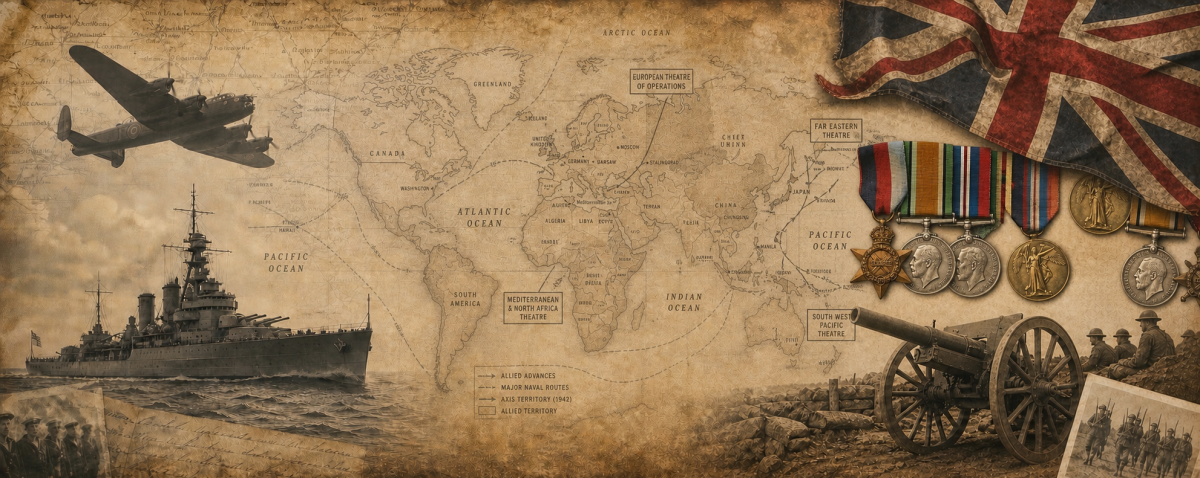

Sidney Thomas Pegden was a young man from Elham, Kent, who served first with the Royal East Kent Yeomanry and later with the 10th Battalion, The Buffs (East Kent Regiment). He died in France on 6 November 1918, only five days before the Armistice, and is buried at Terlincthun British Cemetery, Wimille. His story links a Kent village with a battalion formed from dismounted yeomanry and committed to the final Allied advance on the Western Front. [1][2][3]
Early Life and Family
Sidney’s birth was registered in the Elham district during the final quarter of 1897, under volume 2a, page 1038. The family report gives an approximate December birth, but the registration quarter alone does not establish his exact birthday. He was the son of Alfred George Pegden and Sophia Ann, known as Annie. [1]
The report identifies his mother’s maiden surname as Bailey in its main family summary, but a later narrative calls her Hogben. Without the original marriage or birth certificate, these conflicting surnames cannot be reconciled safely. The secure identification is supplied by the casualty record, which names his parents as Alfred George and Sophia A. Pegden of Elham, Canterbury, Kent. [1][4]
In April 1911, thirteen-year-old Sidney lived at 1 Park Lane, Elham, recorded as a son in the household. The compilation also contains a Folkestone residence entry dated 10 December 1910, although it does not explain its source or circumstances. No civilian occupation, marriage or children are recorded for him. His surviving early-life evidence is therefore brief, centred on his birthplace, parents and home address. [1]
From the Yeomanry to The Buffs
Sidney enlisted at Canterbury and served as Private 2737 in the Royal East Kent Yeomanry. His earlier unit is specified in the report as the 3/1st East Kent Yeomanry. He subsequently served with the 10th Battalion, The Buffs, under number 270372, rendered as T/270372 in part of the compilation. The Commonwealth War Graves Commission records the unprefixed number. [1][2]
The report places a military-service entry in 1918, but does not reproduce an attestation date. That entry should not automatically be treated as the year he first enlisted, particularly because his earlier yeomanry service is separately recorded. The available material establishes the sequence of regimental affiliations, not the precise dates of his transfers or overseas embarkation. [1]
His service reflects the wartime transformation of mounted Territorial units into infantry. The 10th (Royal East Kent and West Kent Yeomanry) Battalion, The Buffs, was formed at Sollum, Egypt, on 1 February 1917 from two dismounted yeomanry regiments. It joined 230th Brigade of the 74th (Yeomanry) Division. [3]
Sidney’s connection with a yeomanry unit does not, by itself, prove that he was present when the new battalion formed. A complete service record would be needed to identify when he joined the 10th Battalion and which parts of its campaign he experienced personally. [1]
Sidney’s two regimental identities preserve a wartime transition: from the Royal East Kent Yeomanry to an infantry battalion of The Buffs.
Service details in the family report and the battalion’s formation history.
The Battalion’s Palestine Campaign
The 74th Division was assembled in Egypt in 1917 from dismounted yeomanry formations. Its constituent battalions fought as infantry, while retaining their yeomanry associations in their titles. Within 230th Brigade, the 10th Buffs served alongside battalions of the Norfolk, Suffolk and Royal Sussex regiments, although the Norfolk battalion left the brigade in June 1918. [5]
The division fought in the Second Battle of Gaza in April 1917 and the Third Battle of Gaza later that year, including the capture of Beersheba and the Sheria position. It subsequently participated in the capture and defence of Jerusalem, followed by the Battle of Tell’Asur in March 1918. These engagements establish the formation’s experience before France, rather than a verified personal battle list for Sidney. [1][5]
Transfer to the Western Front
During spring 1918, the division prepared to leave Palestine for France. Embarkation began at Alexandria on 29 April, and its first units reached Marseilles on 7 May. By 18 May, concentration was complete near Rue, north of Abbeville. The report gives the same May arrival period for the 10th Buffs. [1][5]
The change of theatre required further training, notably in gas defence and the demands of Western Front operations. After a period in reserve, the division took over a front-line sector near Merville on 14 July. It later fought at the Second Battle of Bapaume in early September and the Battle of Épehy on 18 September, before joining the final advance in Artois and Flanders. [5]
Unit Context at the Time of Death
When Sidney died on 6 November, his battalion remained in 230th Brigade, 74th Division, during the closing advance towards and beyond Tournai. The division crossed the Scheldt on 9 November, three days after his death, and advanced units subsequently crossed the Dendre Canal. At the Armistice, the division had reached Ath. [1][5]
This chronology qualifies the report’s statement that the battalion ended the war at Tournai: the formation was operating in that broader area, but its advanced units had moved farther east. More importantly, the battalion’s advance must be separated from Sidney’s own circumstances. His burial near Boulogne does not establish that he was still serving in its forward positions on the day he died. [1][5][6]
Circumstances of Death
Private Sidney Thomas Pegden died on 6 November 1918. The family report’s narrative attributes his death to disease, but it does not reproduce a medical certificate or identify a particular illness. The official casualty information confirms his death date, unit and commemoration, without supporting a more detailed medical account in the material available here. [1][2]
It would therefore be unsafe to identify influenza, pneumonia or another diagnosis, or to describe his death as the result of a battlefield wound. The appropriate account is that he died during service in France, with disease given as the cause in the supplied family compilation. [1]
His official commemorated age is twenty-one. The birth registration in the final quarter of 1897 allows that age, although the report’s approximate December birth would make him twenty on 6 November. An exact birth certificate would resolve the difference; the approximate date should not override the recorded commemorative age. [1][2]
Burial and Commemoration
Sidney rests in Terlincthun British Cemetery, Wimille, in grave X. B. 30. The cemetery lies in the Boulogne area of northern France. Its history is particularly relevant: the Commonwealth War Graves Commission explains that it opened in June 1918 when available space for service burials in the civil cemeteries of Boulogne and Wimereux had been exhausted. [1][6]
Terlincthun was used chiefly for burials from the surrounding base hospitals. That context is consistent with the report’s account of death from disease, but it does not identify Sidney’s hospital, prove where he died or establish whether his present grave was his original burial place. [1][6]
He is also remembered locally at Elham. The parish roll-of-honour transcription names Private 270372 Sidney Thomas Pegden and identifies his parents. His military remembrance is therefore connected both with an individual grave in France and with the Kent community recorded in his childhood census and casualty details. [1][4]
Sidney died five days before the Armistice: close to the war’s end, but too soon to return to Elham.
His confirmed death date was 6 November 1918.
Legacy
The family report records the British War Medal and Victory Medal, together with a Memorial Plaque. No wife or children are listed, so his surviving family story centres on his parents and wider relatives. His remembrance also depends on keeping the evidence in proportion: the battalion’s extensive campaigns explain his military setting, while his individual movements and final illness remain only partly known. [1]
What survives is nevertheless enough to restore an identity beyond the casualty entry: Alfred and Sophia’s son, a boy at Park Lane, a yeomanry recruit and a private of the 10th Buffs. His grave and Elham’s roll of honour preserve that connection between home and service. [1][4]
Sources and Further Reading
- Commonwealth War Graves Commission: Sidney Thomas Pegden — official casualty details.
- Commonwealth War Graves Commission: Terlincthun British Cemetery, Wimille — cemetery origins and base-hospital context.
- Roll of Honour: Elham, Kent — local memorial transcription and Sidney’s entry.
- The Long, Long Trail: The Buffs (East Kent Regiment) — formation of the 10th Battalion.
- The Long, Long Trail: 74th (Yeomanry) Division — Palestine service, transfer to France and final advance.
- Imperial War Museums, Lives of the First World War: Sidney Thomas Pegden — individual remembrance profile.
- Individual Report for Sidney Thomas Pegden, supplied family-history compilation — birth registration, census residence, family relationships, service numbers, medals and burial reference.
Sources
[1] Individual-Report-for-Sidney-Thomas-Pegden.pdf https://ppl-ai-file-upload.s3.amazonaws.com/web/direct-files/attachments/141549598/a95aa71e-f8b3-4745-8dc2-c94eb54935a4/Individual-Report-for-Sidney-Thomas-Pegden.pdf
[2] Private Sidney Thomas Pegden | War Casualty Details 4026783 https://www.cwgc.org/find-records/find-war-dead/casualty-details/4026783/sidney-thomas-pegden/
[3] Buffs (East Kent Regiment) – The Long, Long Trail https://www.longlongtrail.co.uk/army/regiments-and-corps/the-british-infantry-regiments-of-1914-1918/buffs-east-kent-regiment/
[4] Kent – Elham – Roll of Honour https://www.roll-of-honour.com/Kent/Elham.html
[5] 74th (Yeomanry) Division – The Long, Long Trail https://www.longlongtrail.co.uk/army/order-of-battle-of-divisions/74th-yeomanry-division/
[6] Terlincthun British Cemetery, Wimille | Cemetery Details | CWGC https://www.cwgc.org/visit-us/find-cemeteries-memorials/cemetery-details/2027534/terlincthun-british-cemetery-wimille/
[7] Life story: Sidney Thomas Pegden | Lives of the First World War https://livesofthefirstworldwar.iwm.org.uk/lifestory/3462043
[8] Search for “Pegden” in lastname | Lives of the First World War https://livesofthefirstworldwar.iwm.org.uk/searchlives/field/lastname/Pegden/filter
[9] Terlincthun British Cemetery – Wikipedia https://en.wikipedia.org/wiki/Terlincthun_British_Cemetery
[10] CWGC Cemetery: TERLINCTHUN BRITISH CEMETERY, WIMILLE – CPGW https://cpgw.org.uk/cwgc-cemeteries/terlincthun-british-cemetery-wimille/
[11] Sydney Pegden Släkthistoria och historiska poster – MyHeritage https://www.myheritage.se/names/sydney_pegden
[12] Sidney Thomas PEGDEN 1897 – 1918 – Faded Genes https://www.fadedgenes.co.uk/SidneyPEGDEN.html
[13] 74 (YEOMANRY) DIVISION 230 Infantry Brigade Buffs (East Kent … https://www.dymocks.com.au/74-yeomanry-division-230-infantry-brigade-buffs-east-kent-regiment-10th-battalion-by-wo9531532-9781474534710
[14] Descendants of Mark CLAYSON and his wife Sarah (nee NORRIS) https://www.fadedgenes.co.uk/MarkCLAYSONdescendants.html
[15] Cemetery : Inverclyde’s Great War https://www.inverclydeww1.org/cemetery/terlincthun-british-cemetery-wimille
[16] Military people in tournai, British troops Images — Public Domain … https://picryl.com/topics/military+people+in+tournai/british+troops?page=1
Discover more from Mike's Cousins
Subscribe to get the latest posts sent to your email.