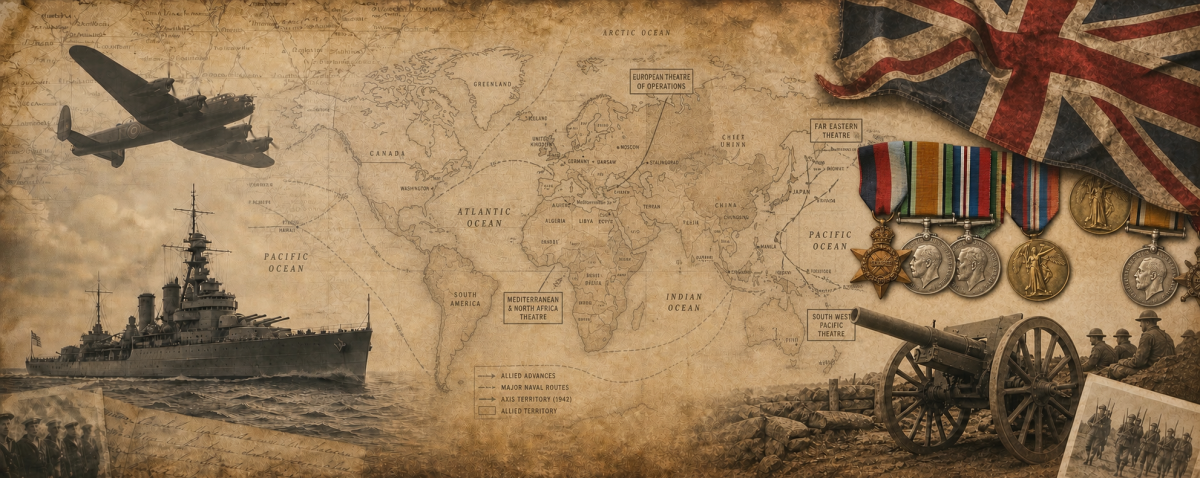

Eric Victor Cheeseman was born in Cranbrook, Kent, on 9 April 1922, the son of Albert Edward Cheeseman and Edith Sarah Fedarb. He grew up in the Weald of Kent, in a market town shaped by agriculture, local trade, and the long traditions of Cranbrook School and the surrounding rural parishes. By 1941 he was living in Kent, and by the time the Second World War reached its darkest years he had entered military service. [1]
He served as Bombardier 6285906 in the Royal Artillery, with the 5 Searchlight Regiment. Cheeseman died on 7 August 1943 at the age of 21 while a prisoner of war in Thailand, and he is buried at Kanchanaburi War Cemetery, one of the principal Commonwealth cemeteries linked to the Burma-Siam Railway. His gravestone bears the inscription: “Gone from us but not forgotten, never shall thy memory fade.” [2][1]
He was a young Kent man who served in searchlight artillery and died as a prisoner of war on the Burma-Siam Railway.
Early Life and Family
Cheeseman’s early years were spent in Cranbrook, a historic market town with deep roots in the Weald of Kent. The family record identifies his father as Albert Edward Cheeseman and his mother as Edith Sarah Fedarb, placing him in a working family with London connections later reflected in his adult residence at 69 Benhurst Court, Streatham. The move from Kent to south London before the war mirrors the wider pattern of interwar mobility in and around the capital. [1]
The 1939-era record does not show a spouse or children, and his death at 21 meant that there was no later family life of the kind many men might otherwise have built after the war. Instead, the surviving evidence focuses on his parents, his service, and the place where his remains were laid to rest. In that sense, his biography is both brief and deeply poignant. [1]
Military Service
Cheeseman served in the Royal Artillery as a Bombardier, service number 6285906, and the record places him with the 5 Searchlight Regiment. Searchlight units were part of Britain’s air-defence system, using powerful lights to help locate hostile aircraft at night and to assist anti-aircraft gunners and fighter control. Although searchlight work was usually associated with the home front and air defence, the regiment’s wartime history could be complex, and many men later became prisoners of war in the Far East after capture in earlier campaigns. [3][4][5][1]
As a bombardier, Cheeseman held a junior NCO rank that carried responsibility and technical competence. In the Royal Artillery such a rank normally indicated experience, reliability, and the ability to supervise others in a specialist battery or section. The family report and CWGC record together show that he was serving overseas in 1943 after being captured in February of that year. [1]
Unit Context at Time of Death
Cheeseman’s death took place against the backdrop of the Burma-Siam Railway, built by the Japanese between 1942 and 1943 to improve military supply routes into Burma. Tens of thousands of Allied prisoners of war and Asian labourers were forced to work on the railway under brutal conditions, with disease, malnutrition, exhaustion, and violence causing enormous loss of life. Kanchanaburi War Cemetery was created to receive many of the dead from the southern section of the railway and now contains more than 5,000 Commonwealth burials. [6][2][1]
By 1943, the men buried at Kanchanaburi represented the human cost of a system of captivity in which captivity itself became a lethal condition. Cheeseman’s regiment and rank matter because they identify him not only as a casualty but as a trained artilleryman who had become one of the prisoners compelled into the Japanese war economy of labour and movement. His service record is therefore inseparable from the broader history of the Burma-Thailand railway and the Allied POW experience in Southeast Asia. [2][6][1]
He died in the shadow of the Burma-Siam Railway, where captivity, disease, and forced labour claimed thousands of lives.
Circumstances of Death
Eric Victor Cheeseman died in Thailand on 7 August 1943 at the age of 21. The family record gives the cause of death as indigestion, but in the context of POW life this almost certainly reflects a much broader physical breakdown brought on by harsh conditions, inadequate food, disease, and exhaustion. The exact immediate circumstances are not described in the record, yet the setting makes clear that he was living and dying under captivity conditions far from home. [2][1]
His death came only months after capture on 17 February 1943, and the probate record later confirmed that he had died “on war service”. That phrasing underlines the fact that even though he was a prisoner, he remained a serviceman in the eyes of the state and the Commonwealth War Graves Commission. His name is also preserved in the memorial panels and cemetery records that keep alive the memory of those lost on the railway. [7][2][1]
Burial and Commemoration
Cheeseman is buried in Kanchanaburi War Cemetery, Plot 8, Row G, Grave 14. The cemetery lies beside the Thailand-Burma Railway Centre and serves as the final resting place for thousands of Commonwealth prisoners of war who died during construction of the railway. His headstone is inscribed with his rank, name, regiment, date of death, and the personal family message chosen by his loved ones. [2][1]
The inscription, “Gone from us but not forgotten, never shall thy memory fade,” gives voice to the grief of his family in Streatham. The probate record shows that administration of his estate was granted to his mother, Edith Sarah Cheeseman, in August 1946, with modest effects of £123 9s. 2d. The CWGC entry and the family report together preserve both the official facts of burial and the deeply personal loss behind them. [1]
Legacy
Eric Victor Cheeseman’s life was short, but it traversed the wider wartime geography of the Second World War: from Cranbrook and Streatham to captivity in Thailand and burial at Kanchanaburi. He was a young bombardier in the Royal Artillery whose service ended not in action against the enemy but in the desperate conditions of prisoner-of-war labour under Japanese control. His story is a reminder that war’s cost was borne not only by those killed in battle, but by those who died in captivity after battle was over. [2][1]
His grave in Kanchanaburi stands among thousands of others from the Burma-Siam Railway, each one marking an individual life within a vast and tragic system of forced labour and loss. For family history, Cheeseman’s biography preserves the arc of an ordinary Kent and London upbringing, a wartime artillery career, and a death that connects directly to one of the darkest episodes of the Far Eastern war. His memory endures in the cemetery, the CWGC record, and the words cut into his headstone. [1][2]
Sources and Further Reading
- Commonwealth War Graves Commission: Eric Victor Cheeseman
- Kanchanaburi War Cemetery | CWGC
- Kanchanaburi Memorial | CWGC
- National Museum of Australia: Burma-Thailand Railway
- 5 Searchlight Regiment RA
Sources
[1] Individual-Report-for-Eric-Victor-Cheeseman.pdf https://ppl-ai-file-upload.s3.amazonaws.com/web/direct-files/attachments/141549598/ce6ab936-01e7-45b4-b004-a6bd1eab9941/Individual-Report-for-Eric-Victor-Cheeseman.pdf?AWSAccessKeyId=ASIA2F3EMEYEYCNL7Z33&Signature=rK%2BVWipiZ0mdHZGW90cG7dHDi%2BI%3D&x-amz-security-token=IQoJb3JpZ2luX2VjEHcaCXVzLWVhc3QtMSJFMEMCIBzC1kkdFqeuFs5LtzQSpLg6mF5B4duLTWanT6y2CXv2Ah8MTwKGaFCdzKa%2BnirDPuXM8%2FYVQ8IfqjWaVFtJ2%2FkHKvMECEAQARoMNjk5NzUzMzA5NzA1Igyb8Pzsqf1GK1XZpqgq0ASlUmWuAt5d6MJjVHvOx6U738pG%2FR8llJn6C3UtevnggmseTVX4%2BRJ2zyH89nHkI3qEj8Yu%2Fzkg4fNTbhH8lNHW7Ho51NYEOdjJxAjQdkWdOmbPhRf%2Fy6pDDJmU27jG%2B3jdUImKwE3uIgRAq3NPlsHlUzD5Q4WQcrUxDpmsZeAwgUBg6LvBCUr3ah0fKHnWdkK2NmB2rXfEOAzzkMd8GlkriNNt3h1EbB%2B7JI4PZ6GIsBP5HTFwa%2BNEZGgAqGJ4zalzBuYAs4ny4Z9%2BNPjVYz16xxNvFMzaBJpP8SG0%2BU4D%2BTBkdshKgCSWSxWT8gXXb7RygEgqjWdm4BKS0tZH4n%2BID6xeP0NaEifFx5Gygcrx3XdeAg2f12teb6W8aS5xv2pM5WiNJ8KklnFul6m0BgNvyTGGqHvcyBi95xOaUpNtFsX2scwBfhhSlQEbLMeizX2EzYMw4UwEYuCQ45HislNeyD5EPiSRDu1uoysCrIrTQwT3PPg60ESZTHd%2BmrLUCkwUtufMOd%2FZeMxDmdYmFD0Zfb4Wx%2FZzbBdWAUqpimXGNlG2UjweoUcq4qS5QQretpNmifD5cD7Gar6Ot20rFf%2BQlE1o3JXVZ0EwMqklXlMEwBXWRqpnIRjsQTcPAqoo3xhoPfWrj7MoIxnQbuNek%2BEXLGiu4SUHFtxjoM3xHXkv%2FmlDD4Ktl3X3FSB2Y6265M08mVZoE0f5tFLXKz5elb2oZyFszwtNlSsxpPkD4KEvY6cH7toxl9y34nfYwzxJNy9v8gGnG36LVybo0UZxMeMSMM200tMGOpoBfMCpCclqEYRm3jCtmdP1oWlMjuHznueZPmrE6tXiyVtnxFluXh1fd5fY2BuexTru1aNWwxWT%2BTyut%2Bepe11tG6Q0Mnbp1288WCtxTuDtTg2tdIuNCgRHMCb9tqydmCX%2BGUbmoartXNB3dgWipnWDhQ%2Bb5drsQzPnMAxphHnzEeQ8I2MsuV9H2fDzbkQCHWBJ%2FLd2zfmZETk6Rg%3D%3D&Expires=1786027586
[2] Kanchanaburi War Cemetery https://www.cwgc.org/visit-us/find-cemeteries-memorials/cemetery-details/2017100/kanchanaburi-war-cemetery/
[3] 5th Searchlight Regiment, Royal Artillery https://en.wikipedia.org/wiki/5th_Searchlight_Regiment,_Royal_Artillery
[4] 5 Searchlight Regiment RA https://ra39-45.co.uk/units/searchlight-regiments/5-searchlight-regiment-ra
[5] 2nd Searchlight Regiment, Royal Artillery https://en.wikipedia.org/wiki/2nd_Searchlight_Regiment,_Royal_Artillery
[6] Burma–Thailand Railway https://www.nma.gov.au/defining-moments/resources/burma-thailand-railway
[7] Kanchanaburi Memorial | Cemetery Details https://www.cwgc.org/visit-us/find-cemeteries-memorials/cemetery-details/2017101/kanchanaburi-memorial/
[8] Tracing unknown Regiment in Burma 1943-45 https://ww2talk.com/index.php?threads/tracing-unknown-regiment-in-burma-1943-45.58709/
[9] Kanchanaburi War Cemetery Thailand https://dyingtogetin.com/kanchanaburi-war-cemetery-thailand/
[10] 5th Searchlight Regiment, Royal Artillery https://www.wartimememoriesproject.com/ww2/allied/battalion.php?pid=5527
[11] 28th Field Regiment, Royal Artillery https://burmastarmemorial.org/archive/stories/1405862-28th-field-regiment-royal-artillery
[12] “FREEING THE DEMONS” – Prisoners of War of the Japanese https://www.pows-of-japan.net/booksetc/NellisComposite.doc
[13] Cemeteries – 2/29th Battalion A.I.F. Association https://www.229battalion.org.au/cemeteries
[14] The 1943 Burma railroad https://www.youtube.com/watch?v=OhnHhaON_j4
[15] List of Prisoners of War who worked on the Burma https://www.iwm.org.uk/collections/item/object/1030009604
Discover more from Mike's Cousins
Subscribe to get the latest posts sent to your email.