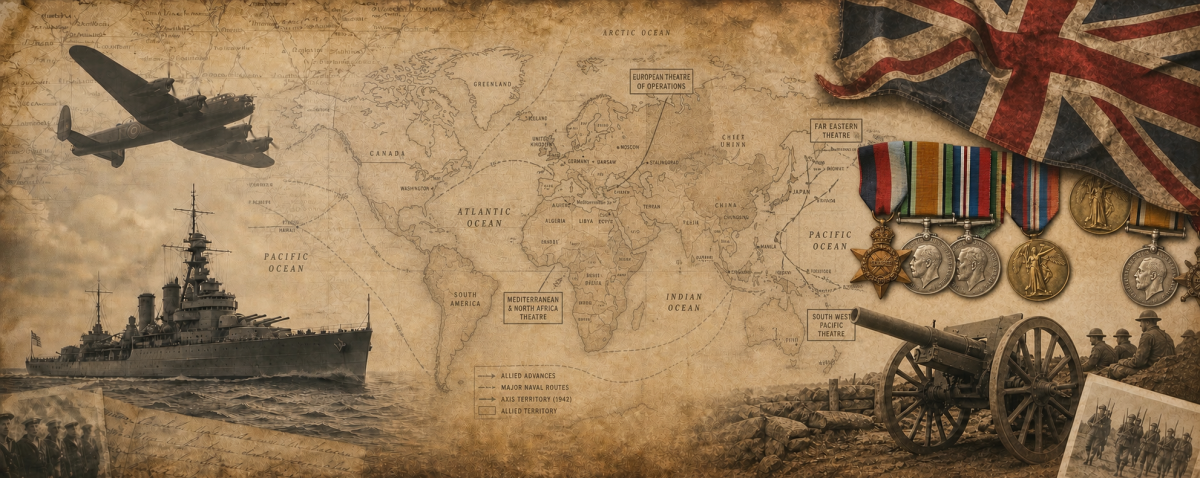

Pilot Officer Philip Rodney Graves-Hook, RAFVR, pilot of Lancaster III NE125 “EA-K” of No. 49 Squadron, was killed on the night of 22/23 May 1944 on operations to Brunswick.
Family report, squadron record, and loss record
Early Life and Family
Philip Rodney Graves-Hook was born on 2 February 1920 in Folkestone, Kent, the son of Richard Graves-Hook and Ethel Rogers.[file:106] In the 1921 census he appears at 4 London Road, Folkestone, aged one, placing him in a busy commercial part of the town during the early inter-war years.[file:106] By 1939 he was living at 15 Wear Bay Road, Folkestone, then a residential address on the East Cliff overlooking the Channel.[file:106]
The family report records two marriages in Philip’s short life.[file:106] On 6 December 1940 he married Lena Isabella McLelland at St Andrew’s, Buckland, Dover, an event noted in the Dover Express of 13 December 1940.[file:106] Later, about March 1944, he married Sheila Rosa Hitchcox in the Barrow upon Soar registration district of Leicestershire, and the CWGC record names him as the husband of Sheila Graves-Hook of Barkby, Leicestershire, at the time of his death.[file:106]
Training and Early Service
Before joining aircrew service, Philip’s 1939 Register entry gives his occupation as “Royal Signal Corp”, while another note in the family report points to a 1939 British Postal Museum and Archive appointment paper nominating him to “Wireless” work at Margate Sorting Office.[file:106] That combination suggests an early background in communications and signalling, a useful foundation for later RAF training even though he ultimately served as a pilot.[file:106] The report’s commentary reasonably links this wireless experience to the technical environment of wartime aviation.[file:106]
Philip was also an accomplished peacetime flyer before the war fully took hold.[file:106] His Royal Aero Club Aviators’ Certificate records that he qualified at the Kent Flying Club on 29 December 1938, flying a Miles Hawk with a Cirrus III 85 h.p. engine, and gives his address as 173 St Radigund’s Road, Dover.[file:106] This private flying qualification is important, because it shows that his path into RAF service was built on pre-war aviation enthusiasm and practical flying experience rather than beginning entirely from scratch in wartime.[file:106]
Military Service
By 1944 Philip was serving as a Pilot Officer in the Royal Air Force Volunteer Reserve, service number 172589.[file:106] The family report identifies him as a pilot in Group 5, No. 49 Squadron, whose motto was Cave canem, “Beware of the dog”.[file:106] His unit aircraft on his final operation was an Avro Lancaster III, serial NE125, squadron code EA-K, taking off from RAF Fiskerton in Lincolnshire.[file:106][web:107]
No. 49 Squadron was one of Bomber Command’s long-established heavy bomber squadrons and in 1944 formed part of No. 5 Group, the group noted for precision marking methods and a strong operational identity within Bomber Command.[web:109] The squadron flew Lancasters from Fiskerton and took part in the main night offensive against German industrial and transport targets during the later war years.[web:108][web:109] Philip therefore served in one of the RAF’s experienced front-line bomber squadrons at a time when operational flying remained extremely dangerous despite Allied progress in the air war.[web:108][web:109]
Unit Context at the Time of Death
Philip’s final operation began on 22 May 1944 and ended in the early hours of 23 May 1944.[file:106] The target was Brunswick, rendered in the report as “Braunschweig”, and the raid was flown at night under conditions of only 1 per cent moonlight.[file:106] According to the 49 Squadron Association, over 220 Lancasters from Nos. 1 and 5 Groups, together with 10 Mosquitoes, made up the force dispatched to Brunswick that night.[web:108]
Brunswick was an important German industrial city and transport hub, and raids against it formed part of Bomber Command’s wider strategic offensive against German war production and communications in 1944.[web:108][web:109] Philip’s aircraft, Lancaster NE125 EA-K, left Fiskerton as part of that large bombing force.[file:106][web:107] The Aviation Safety Network record states that the aircraft crashed in a peat bog about 1 kilometre south of Hagen, Germany, after the operation.[web:107]
The family report states that the aircraft was believed to have been shot down by a combination of flak and fighter action near Hagan, clearly meaning Hagen.[file:106] This is consistent with the hazards faced by Bomber Command crews in 1944, when German night fighters and anti-aircraft defences still inflicted serious losses on raids deep into Germany.[file:106][web:107] In other words, the military unit context of his death was not merely that he belonged to 49 Squadron, but that he was part of a major 5 Group night attack in which heavily defended industrial Germany remained lethally dangerous to RAF bomber crews.[web:108][web:109]
Philip Graves-Hook died not on a routine flight, but in the midst of a large Bomber Command night operation, flying with one of 5 Group’s Lancaster squadrons against Brunswick in May 1944.
49 Squadron Association and operational loss record
Circumstances of Death
Pilot Officer Philip Rodney Graves-Hook was killed on 23 May 1944 in Germany at the age of twenty-four.[file:106] The family report, CWGC entry, and loss record all agree on the date, the operational target, and his role as pilot of Lancaster NE125 of No. 49 Squadron.[file:106][web:107][web:108] His death occurred only a little over three months after the service note tied to Fiskerton in February 1944, suggesting a rapid progression from squadron service into the dangerous operational routine of Bomber Command.[file:106]
The report’s last operation summary gives the reason for loss as a likely combination of flak and fighter attack, ending in a crash near Hagen.[file:106] Aviation Safety Network likewise records the loss of Avro Lancaster NE125 on 23 May 1944 after departure from RAF Fiskerton for operations.[web:107] As with so many Bomber Command casualties, the language of the record is brief, but behind it lay a violent night action over enemy territory from which the crew did not return.[file:106][web:107]
Burial and Commemoration
Philip is buried in Becklingen War Cemetery, Germany, in grave 24.B.1.[file:106] His gravestone inscription, transcribed in the family report, reads: “PILOT OFFICER / P.R. GRAVES-HOOK / PILOT / ROYAL AIR FORCE / 23RD MAY 1944 AGE 24 … REMEMBERED ALWAYS”.[file:106] The CWGC record also identifies him as the son of Richard and Ethel Graves-Hook and the husband of Sheila Graves-Hook of Barkby, Leicestershire.[file:106]
Becklingen War Cemetery contains many Commonwealth airmen and soldiers who died in northern Germany and whose graves were concentrated there after the war, making it one of the principal CWGC cemeteries for casualties of the later air war in that region.[web:112] Philip’s burial there places him among the many Bomber Command dead whose operational losses occurred deep within Germany and whose remains were recovered only after the conflict.[web:112] His Find a Grave memorial, ID 18485835, provides an additional modern point of remembrance for descendants and researchers.[file:106][web:112]
Legacy
Philip Graves-Hook’s story links Folkestone, Dover, Margate, Leicestershire, and RAF Fiskerton in a life compressed by war into only twenty-four years.[file:106] He stands out as a figure shaped by pre-war technical training and aviation enthusiasm, moving from wireless work and private flying into operational service as a Lancaster pilot.[file:106] For a family-history site, that combination of local Kent roots and wider wartime mobility gives his biography unusual depth and reach.[file:106]
His life also reflects the intensity and fragility of Bomber Command service in 1944.[web:108][web:109] Even as Allied fortunes improved in the months before D-Day, crews of heavy bombers still faced long odds on operations over Germany, and a single night raid could wipe out an aircraft and its crew completely.[web:107][web:108] Philip’s death on the Brunswick operation belongs to that larger story of sacrifice among the young men of the RAF Volunteer Reserve.[file:106][web:109]
Sources and Further Reading
- Compiled family report: Individual Report for Philip Rodney Graves-Hook.[file:106]
- Commonwealth War Graves Commission: Philip Rodney Graves-Hook.[file:106]
- 49 Squadron Association: Philip Rodney Graves-Hook.[web:108]
- No. 49 Squadron RAF.[web:109]
- Accident Avro Lancaster NE125, 23 May 1944.[web:107]
- Find a Grave: Philip Rodney Graves-Hook.[web:112]
Discover more from Mike's Cousins
Subscribe to get the latest posts sent to your email.